

American Shad
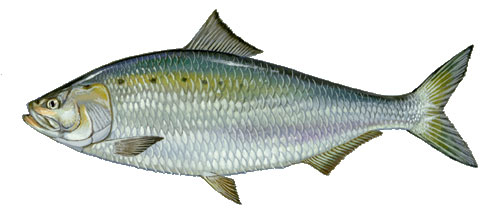
A silvery herring that runs up coastal rivers by the thousands each spring. American shad hit lures hard for their size and put up a scrappy, jumpy fight on light tackle, which is why anglers line the riverbanks for them every March and April.
American shad are deep-bodied, strongly compressed fish, silvery overall with a green to blue-green back, and they show a row of dark spots running back from the gill cover along the upper side. That spot row, usually one prominent spot followed by several fainter ones, is the fastest way to sort them out from their closest lookalikes.
Hickory shad look almost identical but have a distinctly protruding lower jaw that juts past the upper jaw, giving the mouth an underbite look, while an American shad's jaws line up nearly even. Hickory shad also tend to show more spots in that side row and run smaller on average. Blueback herring and alewife are the other common mix-ups, but both are smaller and rounder in cross-section, lack the strong body depth of a shad, and have a single spot behind the gill cover instead of a full row. On alewife, the eye is noticeably larger relative to the head, and the belly scutes (the sawtooth-edged scales along the belly) are less pronounced than on American shad, which have a sharp, saw-edged belly you can feel by running a finger along it.
The app forecasts these conditions for your spot, and learns which ones you catch on.
Season
Where it lives
American shad spend most of their lives in the ocean, feeding along the Atlantic coast, and only come into fresh water to spawn. In North Carolina and Virginia, that means the Roanoke, Tar, Neuse, Cape Fear, and their tributaries fill up with fish every spring. In South Carolina, look to the Santee-Cooper system and the Edisto.
While running, they hold in current seams, below dams and rock ledges, and in deep pools where a river narrows. Once a stretch of river gets blocked by a dam or shoal, that spot becomes a bottleneck where fish stack up and anglers gather.
What it eats
Shad eat plankton, tiny crustaceans, and small fish while at sea, filtering much of it through their gills. Once they enter fresh water to spawn, they largely stop feeding. That is the catch with shad fishing: you are not offering them a meal, you are triggering a reflex strike or an aggravated response to something invading their space.
How to catch it
Small, flashy shad darts and spoons in white, pink, red, and chartreuse are the standard lures. Fish light spinning tackle, four to eight pound line, and work the lure with a slow, steady swing through current seams and pools. A lot of anglers use a double-dart rig, two darts tied a foot or so apart, to double their chances and figure out what depth fish are holding at.
Get your presentation down near the bottom in the deeper holes and slow your retrieve down more than feels natural. Shad often peck at a lure before committing, so use a light hook set and stay ready. Fish move in waves with the water temperature, so check river reports and fish the days after a warm-up in March and April.
- When do American shad run?
- They run in spring, moving from saltwater into rivers to spawn. Timing shifts with latitude, starting as early as late winter in the south and stretching into early summer farther north.
- What do American shad eat, and what should I use to catch them?
- Once they enter rivers to spawn they stop feeding, so they are not biting out of hunger. They still strike small, flashy lures out of reflex or aggression, so tiny spoons, shad darts, and small flies in bright colors work best.
- How big do American shad get?
- Most run 2 to 5 pounds, with females larger than males. A big one can push past 8 pounds, and the all-tackle records are close to 11 pounds.
- Are American shad good to eat?
- The meat is rich and flavorful but full of fine bones, so it takes some skill to fillet well. Their roe is considered a delicacy and is often the main reason anglers keep them.
- Should I keep or release American shad?
- Many anglers practice catch and release, especially on rivers with declining runs, since these fish only get one shot at spawning per trip upriver. Check local regulations, since some rivers have closed seasons or strict slot and bag limits to protect the run.
- What is the best time of day to catch a shad run?
- Morning and evening tend to produce better action, but shad will bite steadily through the day during the peak of the run. Focus on current seams, deep pools below dams or rapids, and any spot where the run bottlenecks.