

Arctic Grayling
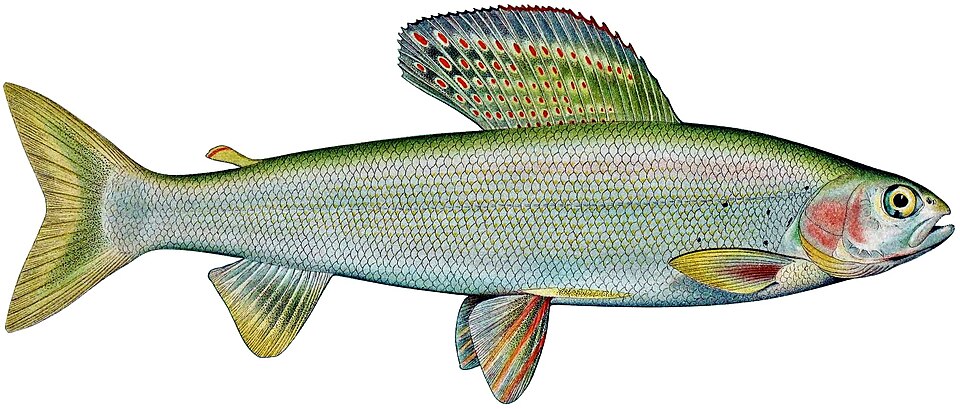
A sleek, sail-finned trout relative known for its oversized dorsal fin and its taste for cold, clean water. Anglers seek it out in remote, high-country streams where catching one feels like a genuine backcountry reward.
The giant sail-like dorsal fin is the giveaway. No other freshwater fish in North America carries a dorsal fin that tall and that colorful, often shot through with rows of pink, purple, or turquoise spots and an edge trimmed in orange or red. Arctic grayling also have a small mouth, a slim, silvery-gray body, and a faint iridescent sheen along the sides that can flash blue or lavender in the sun.
Anglers new to grayling water sometimes mistake them for mountain whitefish or small trout at a glance, especially in low light or from a distance. Whitefish have a small dorsal fin and a blunt, almost snout-like nose, nothing close to the grayling's sail. Trout have a more rounded dorsal fin and lack the large scales and streamlined shape of a grayling. Once you see that dorsal fin up close there is no mistaking a grayling for anything else.
The app forecasts these conditions for your spot, and learns which ones you catch on.
Season
Where it lives
Arctic grayling live in cold, clear rivers, high mountain lakes, and clean, gravel-bottomed streams across the northern Rockies and interior Alaska. They need cold water and clean gravel to survive, so you find them in remote drainages far from development, often well up in headwater country above where trout streams warm and slow.
They hold in the same kind of water as trout: riffles, current seams, and the tailouts of pools. Look for them where a stream narrows and the current picks up speed over gravel or cobble. In lakes, they cruise shallow flats and inlet areas where current brings in food.
What it eats
Grayling feed mostly on aquatic insects: mayflies, caddisflies, midges, and stoneflies, both as nymphs and adults. They will also take small terrestrial insects that fall into the water and the occasional tiny baitfish or fish egg. They are sight feeders that rise readily to insects on the surface, which is a big part of their appeal.
How to catch it
A light fly rod with small dry flies is the classic approach. Grayling rise eagerly to a well-presented fly, and a size 14 to 18 Adams, elk hair caddis, or parachute pattern drifted through a current seam will usually draw a strike. They are not leader-shy and tend to be more willing than trout, which is part of why they make a good introduction to fly fishing once you can reach the water they live in.
Ultralight spinning gear works too. A small spinner or spoon cast upstream and retrieved through a riffle will take fish. Because grayling live in remote, fragile watersheds, most of these fisheries are catch-and-release or carry tight bag limits. Check your state's regulations before you go, and handle any fish you keep briefly and gently.
- How big do Arctic grayling get?
- Most run 10 to 16 inches and under a pound. A trophy fish pushes past 20 inches, but that is rare and usually comes from remote, lightly fished water.
- What do Arctic grayling eat?
- Mainly aquatic insects, both nymphs and adults, along with small crustaceans and the occasional small fish or fish egg. They are known for rising eagerly to dry flies, which is a big part of their appeal.
- When is the best time to catch Arctic grayling?
- Summer, once ice-out water has warmed and insects are hatching. Grayling feed aggressively at the surface on warm, calm days, and dawn or dusk during a hatch is prime time.
- When do Arctic grayling spawn?
- In spring, shortly after ice-out, in gravelly stream sections. They do not build nests like trout, they simply broadcast eggs over gravel and current does the rest.
- Are Arctic grayling good to eat?
- Yes, the flesh is mild and firm, similar to trout. That said, many grayling waters are remote, fragile, or slow to recover from harvest, so check local regulations and consider releasing fish, especially larger ones.
- Why are Arctic grayling harder to find than trout?
- They need cold, clean, well-oxygenated water and are sensitive to habitat change, so their range has shrunk in many areas. Where they still thrive, they are usually in remote rivers and lakes far from heavy fishing pressure.