

Atlantic Cod
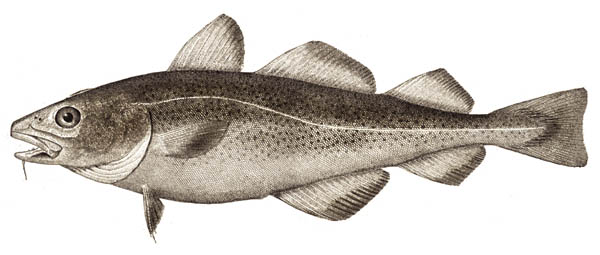
A cold-water bottom fish with a long history on the New England dinner table. Cod fishing is stricter and slower than it used to be, but a hard-fighting fish still comes up from deep structure for anglers willing to work bait or jigs on the bottom.
Atlantic cod are easiest to identify by the single barbel (whisker) hanging from the chin, a rounded tail fin, and a clear white lateral line running down a body that ranges from brownish-red to olive green with scattered dark spots. They have three dorsal fins and two anal fins, a shape that separates them right away from single dorsal fin species.
The main lookalike is haddock. Haddock have a dark lateral line instead of a white one, a black patch above the pectoral fin, and a more deeply forked tail. Pollock get confused with cod too, but pollock lack the chin barbel, have a protruding lower jaw instead of the cod's slightly overhanging upper jaw, and show a greenish, less blotchy color overall. If you check the chin for a barbel and the tail for shape, cod, haddock, and pollock sort out fast.
The app forecasts these conditions for your spot, and learns which ones you catch on.
Season
Where it lives
Atlantic cod live in cold, deep water off the northeastern coast, from the Gulf of Maine out to offshore banks and ledges. They hold near the bottom around rock piles, wrecks, and drop-offs where current sweeps bait past structure.
In winter and early spring some fish move closer to shore and into deeper bays, but most reliable cod fishing today happens well offshore, in sixty to two hundred feet of water, on party boats and charters running out to known structure.
What it eats
Cod eat whatever lives on or near the bottom. Clams, crabs, worms, herring, and small fish like sand eels make up most of their diet. They root around wrecks and rock piles hunting by smell as much as sight, which is why a bait that sits still on the bottom works as well as one that moves.
How to catch it
Bottom fishing is the standard approach. A high-low rig or a simple sinker rig baited with clam, squid, or a chunk of herring, dropped straight to the bottom over structure, is the most consistent method. Keep the weight heavy enough to hold bottom in the current, since cod fishing usually happens in deep water with real tidal flow.
Diamond jigs and heavy bucktails worked in a slow lift-and-drop right off the bottom also draw strikes, especially over wrecks. Cod bite best in cold water, so fall through early spring is the season to target them, and the bite is often best on the drift over known rock or wreck marks rather than at anchor.
Atlantic cod stocks are under heavy restriction in US waters. Seasons, size limits, and bag limits change often and some areas are closed to cod fishing entirely. Check your state and federal regulations before you go, and confirm the current rules before you keep a fish.
- When do Atlantic cod spawn?
- Most spawning happens in late winter through early spring, when cod move to specific offshore grounds to release eggs into the water column. Timing shifts some depending on water temperature and location.
- What do Atlantic cod eat?
- Cod are bottom feeders that eat whatever is available, including small fish, crabs, clams, worms, and squid. They are not picky, which is why cut bait, clams, and jigs all work.
- What is the best time to catch Atlantic cod?
- Cold water months are best, since cod move shallower and feed harder when temperatures drop. Many anglers find fall through early spring more productive than the heat of summer, when cod push to deeper, cooler water.
- How big do Atlantic cod get?
- Cod commonly run 5 to 20 pounds, with larger fish over 40 pounds still caught occasionally. Historically they grew much bigger, but heavy fishing pressure over decades has reduced the average size in most areas.
- Are Atlantic cod good to eat?
- Yes, cod is a classic table fish with firm, mild white flesh that holds up well to almost any cooking method. It is one of the most popular eating fish in the ocean.
- Are there catch limits on Atlantic cod?
- Yes, in most areas Atlantic cod are managed with strict size limits, bag limits, and seasonal closures because populations have declined sharply from historic levels. Always check current regulations before you keep any fish, since rules change often and vary by location.