

Atlantic Mackerel
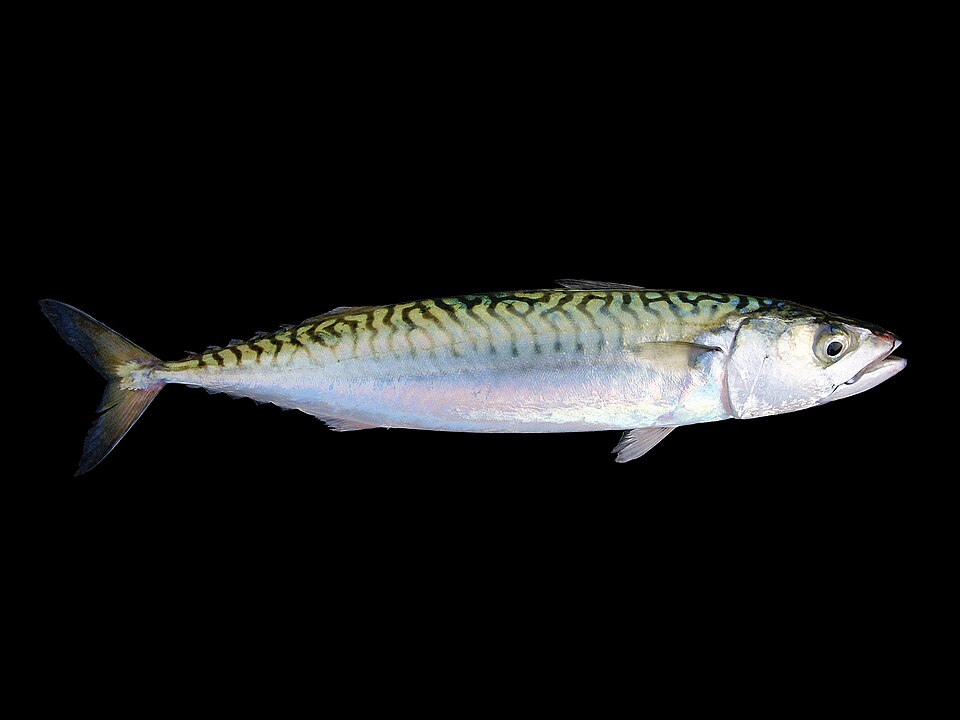
A fast, schooling baitfish-sized predator that swarms piers and jetties along the Atlantic coast. Easy to catch in bulk, fun on light tackle, and great table fare fresh or smoked.
Atlantic mackerel are slim, torpedo-shaped fish with iridescent blue-green backs marked by dark, wavy vertical bars that never form solid rows or spots. The belly is bright silver with no marks at all. There is no scute line down the sides like you see on jacks, and the skin feels smooth, almost slick, since the scales are tiny.
The common mix-up is with Spanish mackerel and chub mackerel. Spanish mackerel have yellow-gold spots scattered on their sides instead of bars, and they run bigger and deeper bodied. Chub mackerel look almost identical at a glance, but their wavy back markings are duller and less defined, and they have a scattering of faint spots below the lateral line that true Atlantic mackerel lack. Bonito and small tunas get thrown into the confusion too, but those have a stiff, forked tail with a narrow keel and finlets that look different up close, plus solid dark stripes rather than broken bars.
The app forecasts these conditions for your spot, and learns which ones you catch on.
Season
Where it lives
Atlantic mackerel are a coastal, open-water schooling fish found from the Mid-Atlantic up through New England and into the Gulf of Maine. They are migratory, moving inshore in huge schools during spring and again in fall as water temperatures shift, then heading offshore to deeper, cooler water for summer and winter.
You find them around piers, jetties, harbor mouths, and open beaches wherever bait is thick. They often show up suddenly in massive numbers, chasing small baitfish right up against the shoreline, then vanish just as fast when the school moves on.
What it eats
Mackerel feed on small baitfish, shrimp, and zooplankton. They are aggressive, fast-moving feeders that hunt in tight schools, often slashing through bait balls near the surface. This makes them predictable and easy to target once you find a school actively feeding.
How to catch it
A simple string of small feathered or mackerel jigs, often called a mackerel tree, is the classic rig. Drop it into a school and jig it up and down, and it is common to hook two or three fish at once. No bait needed, though a small strip of squid or fish belly on the hooks can help on slow days.
Light spinning tackle works well too. Cast small spoons or shiny metal jigs into a breaking school and retrieve quickly with a steady or twitching motion. Fish from piers, jetties, or boats when you see birds diving or bait scattering on the surface, that is the sign a school is close and feeding hard.
- When do Atlantic mackerel spawn?
- They spawn in spring, usually as water temperatures climb into the low 50s Fahrenheit. Spawning happens offshore over open water, not in any specific structure, and large schools stage in coastal waters before and after.
- What do Atlantic mackerel eat?
- Mostly small baitfish, shrimp, and planktonic crustaceans like copepods and krill. They feed by swimming through schools of prey with their mouths open, so small flashy jigs and shiny lures work well.
- When is the best time to catch them?
- Spring and fall, when big schools move inshore to feed, are usually the best windows. They travel in large, fast-moving schools, so once you find one you can often catch several fish quickly.
- How big do Atlantic mackerel get?
- Most run 12 to 18 inches and under a pound and a half. Anything over 20 inches is a genuinely large one for this species.
- Are Atlantic mackerel good to eat?
- Yes, they have rich, oily flesh with a strong flavor, similar to other mackerel species. They do not keep well on ice for long, so clean and cook or freeze them soon after catching.
- Do I need a lot of gear to catch them?
- No. Light spinning tackle or even a simple mackerel tree rig with small jigs dropped into a school will catch fish fast. Heavy gear is not necessary since these fish are small and not particularly strong fighters.