

Black Crappie
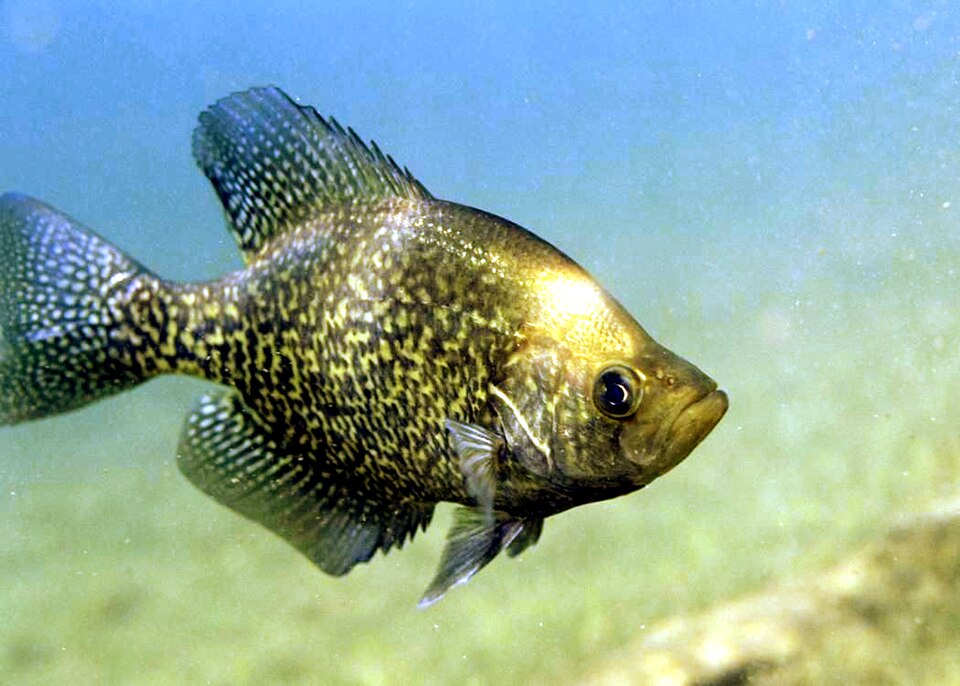
A schooling panfish prized for its mild, flaky meat. Black crappie roam in loose groups around cover, and finding one usually means you can catch a dozen.
Black crappie are most often confused with white crappie, and the easiest way to tell them apart is the spot pattern versus the stripe pattern. Black crappie have irregular, blotchy black speckles scattered randomly across a silvery-green body, with no clear vertical bars. White crappie show faint, distinct vertical bars running down the sides instead of random speckling. The dorsal fin is another giveaway: black crappie have seven or eight spines in the dorsal fin, while white crappie have only five or six, which makes the black crappie's dorsal fin look taller and set further forward.
Body shape can also help. Black crappie tend to run a bit deeper-bodied and more compressed than white crappie, giving them a slightly more oval, saucer-like profile. Beginners sometimes confuse small crappie with bluegill or other sunfish, but crappie have a much longer dorsal fin base relative to body size, a bigger mouth, and that speckled or barred pattern that sunfish lack entirely.
The app forecasts these conditions for your spot, and learns which ones you catch on.
Season
Where it lives
Reservoirs, lakes, and slow rivers with some depth to them. Black crappie favor clearer water than their cousin the white crappie, and they hold around standing timber, brush piles, bridge pilings, and creek channel edges. They suspend rather than sit on the bottom, often stacking up at a specific depth around cover.
In early spring they move shallow into coves and creek arms to spawn around brush and stumps in three to eight feet of water. The rest of the year they sit deeper, relating to submerged structure, and you often have to find them with electronics or by working a range of depths.
What it eats
Small baitfish and minnows make up most of an adult crappie's diet, along with insect larvae and tiny crustaceans. They feed by ambush, holding near cover and darting out to grab something passing by, and they tend to look up rather than down when they eat.
How to catch it
A small minnow or a soft plastic jig under a slip float is the standard rig. Set the depth to match where the fish are holding, which changes through the year, and drift or cast it near brush piles, laydowns, and dock pilings. In spring, work the shallows around spawning cover with the same rig or a small jig on a light jighead.
Crappie have soft, thin-skinned mouths, so keep the drag light and don't horse them on the way in. A light spinning rod with two or four pound line lets you feel the bite and cast small jigs a long way. In North Carolina reservoirs like Jordan Lake, High Rock, and Santee Cooper across the line in South Carolina, working brush piles at ten to twenty feet in summer with a jig tipped with a minnow is a proven pattern.
- When do black crappie spawn?
- They spawn in spring when water temps hit the mid to upper 50s and low 60s, usually earlier than largemouth bass in the same lake. Males move into shallow brush, timber, and dock pilings first to fan out nests, and this is when fishing for them is easiest.
- What do black crappie eat?
- Small minnows, shad, and other baitfish make up most of their diet as adults, though they also eat insects and zooplankton, especially when young. A small jig or live minnow fished slow imitates their food well.
- What is the best time to catch black crappie?
- Spring during the spawn is the easiest time, when fish are shallow and stacked around brush and cover. In summer and winter they move deeper and school tight around structure, so you have to find them with electronics or by working brush piles and drop-offs.
- How big do black crappie get?
- Most run 8 to 12 inches, with a solid fish being close to a pound. Trophy black crappie can push past 2 pounds and 15 inches, though fish that size are rare and usually come from lakes managed specifically for big crappie.
- Are black crappie good to eat?
- Yes, they are one of the best-eating freshwater fish around. The meat is white, mild, and flaky, which is part of why they are so popular with anglers who fish for the table.
- How can I tell a black crappie from a white crappie?
- Look at the pattern and the dorsal fin. Black crappie have random black speckles and seven to eight dorsal spines, while white crappie have faint vertical bars and only five to six dorsal spines.