

Blue Catfish
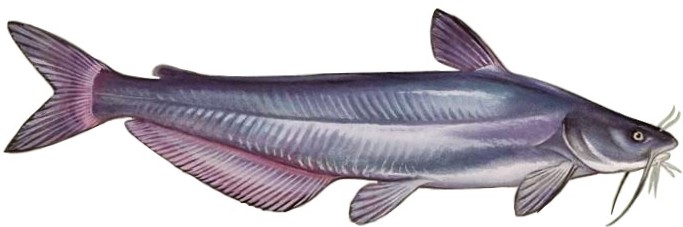
A giant catfish that keeps growing as long as it lives, and in NC reservoirs and rivers it lives a long time. Blue cats over 50 pounds are caught every year, and they pull hard enough to make you rethink your drag setting.
Blue catfish are most often confused with channel catfish, and the two do overlap in size and color enough to fool a beginner. The easiest tell is the anal fin. A blue catfish has a long, straight-edged anal fin with 30 to 35 rays that looks almost rectangular. A channel catfish has a shorter, rounded anal fin with fewer rays and a curved margin. Blue catfish also lack the dark spots that small and mid-size channel cats usually show, though very large channel cats can lose their spots too, so do not rely on spots alone.
Body shape helps as well. Blue catfish have a straight profile from the dorsal fin to the head with a slightly humped back on bigger fish, while channel catfish have a more sloped forehead. Color runs slate blue to gray on the back fading to white on the belly, which is where the name comes from, but channel cats can show similar coloring, so use the anal fin first. The other lookalike is the flathead catfish, which is easy to rule out by the head and tail. A flathead has a flat, wide head and a square tail, while a blue catfish has a narrower head and a forked tail.
The app forecasts these conditions for your spot, and learns which ones you catch on.
Season
Where it lives
Big water. Blue catfish want deep river channels, reservoir main-lake basins, and the tailraces below dams. They hold near channel edges, humps, and submerged creek beds, moving shallower at night or in stained water to feed.
In North Carolina, lakes like Santee Cooper (technically SC, but the fish run the Wateree and Santee systems into NC water), Badin, and the lower Roanoke and Cape Fear rivers all carry strong populations. Virginia's James and Rappahannock rivers are known blue cat waters too. In summer they suspend near thermoclines in deep holes. In winter they stack up in the deepest parts of the channel and barely move.
What it eats
Almost anything dead, dying, or alive. Shad and herring make up most of their diet, but they will eat sunfish, crayfish, worms, and even freshwater mussels. Big blues are scavengers as much as hunters, and a fresh-cut chunk of oily baitfish will draw them from a long way off on current or scent.
How to catch it
Cut bait is the standard, and freshness matters more than anything else. Cut gizzard shad or skipjack herring into chunks, fish it on a Carolina rig with an egg sinker and a wide-gap circle hook, and cast it to the edge of a channel or a deep hole. Let it sit on bottom and wait. Circle hooks matter here: set the rod in a holder and let the fish hook itself, since a hard hookset with a circle hook often pulls it free.
For big fish, fish deep holes below dams in winter and early spring when blues stack up to feed on shad killed by the turbines. In summer, anchor over river channel bends at night and soak two or three rods at different depths until you find where the fish are holding. Heavy tackle is not optional. A 50-pound blue catfish on light gear just breaks it.
- How big do blue catfish get?
- Blue catfish are the largest catfish species in North America. Many fish caught run 10 to 40 pounds, and fish over 60 pounds show up in big rivers and reservoirs every year. The all-tackle record is over 140 pounds.
- What do blue catfish eat?
- They are opportunistic feeders that eat baitfish, shad, herring, crawfish, and just about anything dead or alive they can find on the bottom. Fresh cut bait, especially oily fish like shad or skipjack, is the top producer for big fish.
- When is the best time to catch blue catfish?
- Late spring through fall is prime time, with many anglers finding the biggest fish in summer when shad are abundant. Blue cats stay active in cold water too and can be caught all winter in deep river channels and reservoir holes where other catfish slow down.
- When do blue catfish spawn?
- They spawn in late spring to early summer once water temperatures reach the mid to upper 70s. Males guard the nest, which is usually a cavity under a bank, log, or rock, and fishing slows during the peak of the spawn since the fish are focused on guarding eggs, not feeding.
- Are blue catfish good to eat?
- Yes, smaller and mid-size blue catfish, under about 20 pounds, have firm white meat and are a popular table fish. Very large trophy fish are usually released, both because the meat gets tougher and because those big breeders are important to the fishery.
- Where do you find blue catfish?
- Look for them in large rivers, reservoirs, and the tailwaters below dams. They hold in deep holes, channel edges, and current seams, and they often stack up near baitfish schools in open water rather than hugging shallow cover like a channel cat might.