

Bonefish
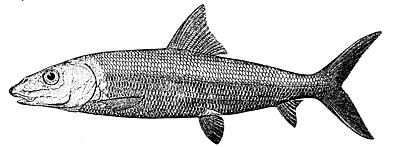
The gray ghost of the flats. Bonefish are built like torpedoes, spook at a shadow, and once hooked run harder for their size than almost anything else that swims in skinny water.
Bonefish are silver, torpedo-shaped fish built for speed across skinny flats. They have a long, pointed snout that overhangs a small, underslung mouth set up for rooting in sand and mud, a single soft dorsal fin, and a deeply forked tail. The back is dusky olive to blue-green and fades into bright chrome sides, sometimes with faint dusky bars that show up when the fish is spooked or resting on a dark bottom.
The main lookalikes on the flats are ladyfish and mullet. Ladyfish have a similar silver, streamlined shape but their mouth is angled upward, not underslung, and their body is more slender with a more forked, pointed tail profile. Mullet school and tail in the same skinny water, but they have a blunt, rounded snout, a small terminal mouth, and often two separate dorsal fins, nothing like the pointed sand-shark nose of a bonefish. Small tarpon can also flash silver in similar water, but tarpon have large, obvious scales, an upturned mouth, and a long trailing filament on the dorsal fin that bonefish never have.
The app forecasts these conditions for your spot, and learns which ones you catch on.
Season
Where it lives
Bonefish live on shallow, clear saltwater flats in the warmest coastal waters of the country, mainly the southern tip of the Florida peninsula and the Keys. They cruise skinny water over sand, turtle grass, and marl bottom, often in water barely deep enough to cover their backs.
They move with the tide. Bonefish push onto the flats as water floods in to feed, then slide off into deeper channels and basins as the tide drops. Look for them tailing in water so shallow their tails and backs break the surface, or nervous water where a school pushes a wake across a flat.
What it eats
Shrimp, crabs, and small baitfish that live in the sand and grass. Bonefish feed with their heads down and tails up, grubbing food out of the bottom, which is exactly the tailing behavior anglers look for to find them. They have no real teeth, just crushing plates in the throat for grinding up shellfish.
How to catch it
This is a sight-fishing game. You need calm, bright conditions, polarized sunglasses, and either a boat with a poling platform or the patience to wade slowly and watch. Once you spot a fish or a school, cast well ahead of its path, not at it, and let the bait or fly settle before it arrives.
Live shrimp on a light spinning outfit, fished on a small hook with just enough weight to sink it, is the classic bait approach. Fly anglers use small crab and shrimp patterns stripped in short, slow twitches once a fish is in range. Either way, keep your movements slow and quiet. Bonefish spook off a heavy footstep or a bad cast and the whole school goes with it.
This is a difficult fish for a beginner. Spotting bonefish before they spot you takes practice, and a hooked fish will burn line off a reel faster than most freshwater anglers have ever seen. Almost all bonefish caught in US waters are released. Handle them wet, keep them in the water for photos, and check your state's regulations before keeping any fish.
- What do bonefish eat?
- Mostly shrimp, crabs, and small bottom-dwelling worms and mollusks. They root along sand and mud flats with their snout down, which is why fly and lure patterns that imitate crabs and shrimp work so well.
- How big do bonefish get?
- Most fish caught on the flats run two to six pounds. Fish over eight pounds are considered trophies, and the rare double-digit bonefish is a serious catch anywhere in the world.
- When is the best time to catch bonefish?
- Warm, calm, sunny days are best because you need to spot them by sight in shallow water. Incoming tides that push bait onto the flats usually trigger the most aggressive feeding.
- Do bonefish spawn on the flats?
- No. They gather in large pre-spawn schools near flats edges and channels, then move offshore into deeper water to spawn, usually tied to certain moon phases in cooler months.
- Are bonefish good to eat?
- Not really. They are full of small, fine bones and have soft, unremarkable flesh, so almost everyone releases them. Their real value is as a light-tackle sport fish, not table fare.
- Why are bonefish considered such a hard fish to catch?
- They are extremely spooky in shallow water, with sharp eyesight and a strong flight response to shadows, noise, or bad casts. Once hooked, they make blistering runs across the flats that test light tackle and knots.