

Brook Trout
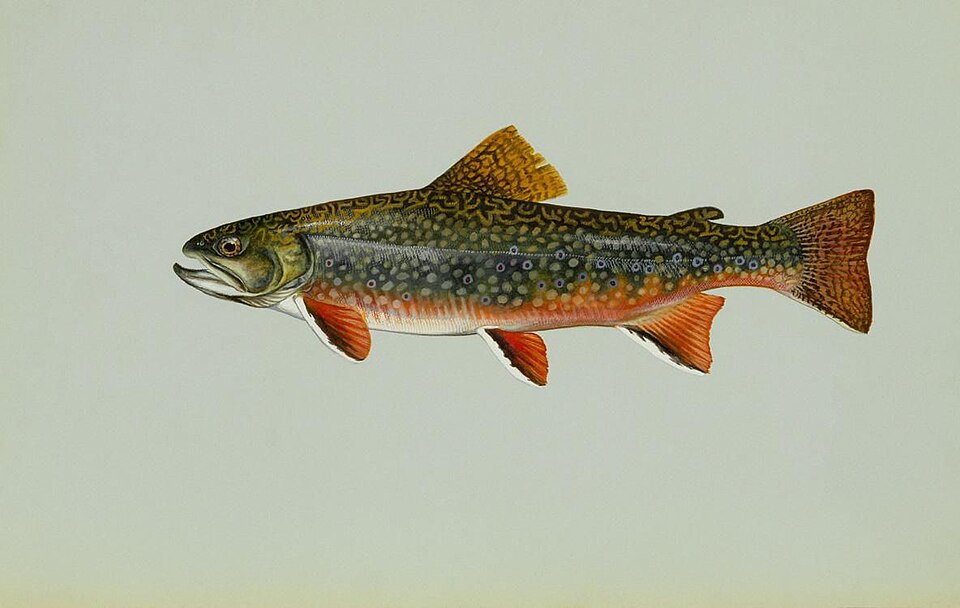
The only trout native to North Carolina, and the reason so many mountain streams are worth the hike. Brook trout are small, gorgeous, and picky about clean, cold water.
Brook trout are actually a char, not a true trout, and once you know what to look for they are easy to tell apart from the fish they get mixed up with. The best field mark is the wavy, marbled pattern on the back and dorsal fin, called vermiculation, which looks like worm tracks or wood grain. No other stream trout has this. Along the flanks look for red spots surrounded by blue halos, set against an olive to dark green body that fades to white or orange on the belly. In spawning males that belly can turn deep orange to red, bordered by a black stripe and then a white leading edge on the lower fins, a combination no other species shows.
The main confusion is with brown trout, which also have red spots, and with lake trout, which share the char family and a light-spotted-on-dark-body look. Brown trout have spots on a golden or tan body but never the blue halos or the marbled back pattern, and their spots are dark, not the light worm-track lines brook trout show. Lake trout have light spots on a dark body too, but the pattern is more like small pale blotches, not vermiculation, and lake trout have a deeply forked tail while a brook trout's tail is square to only slightly notched. Splake, a lake trout and brook trout hybrid stocked in some waters, split the difference with intermediate tail shape and a mix of both patterns, which can make them genuinely tricky to call in hand.
The app forecasts these conditions for your spot, and learns which ones you catch on.
Season
Where it lives
High-elevation streams in the Appalachians, mostly above 3,000 feet in North Carolina, Virginia, and the upstate corners of South Carolina. Brook trout need cold, well-oxygenated water, so you find them in headwater creeks, spring-fed branches, and the small pools and plunges below waterfalls where the water stays cool even in summer.
They hold behind rocks, logs, and undercut banks, anywhere current breaks and food collects. In heavily fished or warmer sections, brookies get pushed further upstream than rainbows or browns, so the smallest, roughest water often holds the best population of true natives.
What it eats
Aquatic insects, larvae, and their own hatching stages make up most of the diet, along with small crustaceans and the occasional terrestrial insect that falls in the water. In bigger pools they will also take small minnows. They feed opportunistically and are not picky, but they spook easily and will not chase far.
How to catch it
Ultralight gear is the whole game. A short spinning rod with 2 to 4 pound line, or a 2 to 4 weight fly rod, lets you fish the tight, brushy water brookies live in. Approach from downstream and stay low. These fish spook at shadows and heavy footsteps on the bank.
Small inline spinners like a size 0 or 1 Panther Martin work well worked upstream through pools. On the fly side, a size 14 to 18 Parachute Adams, Elk Hair Caddis, or a small beadhead nymph fished dead drift through pockets and plunge pools will draw strikes. Fish early morning or overcast days in summer when water temperatures matter most, and expect the best action in cool weather from fall through spring.
- When do brook trout spawn?
- In fall, typically September through November depending on water temperature. They spawn in cold, clean gravel, often in spring-fed streams or areas with upwelling groundwater.
- What do brook trout eat?
- Mostly aquatic insects, larvae, and small crustaceans, along with terrestrial insects that fall into the water. Larger brook trout will also eat small minnows and other fish when available.
- How big do brook trout get?
- In small streams most run 6 to 10 inches and rarely see a pound. In larger rivers, lakes, or far northern waters they can reach several pounds, with trophy fish topping 5 pounds in a handful of well-known waters.
- When is the best time to fish for brook trout?
- Early morning and evening in summer when water is cool, and any time of day in spring and fall when temperatures are milder. Brook trout are the most cold-water dependent of the stream trout and get sluggish or stressed once water warms into the 70s.
- Are brook trout good to eat?
- Yes, they have firm, mild, pink to orange flesh and are considered one of the best-tasting freshwater fish. Many anglers keep a few from stocked or abundant wild populations, though some wild brook trout waters are catch and release only, so check local regulations.
- Why are brook trout considered special compared to other trout?
- They are the only trout native to a large part of eastern North America, and they need the coldest, cleanest water of any stream trout to survive. Because of this, a healthy wild brook trout population is often a sign of excellent water quality.