

Brown Trout
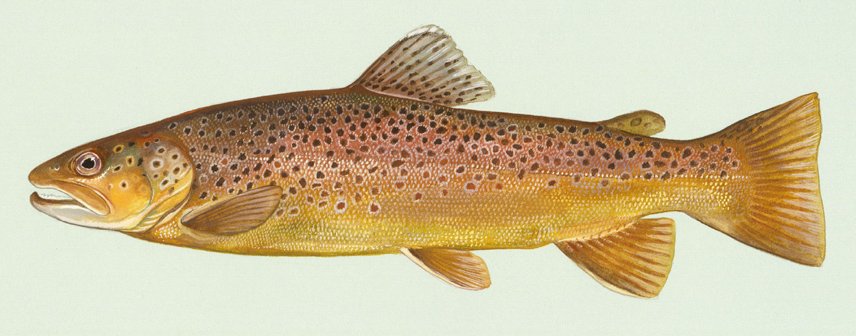
A wary, hard-won trout that rewards anglers who slow down and fish carefully. Brown trout grow bigger and get smarter than rainbows or brookies, and in NC's mountain rivers they're the fish serious trout anglers chase.
Brown trout get mixed up with rainbow trout and Atlantic salmon most often. Look at the body color and spots first. Browns are golden-brown to olive on the sides with large, dark brown or black spots and scattered orange or red spots, often ringed with a pale halo. Rainbows have smaller, denser black spots and usually a pink or red stripe down the side, which browns never have. Browns also lack any spotting on the tail fin, or have just a few faint ones, while rainbows are peppered with spots on the tail.
Atlantic salmon cause more confusion, especially in rivers where both are stocked. Salmon have a more slender, streamlined body, a smaller head relative to their size, and an unspotted or lightly spotted tail with a distinct fork. Browns have a squarer tail, a bigger mouth that extends well past the eye, and their spots often show that orange or red halo salmon lack. If you catch one and gently squeeze the tail fin, a salmon's tail feels stiffer and more forked, while a brown's is broader and flatter. When in doubt, count spots below the lateral line: browns usually have several, salmon typically have none or very few.
The app forecasts these conditions for your spot, and learns which ones you catch on.
Season
Where it lives
Cold mountain streams and tailwaters in western North Carolina, the upstate of South Carolina, and western Virginia. Brown trout want cold, clean, well-oxygenated water, generally below 70 degrees, with deep pools, undercut banks, and structure to hide under. They tolerate slightly warmer and more turbid water than brook trout, which is why they often hold the lower, bigger sections of a river system while brookies stay up in the headwaters.
Look for them in the slow, deep pools behind boulders, in undercut banks along outside bends, and in the tailouts below riffles at dawn and dusk. Delayed-harvest and hatchery-supported streams in the NC mountains (the Davidson, the Nantahala, parts of the South Toe) hold good numbers. Tailwaters below deep-release dams, like the South Holston-style fisheries in VA, can grow genuinely large browns.
What it eats
Aquatic insects, especially in nymph and emerger stages, plus crayfish, sculpins, and smaller fish once they reach any size. Larger browns turn mostly piscivorous and will eat trout half their own length. They feed heavily at low light, dawn, dusk, and after dark, and get much more cautious in bright sun and clear, low water.
How to catch it
Brown trout are the trout that punish sloppy fishing. Fine tippet, a drag-free drift, and a quiet approach matter more here than with stocked rainbows. Nymph rigs with a strike indicator, weighted to bounce just off bottom, take fish consistently through the day. Pheasant tails, hare's ears, and small stonefly patterns all work in NC mountain water.
For real size, fish streamers, sculpin or woolly bugger patterns, in low light or after dark, worked with erratic strips along deep structure. Spin fishermen do well with small jerkbaits and jointed minnow imitations fished slow through deep pools. After rain, when the water is up and stained, browns feed more aggressively and get less spooky, which is often the best time to target a big one.
- When do brown trout spawn?
- In fall, usually October through December depending on water temperature and location. They spawn in gravel-bottomed streams, and even lake-dwelling browns will run up tributaries to do it.
- What do brown trout eat?
- Insects, small fish, crayfish, and just about anything else that fits in their mouth. Larger browns turn heavily predatory and will eat baitfish, sculpins, and even small mice or frogs that end up in the water.
- What is the best time to catch brown trout?
- Low light is key. Early morning, dusk, and cloudy or overcast days are best, since browns are more nocturnal and cautious than rainbows. Many of the biggest fish only feed seriously after dark.
- How big do brown trout get?
- Most stream fish run 10 to 16 inches, but browns can grow much larger in lakes and big rivers with good forage. Trophy fish over 20 pounds show up in select waters, and they are one of the largest trout species you can catch.
- Are brown trout good to eat?
- Yes, the flesh is firm and mild, similar to rainbow trout. Smaller stream fish are excellent on the table, though many anglers release larger browns since they are slow growing and hard to replace.
- Are brown trout harder to catch than rainbow trout?
- Generally yes. They are more wary, more nocturnal, and quicker to spook, which is part of why anglers who chase big browns treat it as its own pursuit.