

Burbot
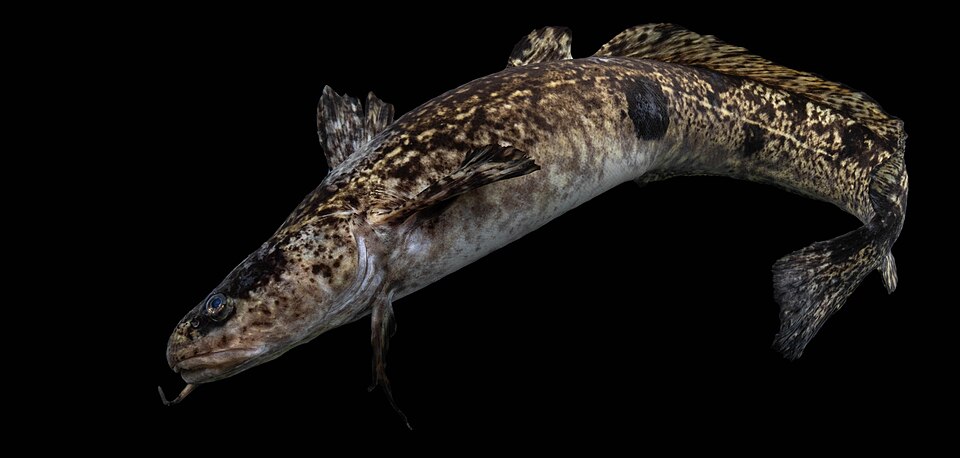
The only true freshwater cod in North America. Burbot are strange-looking, bottom-hugging predators that bite best through the ice, and they make some of the best table fare of any freshwater fish.
Burbot look like nobody else in freshwater except maybe a catfish or an eel, and that confusion is exactly why anglers who catch one for the first time often have no idea what they are holding. The body is long and tapered like an eel, mottled brown or olive with dark blotches, and covered in small smooth scales that make the skin feel slimy rather than rough. A single thick barbel hangs from the chin, which is what drives the catfish comparison, but burbot have no other whiskers and a rounded, almost tadpole-shaped head that no catfish has.
The real giveaway is the fin layout. Burbot have a long, low second dorsal fin that runs most of the length of the back and blends into a rounded tail, plus a similarly long anal fin underneath. Eels have a similar low profile but no barbel and a jaw full of small even teeth rather than the burbot's slightly undershot mouth. If you see a scaleless, whiskered eel with no paired fins, that is a lamprey, not a burbot. Burbot have normal paired pelvic and pectoral fins set well forward on the body, which no lamprey has at all.
The app forecasts these conditions for your spot, and learns which ones you catch on.
Season
Where it lives
Cold, deep lakes and large rivers across the northern tier of the country. Look for burbot in the Great Lakes, the deep reservoirs and rivers of the Mountain West, and lakes across the northern Midwest and interior Alaska. They need cold water year-round, so they hold in the deepest parts of a lake or in slow, deep river channels.
Burbot are nocturnal and stay tight to the bottom over mud, rock, or gravel. In summer they retreat to the coldest deep water available and become hard to catch. In winter they move shallower to spawn under the ice, which is when most anglers actually target them.
What it eats
Burbot are ambush feeders that eat mostly other fish: sculpins, whitefish, smaller burbot, and anything else slow enough to catch along the bottom. They also take crayfish, insect larvae, and fish eggs. They feed almost entirely at night, using smell and a single chin barbel to find food in the dark.
How to catch it
Ice fishing at night is the classic way to catch burbot. Set a heavy bottom rig with a large dead or cut baitfish, or a big minnow, right on the bottom in twenty to sixty feet of water. Burbot spawn in midwinter under the ice, and that is when they move shallow and bite hardest, often right after dark and again before dawn.
In open water, still-fishing with cut bait or a large minnow on the bottom in deep river holes or lake basins works, though summer fishing is slower since burbot go deep and feed less. A simple slip-sinker rig with a stout hook and a heavy leader handles their rough, toothy mouth. Check your state's regulations, since burbot seasons and limits vary widely by region and some waters have special rules to protect them.
- When do burbot spawn?
- Burbot spawn in mid to late winter, usually under ice, moving into shallow gravel or rubble areas at night in large groups. This makes them one of the few fish species you can catch actively spawning through the ice.
- What do burbot eat?
- Burbot are aggressive predators that eat smaller fish, insects, and crustaceans, and they will scavenge dead bait readily. They feed heavily at night and are strongly drawn to bait fished right on the bottom.
- When is the best time to catch burbot?
- Winter through the ice is prime time, especially after dark, since burbot become much more active at night. Open water anglers do best in cold months in deep water near the bottom.
- How big do burbot get?
- Most burbot run 12 to 24 inches and a pound or two, but they can reach well over 3 feet and 10 pounds in good waters. Any fish over 5 pounds is a genuine trophy.
- Are burbot good to eat?
- Yes, burbot have firm white flesh and a mild flavor often compared to lobster or cod, which is why some anglers call them poor man's lobster. They are excellent fried or in a fish boil.
- Do I need to worry about regulations on burbot?
- Rules vary a lot by state and province since burbot are prized in some waters and considered a nuisance or bycatch in others. Check local regulations before you keep a limit, especially through the ice.