

California Corbina
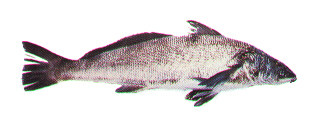
A surf zone specialist found only on the Pacific coast, prized for its wary nature and the pull it gives on light tackle. Sight-fishing for corbina in skinny wash water is one of the more technical challenges in surf fishing.
California corbina belong to the same family as croaker and kingfish, and they get mistaken for both, especially the yellowfin croaker and the smaller surf perch species that share the same beach. Look at the mouth first. A corbina has a single stiff barbel on the chin and a small mouth set low and pointed down, built for sucking sand crabs out of the wash. Yellowfin croaker have a similar shape but show a yellow tint on the fins and lack the chin barbel entirely.
Body color is a plain gray to slate blue on top fading to silvery white below, with faint diagonal wavy lines along the sides that give the species its scientific name, undulatus. There is no spotting, no bold stripe, and no dark blotch on the gill cover like you see on some croaker. The tail is broad and slightly concave, not forked like a surf perch, and the body is longer and more torpedo shaped than the deeper, flatter body of a perch.
The app forecasts these conditions for your spot, and learns which ones you catch on.
Season
Where it lives
Sandy beaches along the southern and central Pacific coast, right in the surf zone. Corbina cruise the wash within a few feet of the sand, often in water barely deep enough to cover their backs, chasing the receding waves in and out.
They favor gently sloping beaches with sandbars and troughs. Look for cloudy, sand-colored water stirred up by wave action, since corbina hunt by feel and smell in that turbulence as much as by sight. They show up as water warms in late spring and stay through summer and into fall, then move to deeper water in winter.
What it eats
Sand crabs are the main course, and corbina key on them hard when they are abundant. They also eat clams, worms, and other small invertebrates they root out of the sand with a small, underslung mouth built for feeding nose-down in the wash.
How to catch it
Live sand crabs are the standard bait, fished on a simple leader with just enough weight to hold near the bottom in the surf. Dig them fresh from the wet sand at low tide right where you plan to fish. Cast into the wash zone, not far out past the breakers, and let the bait sit in the same skinny water the fish are cruising.
Corbina spook easily, so wade in quietly, keep your profile low, and avoid unnecessary movement. Many anglers sight-fish for them, watching for a tailing fish or a push of water in the shallows before dropping a bait a few feet ahead of it. Early morning and calm, clear surf conditions make for the best sight-fishing. This is not a fast-action fish. It rewards patience and a light touch, and it is considered one of the harder surf fish to consistently fool.
- What does California corbina eat?
- Sand crabs are the main food, along with clams, worms, and small crustaceans that wash out of the sand as waves pull back. Corbina root through the wash and along sandbars using smell and the barbel on their chin to find food buried just under the surface.
- When is the best time to catch one?
- Summer through early fall, when sand crabs are abundant and water temperatures are warm, is the most productive stretch. Corbina feed hardest on an incoming tide that floods a flat beach or fills a trough, especially in the early morning or evening.
- How big do California corbina get?
- Most fish caught run 14 to 20 inches, with anything over 24 inches considered a big one. They rarely get much heavier than 6 or 7 pounds.
- Are California corbina good to eat?
- Yes, the meat is white, mild, and well regarded, similar to other members of the croaker family. Many surf anglers target them specifically for the table.
- Do California corbina spawn in the surf?
- Spawning happens in nearshore waters during the warmer months, roughly June through September, which lines up with when they are most active and easiest to catch from the beach.
- What makes corbina hard to catch compared to other surf fish?
- They spook easily in clear, shallow water and often feed just a rod length from shore, so noise, shadows, and heavy leaders will shut down a bite fast. Light line, small hooks, and a quiet approach make the biggest difference.