

California Yellowtail
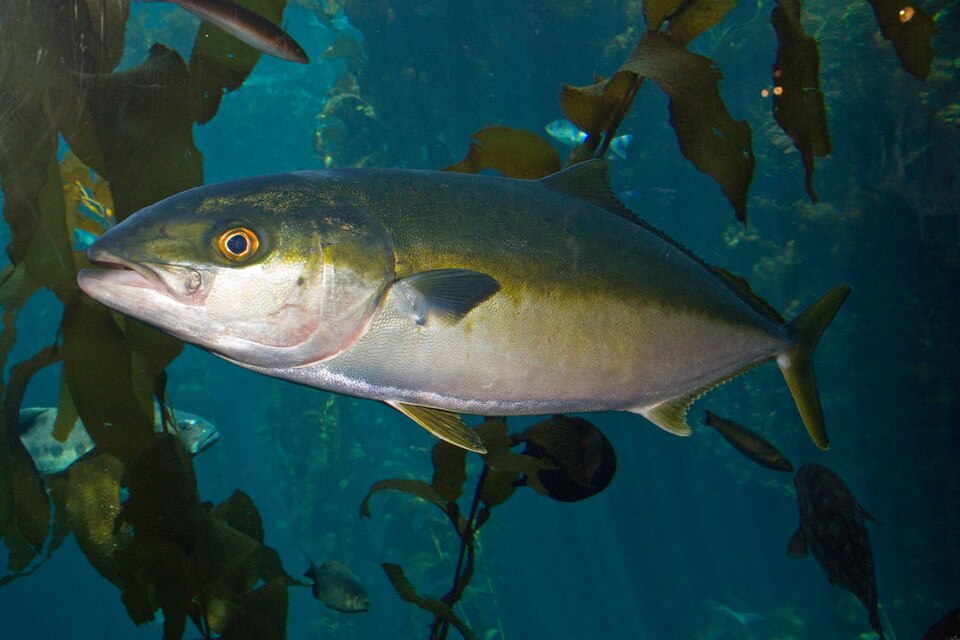
A hard-charging member of the jack family that patrols Pacific coast kelp beds and offshore structure. Yellowtail pull drag like something twice their size and are a rite of passage for anglers moving up from bass to bigger game.
California yellowtail are built like a torpedo, thick through the shoulders and tapering hard to a narrow wrist ahead of the tail. The most obvious field mark is the yellow stripe that runs from the eye to the tail, along with a yellow-green wash on the back and a bright yellow tail. That coloring, plus the amberjack-style build, is where the confusion starts.
The lookalike most anglers actually mix them up with is the amberjack group, greater amberjack and almaco jack in particular. Amberjack tend to run bulkier through the body, lack the strong yellow tail, and usually show a dark diagonal bar through the eye that yellowtail do not have as pronounced. Almaco jack have a taller, more sail-like dorsal fin and a steeper forehead profile. Yellowtail also get confused with bluefin trevally and other jacks in warmer water, but those species are smaller, deeper bodied, and lack the clean yellow stripe and tail. If the fish has a hard yellow tail and a crisp horizontal stripe running the length of the body, you have a yellowtail.
The app forecasts these conditions for your spot, and learns which ones you catch on.
Season
Where it lives
California yellowtail are a Pacific coast fish, found from the Southern California coast out to the offshore islands and down into Baja waters, with fish showing up as far north as central California in warm years. They hold around kelp paddies, kelp beds, rocky points, and offshore banks, and they stack up hard around structure like buoys, oil rigs, and current breaks.
They are a warm water fish and move with the temperature. In strong El Nino years they push further north and closer to shore. Most anglers find them on day boats and long-range trips running out to island backsides and drop-offs, though shore and kayak anglers connect with them near deep rocky points and kelp lines when the fish move in close.
What it eats
Yellowtail eat other fish. Anchovies, sardines, mackerel, and squid make up most of their diet, along with crabs and other bait they can run down in open water or pick off structure. They feed aggressively and will chase bait to the surface, which is why boils and diving birds often give away a school.
How to catch it
Live bait is the standard approach. A live anchovy or sardine on a light fluorocarbon leader, fished with just enough weight to get it down near structure or a kelp paddy, is the most consistent way to hook one. Let the bait swim naturally and be ready for a hard, fast take. These fish will use kelp and rocks to break you off, so you need to turn their head early and keep steady pressure the whole fight.
Jigging works too. A heavy iron jig or a knife jig worked with a fast, erratic retrieve near bait schools or structure draws reaction strikes, especially on party boats working a school that is not eating live bait. Fly-lined bait with no weight at all can be deadly when fish are feeding on the surface. Because yellowtail fight hard and dive for cover, this is not a beginner's first saltwater fish. Use solid tackle, a reel with a strong drag, and check your state's regulations on size and bag limits before you go.
- How big do California yellowtail get?
- Most fish caught run 10 to 25 pounds, with fish over 40 pounds considered big. They can grow past 60 pounds, but those are rare and usually called up from deep structure or open water offshore.
- What do California yellowtail eat?
- They feed on baitfish like sardines, anchovies, and mackerel, along with squid. They will also key in on crabs and other crustaceans when bait schools thin out.
- When is the best time to catch California yellowtail?
- Spring through fall is prime, with activity picking up as water temperatures warm into the mid 60s and above. Early morning and late afternoon tend to produce the most consistent bites.
- Where do you find California yellowtail?
- Look for them around kelp paddies, offshore banks, islands, and current breaks where bait stacks up. They roam in schools and often show up under birds working the surface or around floating debris.
- Are California yellowtail good to eat?
- Yes, they have firm, mild flesh that holds up well to grilling, searing, or raw preparations like sashimi. They are one of the more prized eating fish in their range.
- Do California yellowtail have a spawning season?
- They spawn during the warmer months, generally summer, when adults gather in open water. Spawning does not shut down the bite the way it does for some other species, so they remain catchable through the season.