

Channel Catfish
The easiest big fish to reach in freshwater. Channel cats grow past ten pounds in water you can fish from the bank, and catching them takes patience more than skill.
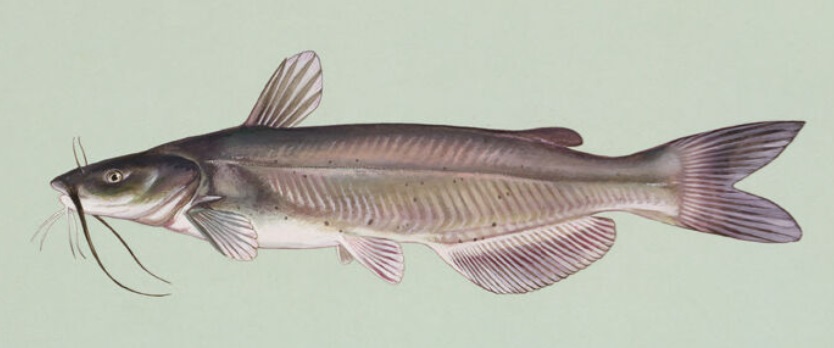
Channel catfish are most often mixed up with blue catfish and juvenile flathead catfish. The easiest tell against blue catfish is body shape and anal fin. A channel cat has a rounded anal fin with a curved edge and fewer than 30 rays, while a blue catfish has a straight-edged anal fin that looks almost rectangular, with 30 or more rays. Channel cats also have a slightly forked tail and a body that stays slim and torpedo-shaped, where big blues get deep and heavy through the shoulders.
Color throws people off more than shape does. Small to mid-size channel catfish usually show scattered black spots along the sides, which is where the species name comes from, but old, larger fish can lose those spots and turn a plain slate gray, leading anglers to call them blues. Check the anal fin every time, spots or no spots. Against flathead catfish, look at the head and jaw. A flathead has a flat, wide head and a lower jaw that juts out past the upper jaw. A channel catfish has a more rounded head and the upper jaw is longer than the lower one, giving it a slight overbite.
The app forecasts these conditions for your spot, and learns which ones you catch on.
Season
Where it lives
Rivers, reservoirs, and bigger ponds. They hold in deep holes, along current seams, and near anything that breaks the flow: bridge pilings, the outside of river bends, the deep end of a dam.
They feed hardest after dark. That is when most serious catfish anglers go.
What it eats
Almost anything. Cut bait, shad, crayfish, insects, mussels, and prepared stinkbaits all catch fish. Channel cats find food by smell and taste rather than sight, so how a bait smells matters far more than how it looks. This is the one fish where something genuinely foul out-fishes something realistic.
How to catch it
Fish the bottom and wait. A sliding sinker rig with a circle hook and a chunk of cut bait, cast into a hole or along a current seam, is the standard method and it is hard to beat.
Use a circle hook and do not strike. Let the fish load the rod, then lift steadily. Striking pulls a circle hook straight back out of the corner of the mouth, which is exactly where you want it to end up.
Go after dark if you can. A spot that gives you nothing at two in the afternoon can be busy at ten at night.
- When do channel catfish spawn?
- Late spring into early summer, once water temperatures reach the mid to upper 70s. Males clear out a nest in a dark cavity like a log jam, undercut bank, or rock crevice, and guard the eggs and fry after the female leaves.
- What do channel catfish eat?
- Pretty much anything. They eat insects, crawfish, small fish, worms, and dead or dying bait, which is why stinkbait, chicken liver, and cut bait all work. They hunt by smell and taste more than sight.
- What is the best time to catch channel catfish?
- Warm summer nights are the classic time, since channel cats feed heavily after dark and move shallow to do it. They also bite well at dawn and dusk, and stay catchable through fall in slower, deeper water.
- How big do channel catfish get?
- Most fish caught run one to five pounds, with a solid adult in the 10 to 15 pound range. The rare trophy pushes past 30 pounds, though fish that size are old and uncommon.
- Are channel catfish good to eat?
- Yes, they are one of the most popular eating catfish in the country. Smaller fish under a few pounds tend to have the mildest, cleanest tasting meat.
- Do I need to worry about limits on channel catfish?
- Rules vary a lot by state and even by specific water, so check local regulations before keeping a mess of fish. Many waters have generous limits since channel cats reproduce well and are stocked widely.