

Coho Salmon
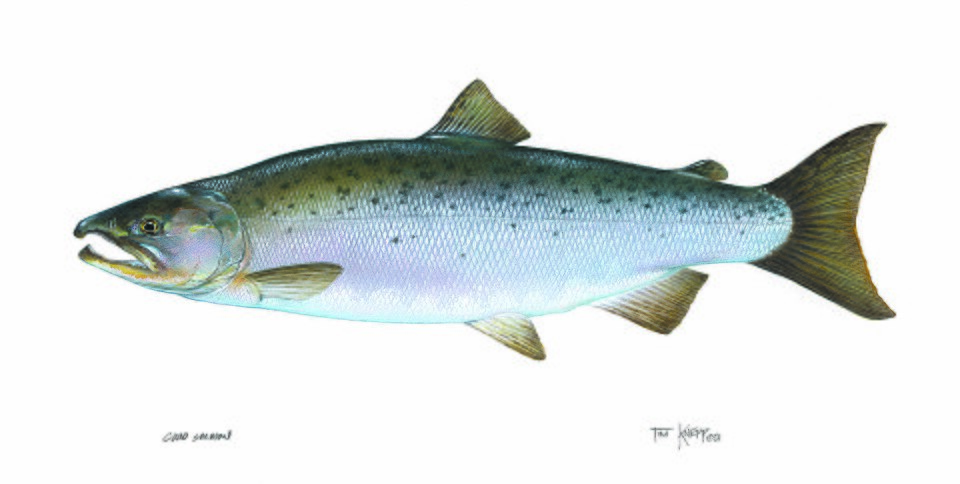
Coho salmon are a hard-fighting Pacific salmon that anglers catch both in saltwater and in the rivers they run up to spawn. They hit lures aggressively and jump when hooked, which makes them a favorite target along the West Coast.
Coho salmon get confused with Chinook salmon and with sockeye, especially in the ocean phase when everything looks silver. The best field mark is the mouth. Coho have a black mouth with a gray or white gum line, while Chinook have a black mouth with black gums all the way through. If you can get a look inside the jaw, that settles it every time.
Body shape and spots help too. Coho carry black spots on the back and upper lobe of the tail only, not on the lower lobe, while Chinook are spotted on both lobes of the tail. Coho also have fewer, larger spots than Chinook's dense speckling. Sockeye are the easiest to rule out once a fish is spawning, since sockeye turn bright red with a green head, while spawning coho turn a dull maroon or brick red on the body with a bright green head and back, and males develop a strongly hooked jaw (kype) similar to other Pacific salmon. In freshwater, coho parr can be mistaken for young steelhead or rainbow trout, but coho parr have shorter, more oval parr marks and an anal fin with a leading white edge that is more pronounced than a trout's.
The app forecasts these conditions for your spot, and learns which ones you catch on.
Season
Where it lives
Coho spend most of their adult lives in the Pacific Ocean, then return to coastal rivers and streams to spawn, usually in fall. You find them along the Pacific coast from the Alaska panhandle down through the Pacific Northwest and into Northern California, both in open saltwater near river mouths and well upstream once they start their run.
The Great Lakes also hold strong populations, planted decades ago and now self-sustaining in places. There, coho roam open water for most of the year and push into tributary streams in late summer and fall to spawn, giving Midwest anglers a shot at the same fish West Coast anglers chase.
What it eats
In the ocean and open lake, coho feed heavily on baitfish like herring, anchovies, and smelt, along with squid and small crustaceans. Once they enter rivers to spawn, they stop feeding altogether. Any strike on a lure or bait at that point is aggression or reflex, not hunger.
How to catch it
In saltwater and open lake water, troll baitfish-imitating spoons, plugs, or flashers with a bait behind them, working just above where sonar marks the fish. Downriggers help you hold the right depth, which is often 30 to 90 feet depending on the season and water temperature.
Once coho enter rivers, switch to casting spoons, spinners, or beads drifted under a float through deep, slow pools and current seams. Bright colors like pink, orange, and chartreuse draw strikes even though the fish are not feeding. Fish early morning and overcast days for the most aggressive action, and check your state's regulations closely, since river seasons and limits on coho are often tightly managed and can close fast.
- When do coho salmon run?
- Most coho runs happen in fall, typically September through November, when mature fish leave the ocean or big lakes and head up rivers and streams to spawn. Timing shifts by a few weeks depending on water temperature and river flow.
- What do coho salmon eat?
- In the ocean or large lakes, coho feed heavily on baitfish like herring, anchovies, and smelt, plus krill and other small crustaceans. Once they enter rivers to spawn, they stop feeding, so hooking one there is more about triggering a reaction strike than imitating a meal.
- How big do coho salmon get?
- Most adult coho run 8 to 12 pounds, with a good fish pushing 15 pounds. Fish over 20 pounds are considered trophies and turn up more often in strong ocean-feeding years.
- Are coho salmon good to eat?
- Yes, coho are excellent table fish with firm, orange-red flesh and a milder flavor than king salmon. Fish are best eaten fresh from saltwater or early in their river run, before spawning changes the texture and flavor.
- What is the best time to target coho?
- Early morning and evening bites are strongest, and overcast days keep fish active longer through the day. In rivers, target them right after a rain raises water levels enough to draw fresh fish upstream.
- Do I need special gear or a license for coho?
- A standard medium to medium-heavy spinning or casting rod handles most coho fishing, whether trolling in open water or casting spoons and jigs in rivers. Regulations vary a lot by state and even by specific river, including gear restrictions and closed sections near spawning grounds, so check local rules before you go.