

Common Snook
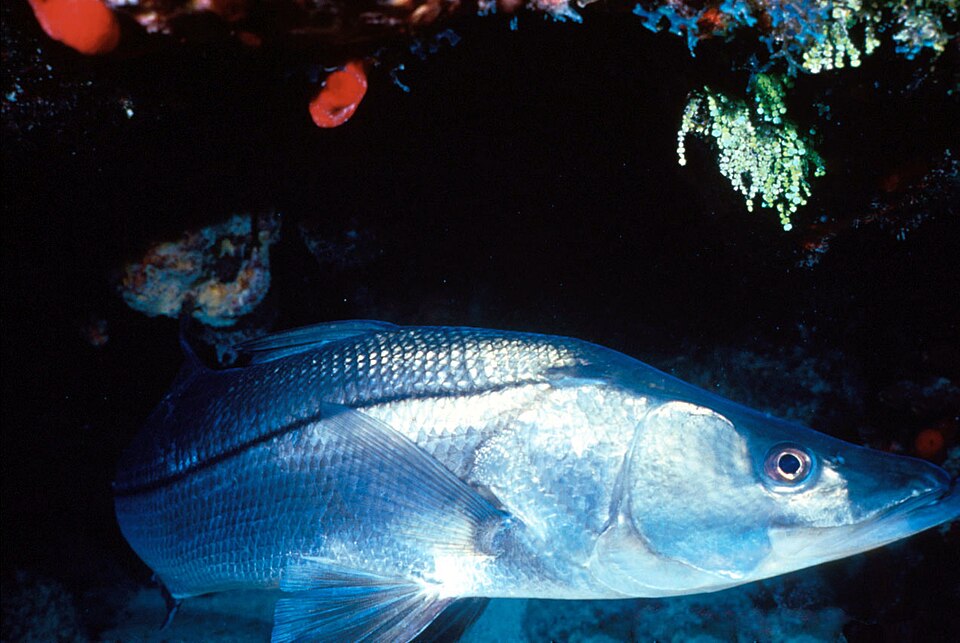
Snook are the trophy of warm coastal flats and inlets, prized for a sideways yellow stripe, a hard sideways run, and a jump that throws hooks. They are catch-and-release or very tightly limited almost everywhere, so check your state's rules before you keep one.
A common snook has one giveaway feature: a bold black lateral line that runs straight from gill to tail, sitting on an otherwise silvery to olive body. No other inshore gamefish in its range wears that stripe as cleanly. Add a sloping forehead, a large undershot jaw, and a prominent pointed dorsal fin set well back from the head, and there is not much room for doubt.
The species it gets mixed up with most is the fat snook and the smaller swordspine or tarpon snook, all of which share that same lateral line and family shape. Fat snook are deeper bodied and shorter, with a steeper forehead profile, and they rarely reach the size a common snook does. Tarpon snook and swordspine snook stay small, usually under a couple pounds, and have a more compressed, almost stubby build. If the fish is large, long, and thin with that black line running dead straight, you are looking at a common snook. Anglers new to the species sometimes also confuse a snook with a ladyfish at a glance because of the silvery color, but ladyfish have no lateral stripe, a smaller mouth, and a deeply forked tail with no separate pointed dorsal fin.
The app forecasts these conditions for your spot, and learns which ones you catch on.
Season
Where it lives
Snook live in warm, shallow saltwater and brackish water along the Gulf coast and the southern Atlantic coast, wherever water stays warm through winter. They cannot handle cold snaps, so their range is limited to the far southern edge of the country and it shrinks after a hard freeze kills off the northern fringe of the population.
Look for them around mangrove shorelines, inlets, passes, bridge pilings, and dock lights at night. They also push well up into brackish rivers and canals, especially in warmer months, and will sit tight against any current break where baitfish get swept past.
What it eats
Snook are ambush feeders that eat baitfish, shrimp, and crabs. They hold in current with their nose pointed into the flow and let food come to them, then explode forward to eat it. Mullet, pilchards, and glass minnows are staple forage, and a snook will crush a shrimp swimming past a dock light without hesitation.
How to catch it
Live bait is the standard approach. A live pilchard, pinfish, or shrimp free-lined or fished under a popping cork near mangroves, dock pilings, or a bridge shadow line will draw strikes. Fish moving water on a falling or rising tide, since snook feed hardest when current is pushing bait past their ambush point.
For lures, a white or chartreuse jig bounced along the bottom near structure works, as does a suspending twitchbait worked slowly around dock lights after dark. Use heavier leader than you think you need, at least 30 to 40 pound fluorocarbon, because snook have rough gill plates that will cut lighter line the instant they turn and run for cover. Set the hook hard and try to keep them out of the pilings, since that first run toward structure is where you lose most fish.
- When do snook spawn?
- Snook spawn in warm months, generally late spring through summer, staging near passes, inlets, and beach fronts where tidal current helps disperse eggs. Fishing can be excellent around these spawning aggregations, but many areas close season to protect them during this stretch.
- What do snook eat?
- Snook are ambush predators that feed heavily on baitfish like mullet, pilchards, and pinfish, plus shrimp and small crabs. They sit in current, along structure, or under lights at night and wait for food to drift by rather than chasing it far.
- When is the best time to catch a snook?
- Low light is best: early morning, dusk, and after dark around lit docks or bridges. Moving tide matters more than time of day, since snook feed hardest when current is pushing bait past their ambush point.
- How big do snook get?
- Common snook can top 40 inches and 30 pounds, though most caught inshore run smaller, in the 5 to 15 pound range. A snook over 30 inches is a genuinely big fish anywhere in its range.
- Are snook good to eat?
- Yes, snook have firm, mild white meat and are considered one of the better eating inshore fish. That reputation is part of why they carry strict size and bag limits, and closed seasons, in most places they are found.
- Can I keep any snook I catch?
- Not always. Snook regulations are tight, with slot limits, closed spawning seasons, and permit requirements in some areas, so check local rules before keeping one. Many anglers release snook outside the legal slot without much fuss since the fish handles catch and release well.