

Crevalle Jack
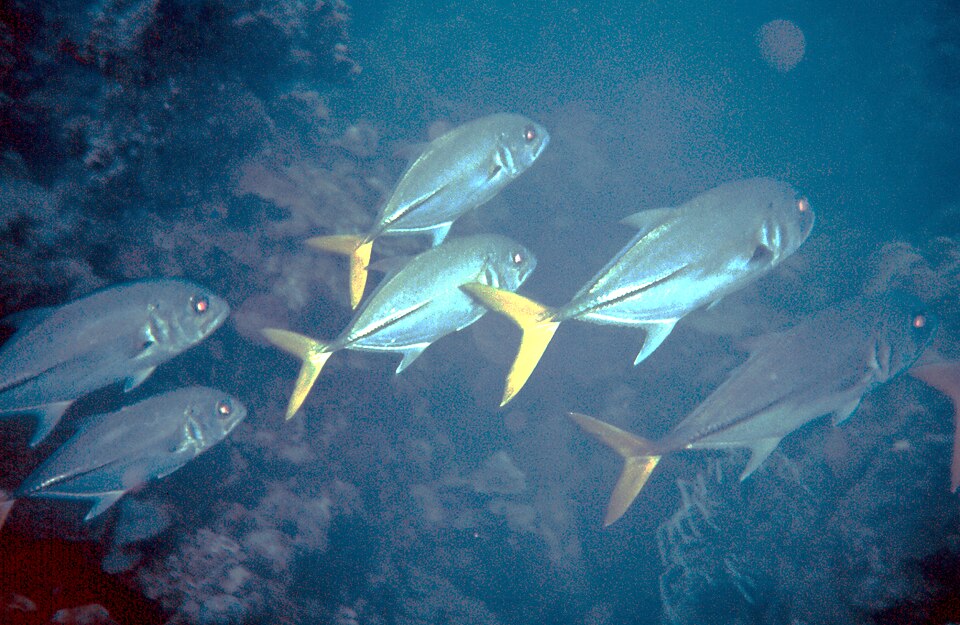
A thick-shouldered brawler that hits like a truck and never stops pulling. Crevalle jack show up in warm coastal waters and turn light tackle into a wrestling match.
Crevalle jack have a deep, blunt-headed body, a sharp yellow to gold wash on the lower sides, and a black spot on the gill cover plus another at the base of the pectoral fin. That combination of two dark spots is the fastest way to confirm the species. Their forehead is steep and almost vertical, giving them a blocky, bulldog profile that other jacks lack.
They get confused with other jack species, especially horse-eye jack and jack crevalle's smaller lookalikes in the same family. Horse-eye jacks are more silver, lack the strong yellow belly, and have a larger eye relative to the head. Bluefish get mistaken for crevalle at a glance because both are aggressive predators, but bluefish have a sleek, torpedo body, a forked tail with no scutes, and a mouth full of visible sharp teeth, while crevalle have small teeth and a row of hard scutes running along the rear portion of the lateral line. Pompano and permit share the deep body shape but are much flatter side to side, more silver overall, and never show the black gill spot.
The app forecasts these conditions for your spot, and learns which ones you catch on.
Season
Where it lives
Crevalle jack are a warm-water coastal fish, common along the Gulf coast and the southern Atlantic coast, with fish pushing into bays, inlets, and even far up tidal rivers when the water warms. They roam open beaches, passes, and nearshore structure, and they often show themselves by busting bait on the surface.
In summer and fall they push north along the Atlantic coast following bait, and you can find them well up the coast during the warm months before they retreat south as water cools. They also turn up around jetties, bridge pilings, and channel edges where current concentrates baitfish.
What it eats
Crevalle jack are aggressive baitfish hunters. Menhaden, mullet, sardines, and other schooling baitfish make up most of the diet, along with shrimp and crabs when they are working shallow flats. They feed in packs, often driving bait to the surface in a churning, splashing frenzy that is easy to spot from a boat or a pier.
How to catch it
Look for surface commotion, diving birds, or nervous bait and cast into the edge of it. A metal spoon, a bucktail jig, or a topwater plug worked fast will draw a strike almost immediately when jacks are actively feeding. Live bait like finger mullet or a live shrimp under no weight, just free-lined into the school, also works well.
Once hooked, a crevalle jack digs hard and runs in tight, powerful circles, so use tackle heavier than the fish's size suggests. A medium-heavy spinning rod with 20 to 30 pound braid and a stout leader will keep you from getting spooled. Most anglers release them since the flesh is strong and dark, but pound for pound they are one of the hardest-fighting fish you can hook from shore.
- How big do crevalle jack get?
- Most fish caught inshore run 2 to 10 pounds, but crevalle jack can top 40 pounds in open water. Anything over 20 pounds is a big fish by most anglers' standards.
- What do crevalle jack eat?
- They are aggressive baitfish predators, feeding on shad, mullet, menhaden, and anything else small enough to chase down in open water or along current lines. They will also hit shrimp and crabs when baitfish are scarce.
- When is the best time to catch crevalle jack?
- Warm months are best, since they are a warm water species that moves inshore and along beaches when water temperatures climb. Look for surface feeding activity, birds working, or bait getting pushed up, especially early morning and late afternoon.
- Are crevalle jack good to eat?
- Most anglers release them. The meat is dark, strong tasting, and considered poor table fare compared to other inshore species, so they are caught almost entirely for the fight, not the fillet.
- Why do crevalle jack fight so hard?
- Their deep, muscular body and broad tail give them serious pulling power for their size, and they use their body shape against you the whole fight, similar to how a permit fights. Pound for pound, they are considered one of the hardest fighting inshore fish.
- Do crevalle jack spawn in a specific season?
- They spawn offshore during the warmer months, typically spring through summer depending on water temperature. Juveniles often show up in estuaries and back bays afterward, growing quickly on abundant baitfish.