

Cutthroat Trout
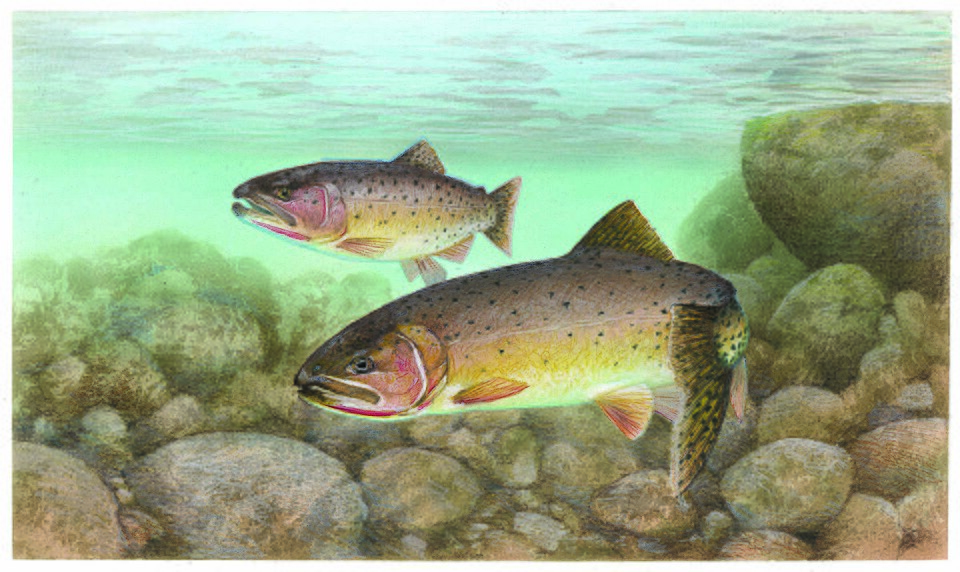
A native trout of the West, named for the red-orange slash under its jaw. Cutthroat live in clean, cold, often remote water and reward anglers willing to hike or wade for them.
Look under the jaw first. Cutthroat trout have a red, orange, or yellow slash mark on each side of the lower jaw, right where the gill plates meet. That mark is the whole ballgame for telling them apart from rainbow trout, which lack it entirely. Body color varies a lot by population, from olive-gold to silver, and all cutthroat carry black spots concentrated toward the tail, but the throat slash is the one mark that holds up everywhere.
Cutthroat and rainbow trout also interbreed where their ranges overlap, producing "cutbows" that show a faint or partial slash and a mix of both patterns. If the slash is weak or muddy rather than sharp, you are probably looking at a hybrid rather than a pure cutthroat. Cutthroat can also be confused with brown trout, but browns have larger, often halo-ringed spots and no throat slash, and their body shape tends to be heavier through the shoulders. Golden trout, a close relative found in some high mountain lakes, share the spotting pattern but run much brighter yellow-orange overall and still lack the true jaw slash in its bold red form.
The app forecasts these conditions for your spot, and learns which ones you catch on.
Season
Where it lives
Cold, clear rivers, high mountain lakes, and headwater streams across the Mountain West and the Pacific Northwest. Cutthroat need clean gravel, cold temperatures, and good oxygen, so they tend to live upstream of where other trout do, in the thin, fast water near the source.
Coastal cutthroat live differently. Along the Pacific coast, some populations run between rivers and saltwater, showing up in tidal creeks and estuaries as well as freshwater. Inland, cutthroat hold in pools and riffles, tucked behind boulders and logs, and stack up in the deeper bends of small streams.
What it eats
Mostly insects: mayflies, caddis, stoneflies, and terrestrials like ants and grasshoppers that fall or get blown into the water. Cutthroat also eat small minnows, eggs from spawning fish, and the occasional crustacean. They feed at or near the surface often enough that dry flies and small surface lures work well.
How to catch it
Light spinning gear or a fly rod both work. Drift a small spinner, an inline spinner, or a nymph through pools and current seams, letting it swing naturally past likely cover. Cutthroat are not picky the way some trout are, but they spook easily in small clear streams, so approach quietly and cast from downstream when you can.
A dry fly like an Elk Hair Caddis or a Parachute Adams fished on a dead drift will draw strikes in summer, especially in the evening. In lakes, work the shoreline and inlet areas with a small spoon or a nymph under a strike indicator. Many cutthroat waters are catch-and-release only or have strict slot limits to protect native populations, so check your state's regulations before you fish.
- When do cutthroat trout spawn?
- Most cutthroat spawn in spring as water temperatures climb into the mid 40s to low 50s, moving into small tributary streams with gravel bottoms. Exact timing shifts with elevation and latitude, running earlier at low elevation and later in high mountain streams.
- What do cutthroat trout eat?
- Aquatic insects make up most of their diet, along with small crustaceans, leeches, and smaller fish where available. In lakes they will key in on emerging insect hatches, and larger cutthroat feed heavily on baitfish or even mice patterns on the surface.
- How big do cutthroat trout get?
- Most stream cutthroat run 8 to 16 inches, but lake-dwelling and sea-run populations can push well past 20 inches and occasionally top 10 pounds. Size depends heavily on the specific population and how much forage is available.
- When is the best time to catch cutthroat trout?
- Early morning and evening produce the most consistent action, especially in summer when water warms up during the day. Spring and fall generally fish better than the heat of midsummer, and cutthroat feed aggressively right after ice-out in lakes.
- Are cutthroat trout good to eat?
- Yes, their flesh is mild and firm, similar to other trout. Many cutthroat waters are catch and release only or have strict limits because some populations are native, isolated, and slow to recover, so check local regulations before keeping one.
- Are cutthroat trout easy to catch?
- They are generally considered less wary than brown trout and will often take a fly or lure readily, which is part of why isolated populations get overfished quickly. That said, heavily pressured cutthroat in popular waters can still get selective and spooky.