

Flathead Catfish
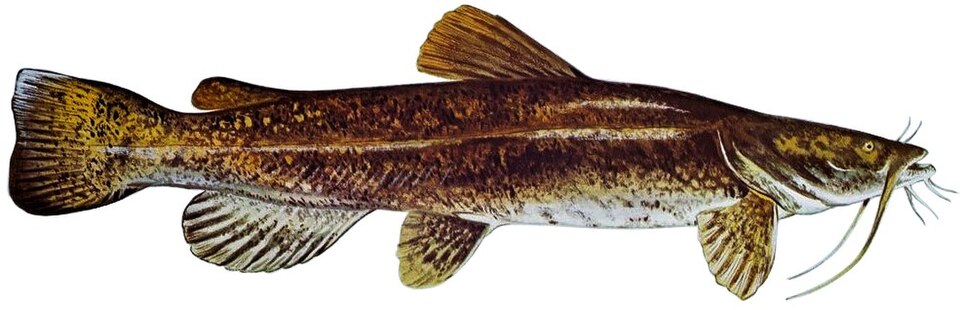
A giant, mostly nocturnal catfish that hunts live prey instead of scavenging. They grow to serious size in NC rivers and reservoirs, and hooking one on tackle you can actually turn is a rite of passage for catfish anglers.
Flathead catfish are most often mixed up with channel catfish and blue catfish, but a few features settle it fast. Flatheads have a flat, wide head that looks almost toad-like, a protruding lower jaw that sticks out past the upper jaw, and a body color that runs mottled yellow-brown to olive with dark blotches, never uniformly gray or blue. Their tail is only slightly notched, almost square, where channel and blue cats have a distinctly forked tail.
Channel catfish have a rounded head, an upper jaw that overhangs the lower one, and dark spots scattered on their sides when young, which flatheads never show. Blue catfish are the other common mix-up, especially big ones, but blues are smooth slate-blue to gray with a deeply forked tail and a straight-edged anal fin. A flathead's anal fin is shorter and rounded rather than straight-edged. If you flip the fish and check the jaw and the tail shape together, you will not misidentify it.
The app forecasts these conditions for your spot, and learns which ones you catch on.
Season
Where it lives
Flathead catfish live in big rivers, reservoirs, and the deep, slow pools connected to them. They want structure: log jams, undercut banks, root wads, bridge pilings, and deep holes with cover nearby. During the day they hole up tight against wood or rock and barely move.
In North Carolina, rivers like the Cape Fear, Neuse, Pee Dee, and Roanoke all carry good populations, along with reservoirs like Santee Cooper across the line in South Carolina. They were introduced outside their native range decades ago and have since taken over many Piedmont and Coastal Plain river systems.
What it eats
Flatheads are predators first, scavengers a distant second. Unlike channel or blue cats, they strongly prefer live prey. Adults eat sunfish, shad, suckers, and other catfish. They feed mainly after dark, moving out of their daytime cover to hunt along current seams and structure.
How to catch it
Live bait is the standard approach and it is not close. Sunfish (where legal to use as bait), small bullheads, or live shad fished on a heavy sliding sinker rig near cover will out-produce cut bait most nights. Use a stout rod, 50 to 80 pound braid or heavy mono, and a strong circle hook. Flatheads fight hard and bury back into wood the instant they feel pressure, so tackle needs to be heavier than it feels like it should be.
Fish after dark, from spring through fall, anchoring or wading near log jams and deep bends. Give the fish time to fully load up the rod before you set, since a flathead often mouths bait before committing. Check state and local rules before using live sunfish as bait, since some waters restrict it.
- How big do flathead catfish get?
- Most fish caught run 5 to 20 pounds, but flatheads regularly top 40 pounds and fish over 60 pounds show up in big rivers and reservoirs every year. They are one of the largest freshwater fish in North America.
- What do flathead catfish eat?
- Almost entirely live fish once they grow past a few inches. Unlike channel cats, flatheads rarely scavenge dead or rotting bait, so live bluegill, shad, or small carp outfish cut bait most of the time.
- When is the best time to catch a flathead catfish?
- Nighttime in summer is the classic window, since flatheads are most active after dark when water temperatures are warm. They spawn in late spring to early summer and feed heavily before and after that period.
- Where do flathead catfish hold in a river or lake?
- Look for deep holes, log jams, undercut banks, and other heavy cover near current. Flatheads are loners that claim a piece of structure and sit tight to it during the day, then move shallower to feed at night.
- Are flathead catfish good to eat?
- Yes, flathead meat is firm, white, and mild, and many anglers rank it above channel catfish at the table. Smaller fish under 10 pounds are generally preferred for eating.
- Should I be worried about flatheads hurting native fish populations?
- In some rivers outside their native range, introduced flatheads have hammered populations of native sunfish and bullheads because they are aggressive live predators. Check local regulations, since some states ask anglers not to release flatheads caught outside their native waters.