

Florida Pompano
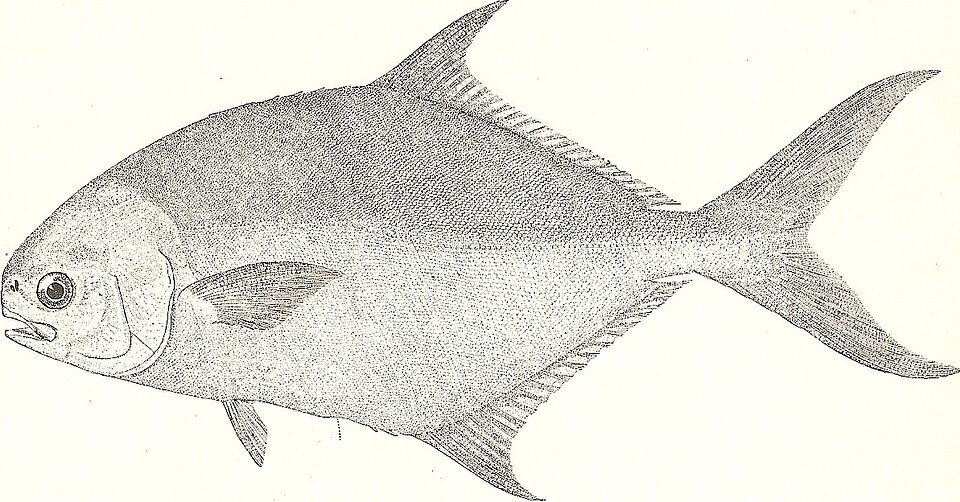
A fast, silvery surf fish prized for its sweet white meat. Pompano run the beach in schools and demand a specific setup, but they are one of the best-eating fish that swims within casting range of the sand.
Florida pompano are most often mixed up with permit and with the less common palometa, since all three share the same deep, silvery, disc-shaped body and forked tail. The easiest split is size and forehead shape. Permit grow much larger, routinely over 20 pounds, with a steeper, more abruptly rounded forehead and a taller, more compressed body. Florida pompano rarely top 3 or 4 pounds and have a more gently sloped, almost straight profile from mouth to dorsal fin.
Color is another giveaway. Florida pompano show yellow on the throat, belly, and pelvic fins along with a silvery-blue back, while permit usually look plainer silver with only a faint yellow wash. Palometa are slimmer, more elongated fish with noticeably longer, trailing dorsal and anal fin filaments than a pompano's short, stubby fins. If you are holding a small, chunky, yellow-bellied fish with short fins, it is a pompano, not a young permit.
The app forecasts these conditions for your spot, and learns which ones you catch on.
Season
Where it lives
Florida pompano live in the surf zone along sandy beaches, cruising the troughs behind the first sandbar and the cuts where water drains out at low tide. They also show up around inlets, piers, and the mouths of sounds where clean sand and moving water meet.
They want warm water and sandy bottom, not mud or rock. Look for washes, sloughs, and points where a sandbar breaks, especially with a bit of wave action stirring up the bottom.
What it eats
Sand fleas (mole crabs) are the top item, along with small clams, coquinas, and other sand-dwelling crustaceans. Pompano root through the wash zone and sift sand for these bite-sized meals, which is why baits that mimic sand fleas work so well.
How to catch it
Fish the surf with a two or three hook pompano rig, small long-shank hooks, and a pyramid sinker to hold bottom in the wash. Bait with fresh or frozen sand fleas, or use small pieces of shrimp or Fishbites if fleas are not available. Cast into the trough just past the first breaker and let it sit, moving your rod holders down the beach every twenty minutes until you find fish.
Pompano jigs, small yellow or pink bucktails bounced along the bottom, also work well from a pier or while wading, especially early morning. Look for a moving tide and slightly murky, sand-stirred water. Dead calm, glassy surf is usually slower than a beach with some chop.
- What do Florida pompano eat?
- Sand fleas, small crabs, clams, and other bottom invertebrates make up most of their diet. They feed by digging in the sand along the surf line and around inlets, which is why bait fished right on the bottom works so well.
- When is the best time to catch pompano?
- Spring and fall are the peak seasons in most areas, when pompano move along beaches and inlets in large schools chasing warmer water. Early morning and the hour around a moving tide, especially an incoming tide, usually produce the best bite.
- How big do Florida pompano get?
- Most fish caught run 1 to 3 pounds, with a big one pushing 5 or 6 pounds. Anything close to 8 pounds is an exceptional fish for this species.
- Are Florida pompano good to eat?
- Yes, they are considered one of the best-tasting saltwater fish around. The flesh is firm, mild, and holds up well to grilling or pan searing, which is a big reason they bring a high price at fish markets.
- Where do Florida pompano spawn?
- They spawn offshore in open water during spring and summer, and the young fish move into surf zones, inlets, and estuaries to grow before heading back offshore as adults.
- What is the best rig for catching pompano from shore?
- A simple double-drop bottom rig with small hooks baited with sand fleas or shrimp, cast just past the breakers, is the standard setup. A pompano jig bounced along the bottom in the surf also works well.