

Freshwater Drum
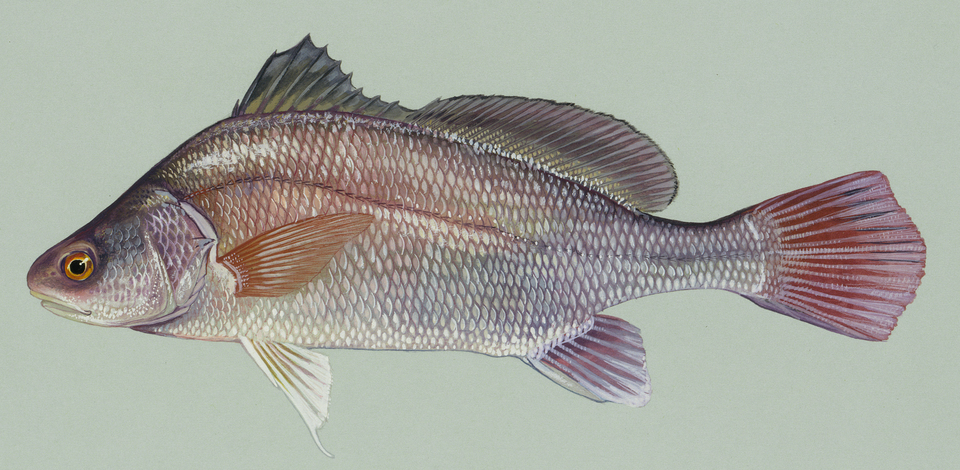
The only freshwater member of the drum family in North America, and a lot more common than most anglers realize. It fights hard, bites readily, and gets ignored by people chasing bass, which makes it an easy fish to catch when you want action.
Freshwater drum have a humped back, a long sloping forehead, and a small chin barbel-free mouth set low and underslung, built for crushing shellfish and crayfish along the bottom. The body is silvery gray to bronze with no bold markings, and the lateral line is unusual for a freshwater fish because it runs all the way to the tip of the tail instead of stopping at the base.
New anglers often mistake a drum for a carp because both are thick-bodied, silvery, and bottom-feeding. Carp have a much larger mouth with two fleshy barbels on each side and no hump behind the head. Drum are sometimes confused with black or white bass too, but the deep humped back, rounded tail, and single long dorsal fin with a notch in the middle separate them right away. If you catch one and cut it open, the pair of large pea-sized ear bones (otoliths) in the skull are a dead giveaway, no other common freshwater fish has stones that big.
The app forecasts these conditions for your spot, and learns which ones you catch on.
Season
Where it lives
Big rivers, reservoirs, and large lakes across the Mississippi River drainage, the Great Lakes, and much of the Midwest and Mississippi Valley. Freshwater drum also turn up in reservoirs and rivers through the Plains and parts of the Southeast interior. They like slow current, sandy or gravel bottoms, and deeper holes below dams, wing dikes, and river channel edges.
They roam in schools and move with the seasons, working shallower flats and current breaks in warmer months and dropping into deeper water as it cools. You will often find them mixed in with catfish and other bottom feeders in the same stretches of river.
What it eats
Freshwater drum feed mostly on the bottom, using strong pharyngeal teeth in their throat to crush shells. Snails, clams, crayfish, and other small mollusks and crustaceans make up a lot of their diet, along with insect larvae and small fish. That shell-crushing ability is also why they are sometimes called sheepshead.
How to catch it
A simple bottom rig is all you need: a sliding sinker, a swivel, and a hook baited with a nightcrawler, cut bait, or a chunk of shad. Fish it slow along river channel edges, below dam tailwaters, or over gravel and sand flats in a reservoir. Drum will also take a jig tipped with a soft plastic or a piece of nightcrawler bounced slowly along the bottom.
They bite year round but tend to school up and feed hard in current seams and eddies where food washes past. Once you find one, stay put. Drum move in groups, so a bite often turns into several fish in the same spot. They pull hard for their size and are good to eat if kept on ice quickly, though many anglers release them.
- What do freshwater drum eat?
- Mostly snails, clams, crayfish, and small fish picked up off the bottom. Their flat, grinding teeth in the throat are built for crushing shells, which is why they hang around mussel beds and rocky bottoms.
- When and where do freshwater drum spawn?
- They spawn in late spring into early summer once water warms into the 60s and 70s, out in open water rather than on nests. Eggs float freely and drift until they hatch, unlike most freshwater fish that guard a bed.
- What is the best time to catch freshwater drum?
- Warm months are most productive, especially early morning and evening. They feed heavily along river current seams, tailwaters below dams, and rocky lake bottoms, and they will bite all day when the water is stained.
- How big do freshwater drum get?
- Most run one to five pounds, but they can top twenty pounds in big rivers and reservoirs. They are the largest member of the drum family that lives entirely in fresh water.
- Are freshwater drum good to eat?
- Yes, the white fillets are mild and firm, though they soften quickly if not iced right away. Many anglers overlook them because of their reputation as a rough fish, but fresh ones cooked the same day eat well.
- Why do people call them croakers or grunters?
- Drum make a loud grunting or croaking sound using muscles against their swim bladder, most often during spawning season. You can sometimes hear it right through the hull of a boat.