

Gray Snapper
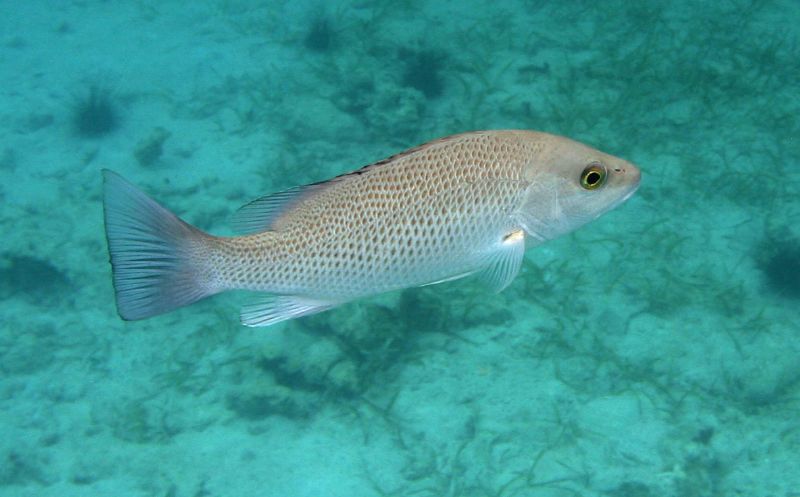
Also called mangrove snapper, this sharp-eyed reef and mangrove dweller is one of the toughest inshore fish to fool. Get one to the boat and you have earned it.
Gray snapper, also called mangrove snapper, are usually confused with mutton snapper and lane snapper, and juveniles get mixed up with schoolmaster snapper. The body is generally dark gray to grayish red, sometimes with a reddish tinge that gets stronger in deeper water, and there is a dark stripe running through the eye on many fish. Mutton snapper show a distinct black spot below the dorsal fin near the tail and have a more sloped, reddish head profile, a spot gray snapper never have. Lane snapper are smaller, brighter red or pink with yellow stripes running the length of the body, markings gray snapper lack entirely.
Look closely at the mouth and canine teeth. Gray snapper have a noticeably underslung lower jaw and two enlarged canine teeth at the front of the upper jaw that are visible even with the mouth closed, a feature that separates them from schoolmaster snapper, which have a blunter head and pale bars on the sides. Fin shape helps too: gray snapper have a straight-edged tail and an anal fin with a rounded rather than pointed tip. In murky light they can look almost uniformly dark, but the eye stripe and those protruding canines are the giveaway up close.
The app forecasts these conditions for your spot, and learns which ones you catch on.
Season
Where it lives
Gray snapper live along the Gulf coast and the southern Atlantic coast, wherever there are mangroves, seawalls, bridge pilings, jetties, and nearshore reefs. Younger fish stack up in mangrove creeks, canals, and grass flats close to shore. Bigger fish move out to deeper structure: reefs, wrecks, rock ledges, and channel markers, often in fifteen to sixty feet of water.
They are structure-oriented year round and do not migrate far. Find the right piling or ledge and you have likely found a resident population that lives there season after season.
What it eats
Gray snapper eat baitfish, shrimp, crabs, and small squid. They feed by sight and are genuinely smart for a fish, quick to spook and quick to learn what a hook looks like. Around structure they hold tight and dart out to grab something, then retreat immediately.
How to catch it
Light, thin leader is the whole game. These fish see heavy line and refuse to eat. Drop down to fluorocarbon leader as light as you can get away with, tie on a small hook, and use live shrimp or a small live baitfish. Free-line the bait or use just enough weight to get it down near the structure without a lot of terminal tackle.
Fish right on the structure itself: pilings, ledges, mangrove roots, wreck edges. Chumming with cut bait or live chum helps pull them up out of cover and gets them competing, which makes them careless. Once hooked, get the fish's head turned away from the structure fast. Gray snapper will bury you in a piling or a rock pile in about a second if you hesitate. Check your state's size and bag limits before you keep any, since they are managed in both the Gulf and Atlantic.
- When do gray snapper spawn?
- They spawn offshore during the warmer months, typically late spring through summer, gathering in groups near reefs and structure to release eggs into open water.
- What do gray snapper eat?
- They are opportunistic feeders that eat small fish, shrimp, crabs, and other crustaceans. Around structure they will also take squid strips and cut bait readily.
- What is the best time to catch gray snapper?
- Early morning and evening are best, especially around structure like docks, mangroves, wrecks, and reefs. Nighttime fishing under lights near bridges or docks can also be very productive since they feed actively after dark.
- How big do gray snapper get?
- Most fish caught inshore run one to three pounds, but offshore around deep reefs and wrecks they can reach ten pounds or more. The current record fish are well over fifteen pounds.
- Are gray snapper good to eat?
- Yes, they have firm, mild white meat and are considered one of the better eating snappers. They are a popular table fish wherever they are caught.
- Are gray snapper hard to catch?
- They have a reputation for being line shy and cautious around hooks, especially bigger fish holding tight to structure. Light leader, small hooks, and a quiet approach make a real difference.