

Greater Amberjack
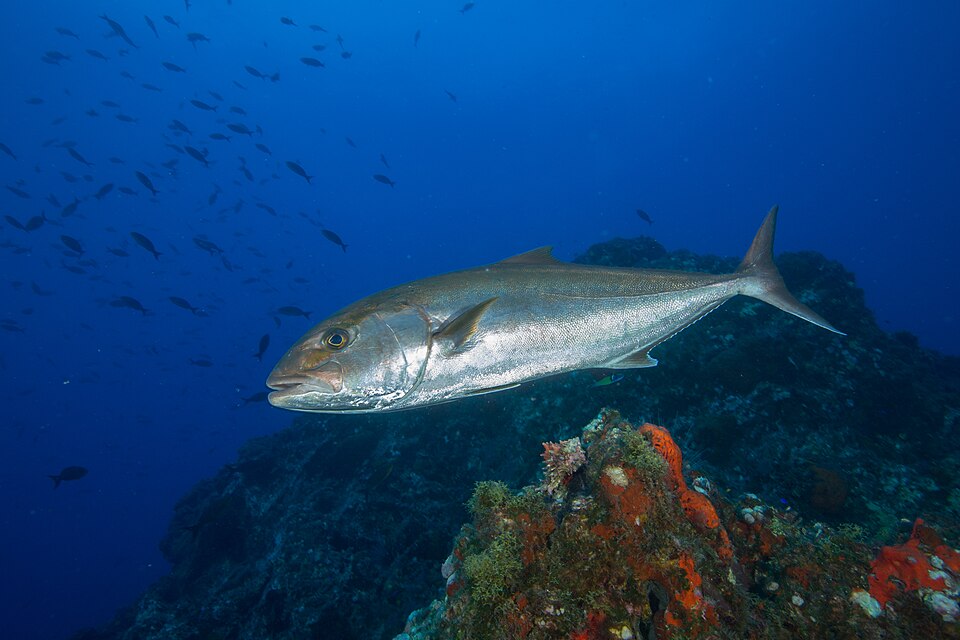
A big, brawling reef fish that lives over deep structure offshore. Amberjack fight harder than almost anything else you can hook on rod and reel, and hauling one up from a wreck will test your arms, your tackle, and your patience.
Greater amberjack are heavy-bodied, torpedo-shaped fish with a brownish to bronze back fading to silver on the sides, often with a faint amber or yellow stripe running down the flank. A dark diagonal bar runs through the eye, which is the fastest way to separate them from lookalikes. There is no true finlet like you see on tunas, and the tail is deeply forked.
The main confusion is with almaco jack and banded rudderfish. Almaco jack have a taller, more compressed body, a steeper forehead, and a longer dorsal fin lobe that sweeps back higher than an amberjack's. Banded rudderfish look almost identical to juvenile amberjack, but they stay smaller, rarely topping a few pounds, and have a shorter dorsal fin base along with more pronounced dark bars when young. Counting soft dorsal rays is the reliable way to separate the two: amberjack run higher counts than rudderfish. Greater amberjack also grow far larger than either lookalike, with adults commonly exceeding 30 pounds, which alone rules out rudderfish on anything but small fish.
The app forecasts these conditions for your spot, and learns which ones you catch on.
Season
Where it lives
Greater amberjack live around deep structure well offshore: shipwrecks, rock ledges, artificial reefs, and rocky bottom in 100 to 250 feet of water. Off North Carolina that means a run out to the Gulf Stream wrecks and live bottom areas, often 20 to 40 miles from the inlet. They hold in big schools right on top of structure, sometimes stacked from the bottom up to mid-water.
Younger amberjack sometimes show up around nearshore structure and even under floating debris or weed lines, but the real fish, the ones worth targeting, sit deep on hard bottom year-round off NC, SC, and VA.
What it eats
Amberjack eat other fish: squid, herring, small jacks, grunts, and whatever schools near the structure they live on. They are aggressive, opportunistic predators that will chase bait a long way off the bottom, which is part of why they hit jigs so hard.
How to catch it
Heavy jigging tackle is the standard approach. Drop a knife jig or bucktail straight to the bottom on a wreck, then work it back up in fast, sweeping strokes. Amberjack often hit on the drop or in the first cranks off bottom, so stay ready the moment the jig lands.
Live bait works just as well and is easier on beginners. Drop a live menhaden, cigar minnow, or pinfish on a heavy circle hook and enough weight to hold bottom over a wreck, then let the current work it. Once hooked, the fish will try to dive straight back into the structure, so you need to gain line immediately and keep steady pressure. This is not a finesse fight. You need a conventional reel with real drag capacity, 50 to 80 pound braid or mono, and the physical stamina to pump a heavy fish up from depth. There is a minimum size and closed seasons in federal waters, so check current regulations before you keep one.
- How big do greater amberjack get?
- They commonly run 15 to 40 pounds, and fish over 80 pounds have been caught. They are the largest member of the jack family found in US waters.
- What do greater amberjack eat?
- They are aggressive predators that feed on smaller fish like squid, herring, and other baitfish, plus crustaceans. They hold near wrecks, reefs, and other structure and ambush prey that swims past.
- When is the best time to catch greater amberjack?
- Spring and early summer are typically best, which lines up with their spawning season when they gather in larger numbers over deep structure. They can be caught year-round in warmer waters but fishing pressure and regulations often close seasons during peak spawning months.
- Are greater amberjack good to eat?
- The meat is firm and steak-like, good for grilling, but many anglers avoid eating large amberjack raw or as sushi because of a higher risk of ciguatera toxin in bigger, older fish from certain areas. Check local health advisories before eating one raw.
- Is there a size or bag limit on greater amberjack?
- Yes, most areas have minimum size limits, bag limits, and closed seasons during spawning months. Rules vary by region and change often, so check current regulations before you keep one.
- How hard do greater amberjack fight?
- Very hard. They are known for long, powerful runs straight back to the structure they came from, and landing a big one often means a real arm workout on stout tackle.