

Green Sunfish
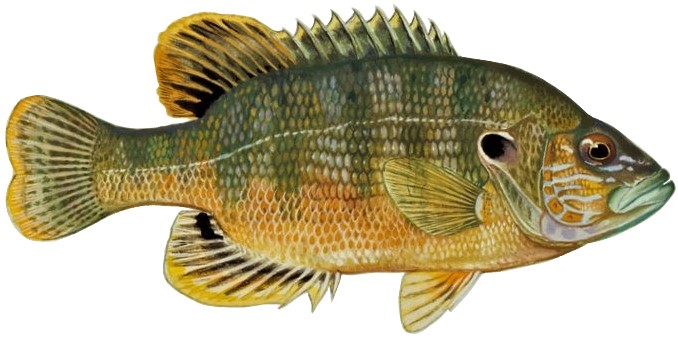
A scrappy, big-mouthed little sunfish that will eat almost anything you put in front of it. Common in small creeks and farm ponds, and a good fish for teaching a kid to cast.
Green sunfish get confused with bluegill, warmouth, and small largemouth bass, but a few features sort it out fast. Look at the mouth first. A green sunfish has a large mouth for a sunfish, with the jaw hinge reaching back to about the middle of the eye. Bluegill and pumpkinseed have small, tight mouths that stop well short of that point. Warmouth also have a big mouth, so check color and body shape next.
Green sunfish are chunky and elongated rather than the flat, saucer-shaped body of a bluegill. Color runs dark olive to blue-green on the back and sides with a brassy or yellow sheen, and the fins usually have a pale white or yellow edge, especially on the dorsal, anal, and tail fins. That white fin margin is one of the best field marks and warmouth do not have it. Warmouth also show reddish-brown streaks radiating from the eye, which green sunfish lack. The ear flap, or opercular flap, on a green sunfish is short, black, and edged in white or pale color, without the long solid black flap of a bluegill.
Green sunfish also hybridize readily with bluegill, green sunfish crosses, and other Lepomis species, so you will sometimes catch fish with mixed traits. If a fish has the deep body of a bluegill but the bigger mouth of a green sunfish, you likely have a hybrid.
The app forecasts these conditions for your spot, and learns which ones you catch on.
Season
Where it lives
Small streams, creeks, farm ponds, and the quiet backwaters of rivers. Green sunfish tolerate low oxygen, warm water, and muddy conditions better than most panfish, so you find them in places bluegill won't bother with, like isolated pools, roadside ditches, and small ponds that go stagnant in summer.
They hold tight to cover: undercut banks, rock piles, brush piles, and culvert mouths. In small creeks, look for the deepest pool within a stretch of otherwise skinny water.
What it eats
Insects, crayfish, small fish, and worms. Their mouth is bigger than a bluegill's relative to body size, so they can and will eat small minnows and even other sunfish. They feed aggressively and are not picky.
How to catch it
A worm or small piece of nightcrawler under a bobber, fished near cover, is all you need. A tiny spinner or small soft plastic jig also works well and lets you cover more water in a creek.
Green sunfish hit hard for their size and do not hesitate. In small streams, work upstream and drop your bait into every pool and undercut bank you find. They often hybridize with bluegill in ponds, so do not be surprised if a fish looks like a bit of both.
- How big do green sunfish get?
- Most run 4 to 7 inches and anything over 9 inches is a big one. They rarely top a pound, with the record fish around 2 pounds.
- What do green sunfish eat?
- They are aggressive feeders that take insects, small crayfish, worms, and small fish. Their larger mouth lets them eat bigger prey than bluegill of the same size, including small minnows and other sunfish.
- When do green sunfish spawn?
- Spawning happens in late spring through summer once water temperatures reach the mid 60s to low 70s. Males fan out shallow, gravelly nest beds near cover and will guard the nest aggressively.
- Are green sunfish good to eat?
- Yes, the meat is mild and flaky like other sunfish. They are smaller than bluegill on average, so it takes more fish to make a meal, but plenty of anglers keep and fry them.
- Why do I catch so many small green sunfish in ponds?
- Green sunfish reproduce fast, tolerate poor water quality, and outcompete other panfish in small, crowded ponds. Left unchecked they overpopulate and stunt, which is why many pond managers actively remove them.
- What is the best way to catch green sunfish?
- A small hook tipped with a worm or piece of nightcrawler under a bobber works almost anywhere they live. They hit small jigs and spinners readily too, and they are one of the easiest fish to catch for a beginner.