

Hickory Shad
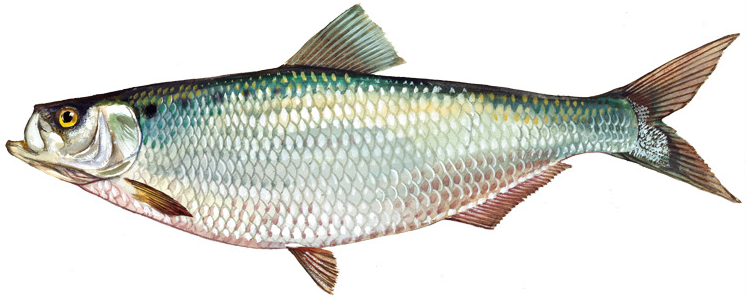
A spring migrant that runs up coastal rivers by the thousands, hits small lures hard, and jumps like a much bigger fish. Bony and not great eating, but one of the best light-tackle fights you'll find in fresh water.
Hickory shad are most often mixed up with American shad and alewives, and the mix-up matters because size and bag limits can differ. The easiest tell is the lower jaw. On a hickory shad it projects noticeably past the upper jaw, giving the fish an underbite you can see from the side. American shad and alewives have jaws that are roughly even, with the upper jaw at most just barely overlapping the lower.
Look next at the dark spot behind the gill cover. Hickory shad usually show one large spot followed by a row of smaller, dimmer spots trailing toward the tail, sometimes fading out entirely. American shad tend to have a single clear spot with little or no trailing row. Body shape helps too: hickory shad are more slender and compressed than the deeper-bodied American shad, and they run smaller overall, rarely topping three pounds. Alewives are shorter and rounder still, with a larger eye relative to head size and no strong underbite.
The app forecasts these conditions for your spot, and learns which ones you catch on.
Season
Where it lives
Hickory shad live along the Atlantic coast and spend most of the year offshore in the ocean, out of reach of anglers. Every spring they run up coastal rivers to spawn, and that run is when you can actually catch them.
In North Carolina, look for them in the Tar, Neuse, Cape Fear, and Roanoke rivers, staging below dams, rapids, and other obstructions that block their path upstream. Virginia's James, Rappahannock, and Chickahominy rivers see solid runs too, as do a number of South Carolina's coastal rivers. Fish will hold in current seams, deep pockets below riffles, and the slower water along the edges of the main flow.
What it eats
Hickory shad feed on plankton, small crustaceans, and tiny baitfish, filtering much of it out of the water column rather than chasing large prey. During the spawning run they are not actively feeding for nutrition, but they still strike out of reflex or aggression at small, flashy lures that swim through their holding water. That reflex bite is the whole reason they are catchable on rod and reel.
How to catch it
Small is the rule. Use tiny jigs, spoons, or shad darts in the quarter-ounce range or less, in white, chartreuse, or pink. A light spinning rod or a fly rod both work well. Cast up and across the current, let the lure sink, and swim it through the seam with a slow, steady retrieve or short twitches. Hits often come right as the lure swings through current breaks below rapids or dam tailraces.
Hickory shad have soft mouths, so keep your drag light and don't horse them. They jump repeatedly once hooked, which is most of the appeal. Fish tend to school tightly, so once you find them in one seam, you can often keep catching fish from the same spot for hours. Early morning and overcast days tend to fish best during the run.
- When do hickory shad run?
- They run in spring, moving from the ocean into coastal rivers to spawn, usually starting earlier than American shad in the same rivers. Timing shifts with water temperature, generally kicking off once water hits the low to mid 50s.
- What do hickory shad eat, and what should I use to catch them?
- Adults feed mostly on small baitfish, insects, and zooplankton, and they strike out of reflex and territory during the spawning run more than true hunger. Small flashy jigs, spoons, and darts in white, chartreuse, or silver work well, along with shad darts and small streamer flies.
- How big do hickory shad get?
- Most run one to two pounds, with a big one pushing three. They are smaller than American shad but put up a scrappy, jumpy fight on light tackle for their size.
- Are hickory shad good to eat?
- They are very bony, more so than American shad, and most anglers release them rather than keep them for the table. Some people smoke or pickle them to deal with the bones, but they are not a common food fish.
- What is the best time of day to catch them during the run?
- Early morning and late afternoon tend to produce best, especially around riffles, current seams, and the base of dams or other barriers where fish stack up. Overcast days can extend the good bite deeper into midday.
- Do I need a license or is there a size limit?
- Rules vary by state and even by river, and some areas restrict harvest during the spawning run to protect the population. Check local regulations before keeping any shad, since seasons and limits change year to year.