

King Mackerel
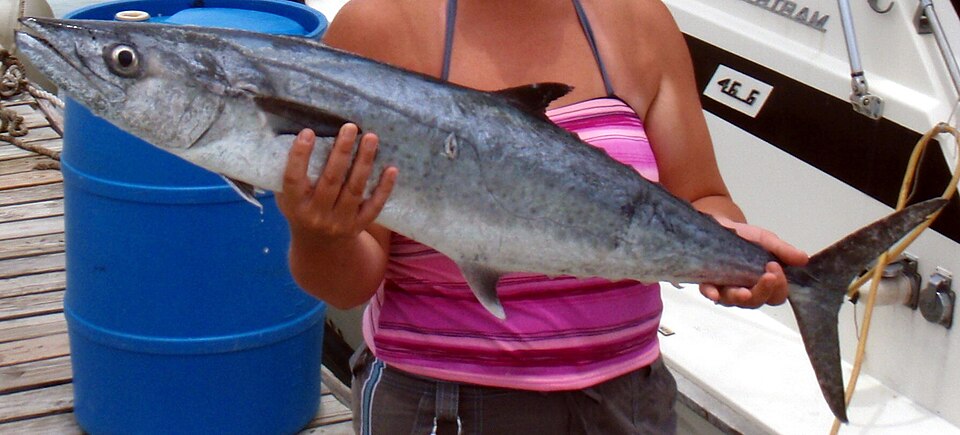
Kingfish are the reason a lot of North Carolina anglers own a bigger boat. They are fast, hard-running coastal predators that show up off the beaches and around the sounds inlets in warm months, and hooking one on light tackle is a genuine fight.
King mackerel get confused with Spanish mackerel and cero mackerel constantly, since all three share the same torpedo body and forked tail. The clearest separator is the lateral line: on a king mackerel it dips sharply in a steep curve just below the second dorsal fin, dropping straight down before running level to the tail. On a Spanish mackerel that line stays smooth and gently wavy the whole way back, with no sharp drop.
Coloring helps too, but only after you check the lateral line. Spanish mackerel show bright bronze or yellow spots scattered above and below the lateral line. Cero mackerel have a yellowish stripe running the length of the body along with faint spots. King mackerel are mostly plain silver to gray with no spots and no stripe once they reach adult size, though small kings can show faint spotting that fades with age. Kings also grow much larger, commonly reaching well over 20 pounds, while Spanish mackerel rarely top 10.
Another quick check is the front of the first dorsal fin. On a king mackerel this fin is uniformly gray to dusky, without the bold black blotch on the membrane near the front that Spanish mackerel and cero mackerel both have. That black patch on the front dorsal is one of the fastest ways to rule out a king.</identification_md"> <parameter name="faqs">[{"question": "What does king mackerel eat and what should I use for bait?", "answer": "Kings feed on baitfish like menhaden, herring, and small jacks, plus squid. Live bait fished on a stinger rig is the standard approach, though trolling spoons, plugs, and cut bait also work well."}, {"question": "When is the best time to catch king mackerel?", "answer": "Warmer months are best, when water temperatures climb into the 70s and baitfish schools move inshore and along nearshore structure. Early morning and late afternoon tend to produce the most strikes."}, {"question": "How big do king mackerel get?", "answer": "Most fish caught run 10 to 20 pounds, but kings can grow past 50 pounds. Fish over 30 pounds are usually called smokers and are prized catches."}, {"question": "Are king mackerel good to eat?", "answer": "Yes, the flesh is firm and flavorful, especially when smoked or grilled, though it is oilier than Spanish mackerel. Larger kings can carry higher mercury levels, so many anglers keep smaller fish for the table and release the big ones."}, {"question": "Do king mackerel have teeth I need to watch out for?", "answer": "Yes. They have a single row of large, razor sharp triangular teeth and will cut through light leader or careless fingers easily. Use a wire leader and handle boated fish with pliers, not your hands."}, {"question": "Where do king mackerel spawn and does that affect fishing?", "answer": "They spawn offshore in warmer months, generally from late spring through summer. Fishing often picks up just before and after the spawn as fish stage in large schools along migration routes."}]
The app forecasts these conditions for your spot, and learns which ones you catch on.
Season
Where it lives
King mackerel are a coastal pelagic species. They roam nearshore and offshore waters along the Atlantic coast, usually from just outside the breakers out to depths around 100 feet, often near structure like live bottom, artificial reefs, wrecks, and the edges of channels near inlets.
They follow bait and water temperature. In North Carolina they show up close to the beach in late spring, push out a bit as summer water warms, and stack up again near shore in fall as bait pushes out of the sounds. Cape Lookout, Cape Fear, and the nearshore reefs off Wrightsville Beach and Morehead City are classic grounds.
What it eats
Kings eat baitfish, almost exclusively. Menhaden, Spanish sardines, cigar minnows, bluefish, and small mackerel make up most of the diet. They hit hard and fast, often striking a bait or lure at speed and taking off before you even feel the full weight.
How to catch it
Live bait trolled slow near structure is the standard approach. A live menhaden, bluefish, or cigar minnow on a stinger rig, run behind a planer or on a downrigger, fished near reefs or along current lines, is how most NC boats target them. Slow-troll at just enough speed to keep the bait swimming naturally.
Dead bait trolled fast also works, especially a rigged ribbonfish or cigar minnow pulled behind a planer. If you see bait getting blown up on the surface, casting a heavy spoon or a stinger-rigged live bait into the melee can draw a strike from a cruising king.
Wire or heavy fluorocarbon leader is non-negotiable. Their teeth will cut straight through mono. Expect a screaming first run when one eats. Do not horse it. Let the drag do the work and keep the rod bent.
- How big do king mackerel get?
- Most fish caught run 5 to 20 pounds, but kings can grow well past 50 pounds. Fish over 30 pounds are usually called smokers and are considered trophy fish.
- What do king mackerel eat?
- They feed almost entirely on baitfish like menhaden, herring, sardines, and small tuna. They are fast, aggressive predators that slash through schools of bait at speed.
- When is the best time to catch king mackerel?
- Warmer months are best, since kings follow bait migrations and prefer water in the 70s. Early morning and late afternoon tend to produce the most strikes.
- Are king mackerel good to eat?
- Yes, the flesh is firm and flavorful, though it is oilier than Spanish mackerel and holds more mercury, so many anglers limit how often they eat larger fish. Smaller kings are generally milder and more popular at the table.
- How do you catch king mackerel?
- Trolling with live bait like blue runners or ribbonfish, or with spoons and diving plugs, is the standard approach. Wire leader is a must since their teeth will cut straight through mono or braid.
- Do king mackerel have any bag limits?
- Yes, most coastal states set minimum size limits and daily bag limits on king mackerel, and rules vary by region and sometimes by season. Check current regulations before you keep any fish.