

Lake Sturgeon
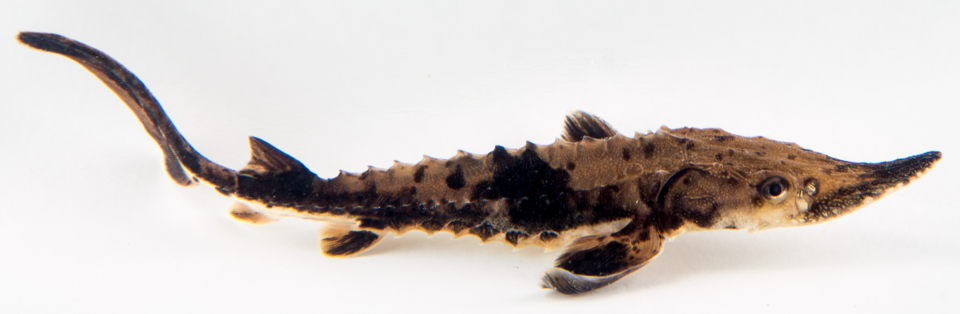
A living relic with bony plates instead of scales and a history going back to the dinosaurs. Lake sturgeon grow huge, fight slow and heavy like hauling up a log, and are tightly regulated almost everywhere, so check your local rules before you target one.
Lake sturgeon are the ancient-looking fish with a shark-like shape, bony armored plates instead of scales, and a long snout with four whisker-like barbels hanging in front of a toothless, tube-shaped mouth on the underside of the head. That mouth alone rules out almost anything else, since no other freshwater fish in their range sucks up food through a retractable tube. Their body is covered in rows of hard, bony plates called scutes running down the back and sides instead of a normal scaled skin, giving them a rough, armored feel.
The main confusion is with other sturgeon species where ranges overlap, particularly shovelnose or pallid sturgeon in big river systems. Lake sturgeon have a shorter, broader, more shovel-shaped snout than the slender pallid sturgeon, and their body is noticeably deeper and heavier bodied rather than the slim, flattened shape of a shovelnose. Coloration also helps: lake sturgeon run olive-brown to gray with a paler belly, while shovelnose tend to be more uniformly pale tan. People sometimes mistake a large lake sturgeon for a catfish at a distance because of the whiskers, but catfish have smooth skin, no bony plates, and a completely different tail shape. A sturgeon's tail is heterocercal, meaning the upper lobe is longer than the lower, similar to a shark's tail, while every catfish has a symmetrical fork.</identification_md> <parameter name="faqs">[{"question": "How big do lake sturgeon get?", "answer": "They are the largest freshwater fish in much of their range, commonly reaching 4 to 6 feet and 50 to 100 pounds, with old fish pushing past 200 pounds and 7 feet. They grow slowly and can live over 100 years."}, {"question": "What do lake sturgeon eat?", "answer": "They feed on the bottom by sucking up insect larvae, crayfish, snails, leeches, and small fish through their tube-shaped mouth. They have no teeth and rely entirely on suction and their barbels to find food by feel and smell."}, {"question": "When do lake sturgeon spawn?", "answer": "Spawning happens in spring, usually when water temperatures reach the low to mid 50s, over rocky shoals or fast rocky stretches of river. Females don't spawn every year and often skip several seasons between spawns."}, {"question": "What is the best time to target lake sturgeon?", "answer": "Spring and fall are the most productive seasons, especially around spawning runs when fish concentrate in rivers below dams or on shallow rocky reefs. Summer fishing is possible but sturgeon tend to spread out and hold deeper."}, {"question": "Are lake sturgeon good to eat?", "answer": "The meat is firm and mild and considered good table fare, but in most places lake sturgeon are protected or catch and release only because they grow and reproduce so slowly. Check local regulations before you even think about keeping one."}, {"question": "Can you legally keep a lake sturgeon you catch?", "answer": "In many states the answer is no, or only within a short, tightly controlled season with strict size and harvest limits. Populations were hit hard by historic overfishing and dam building, so always check current regulations before targeting or keeping one."}]
The app forecasts these conditions for your spot, and learns which ones you catch on.
Season
Where it lives
Big, cold, clean water. Lake sturgeon live in the Great Lakes and their connecting rivers, and in large river systems across the Upper Midwest and parts of the Mountain West. They hold deep, often thirty feet or more, over sand, gravel, or soft mud bottoms where they can root around for food.
In spring they run up tributary rivers to spawn over rock and gravel shoals, often below dams or natural falls. This is when shore anglers get their best shot at one, since the fish are concentrated and shallow for a few weeks.
What it eats
Bottom invertebrates almost entirely. Sturgeon vacuum up crayfish, insect larvae, leeches, snails, and small clams using a tube-shaped mouth that sucks food off the bottom. They have no teeth and hunt by feel, using the sensitive barbels hanging in front of their mouth to find food in murky water. They do not chase baitfish.
How to catch it
Fish on the bottom with heavy tackle. A simple bottom rig with a sliding sinker, a stout leader, and a circle hook baited with nightcrawlers or a chunk of crayfish is the standard setup. Cast it out into a deep hole or along the edge of a spawning shoal and let it sit. Sturgeon fishing is a patience game, not an active retrieve.
Use heavy line, at least 30 pound test, and a stiff rod, because these fish are strong and the fight is long even on a modest one. Many states require a special sturgeon tag or license separate from your regular fishing license, and plenty of waters are catch-and-release only or have strict slot limits. Always check your state's regulations before you keep one, since lake sturgeon are slow to mature and easy to overharvest.
- How big do lake sturgeon get?
- Lake sturgeon are the largest freshwater fish in much of their range. Many run 3 to 5 feet and 20 to 80 pounds, and old fish can top 100 pounds and 6 feet or more. They grow slowly and can live over 100 years.
- What do lake sturgeon eat?
- They feed along the bottom on insect larvae, crayfish, snails, leeches, and small fish, sucking food up through their toothless mouth. They rely on their barbels to feel out prey in murky water rather than hunting by sight.
- When is the best time to catch a lake sturgeon?
- Spring, right after ice out or during their spawning run in rivers and river mouths, is prime time since fish concentrate in shallower current. Many anglers also do well in late summer and fall fishing deep holes with bait on the bottom.
- Can I keep a lake sturgeon if I catch one?
- In most states and provinces, no, or only under very tight limits. Lake sturgeon are slow to mature and slow to recover from overfishing, so seasons, size limits, and harvest tags are common. Check local regulations before you plan on keeping one.
- What is the best bait for lake sturgeon?
- Simple bottom bait works best: nightcrawlers, leeches, cut bait, or shrimp fished on the bottom with enough weight to hold in current. Patience matters more than lure choice since these fish feed slowly and deliberately.
- Are lake sturgeon good to eat?
- Their firm, mild flesh is considered good table fare where legal to harvest, but because most populations are protected or catch and release only, almost all lake sturgeon caught today go back in the water.