

Lake Trout
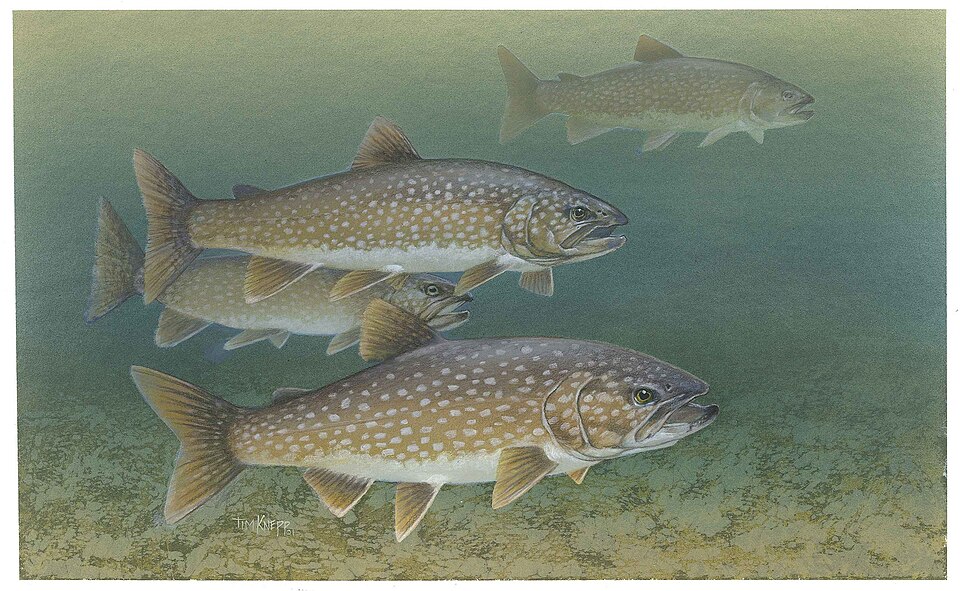
A deep, cold-water char that grows big and fights slow and heavy instead of fast. Lake trout live in the coldest, deepest lakes in the country, and catching one usually means fishing water most anglers never bother with.
Lake trout are actually a char, not a true trout, and their coloring gives it away once you know what to look for. The body is dark gray, green, or almost black, covered in light cream or white spots, never the dark spots on a lighter body you see on brown trout or rainbows. The tail is deeply forked, which separates them from brook trout and splake at a glance, since both of those have a squared-off or only slightly notched tail.
The fish most often confused with lake trout is the splake, a stocked hybrid cross between a lake trout and a brook trout. Splake have a tail that is only lightly forked, somewhere between the two parents, and their spotting pattern is less uniform, often mixing pale spots with faint worm-like markings similar to a brook trout. Lake trout also grow much larger than splake or brook trout, and their body is more torpedo-shaped and less compressed. Deep body color and habitat help too: lake trout live in cold, deep lakes and rarely show the orange or red fin edges you see on brook trout.</identification_md> <parameter name="faqs">[{"question": "When do lake trout spawn?", "answer": "In fall, usually September through November, when water temperatures drop into the 50s. They spawn over rocky reefs and shoals in the evening, and unlike most trout they do not build a nest, they just broadcast eggs into the rocks."}, {"question": "What do lake trout eat?", "answer": "Smaller fish make up most of their diet, especially ciscoes, smelt, and other baitfish, along with insects and crustaceans when they are young. Big lake trout are mostly fish eaters and often key in on whatever baitfish is most abundant in their lake."}, {"question": "When is the best time to catch lake trout?", "answer": "Right after ice-out and again in fall before spawning, they move shallow and are easier to reach. In summer they retreat to deep, cold water and you need downriggers or heavy jigging tackle to get down to them."}, {"question": "How big do lake trout get?", "answer": "Most fish caught run 2 to 10 pounds, but they live a long time and grow slowly, so lakes with light fishing pressure can produce fish over 20 pounds. The record fish caught by rod and reel have topped 70 pounds, mostly from far northern lakes."}, {"question": "Are lake trout good to eat?", "answer": "Yes, the flesh is rich and firm, ranging from white to deep orange depending on diet. Older, larger fish from some lakes can carry higher contaminant levels, so check local fish consumption advisories before eating a big one regularly."}, {"question": "Do lake trout fight hard?", "answer": "They pull hard and stay deep rather than jumping, so most of the fight happens straight down under the boat. Bigger fish in cold, deep water can test your arms and your drag before they finally come up."}]
The app forecasts these conditions for your spot, and learns which ones you catch on.
Season
Where it lives
Deep, cold, clean lakes. Lake trout are the signature fish of the Great Lakes and the big glacial lakes of the northern border states, and they also live in high, cold reservoirs and alpine lakes through the Mountain West. They need cold water and a lot of dissolved oxygen, so in summer they retreat to deep basins, often 60 to 150 feet down or more.
In early spring right after ice-out and again in late fall, lake trout move shallow, sometimes into water you can reach by casting from shore or a boat. The rest of the year they hold deep and relate to structure like sunken humps, reefs, and steep drop-offs near deep water.
What it eats
Lake trout are predators built around eating other fish. Smelt, cisco, sculpin, and small whitefish make up most of their diet in big lakes. They also eat crayfish, insects, and zooplankton when young. Big lake trout key in hard on schools of baitfish suspended over deep structure, and finding the bait usually means finding the fish.
How to catch it
In spring and fall when fish are shallow, cast or troll spoons and minnow-imitating stickbaits along rocky shorelines and points, especially early and late in the day. A slow, steady retrieve with occasional pauses works well since lake trout often hit on the fall.
Once fish go deep for summer, downrigger trolling with spoons or plugs is the standard approach, run 50 to 120 feet down along drop-offs and humps marked on your electronics. Jigging heavy spoons or blade baits straight down over deep structure also works well from a boat once you find fish stacked on a hump or ledge. Use braided line or heavy fluorocarbon since you are fishing deep and need to feel the bite. Lake trout fight slow and dogged rather than fast, so expect a long, steady pull rather than a blistering run.
- When do lake trout spawn?
- In fall, usually September through November depending on water temperature, over rocky reefs and shoals in relatively shallow water. They spawn at night and scatter eggs over the rocks rather than building a nest.
- What do lake trout eat?
- Smaller fish make up most of their diet, especially smelt, cisco, and other baitfish, along with insects and zooplankton when they are young. Adults are efficient open-water predators and will key in on whatever baitfish is most abundant in a given lake.
- What is the best time to catch lake trout?
- Right after ice-out and again in fall before the water fully cools are the easiest times, since the fish sit shallower and are easier to reach. In summer they retreat to deep, cold water and you need to fish much deeper, often 60 to 150 feet down.
- How big do lake trout get?
- Most fish caught run from 2 to 15 pounds, but lake trout are one of the longest-lived and largest freshwater fish in North America, with some lakes producing fish over 30 pounds and rare giants pushing past 50.
- Are lake trout good to eat?
- Yes, the flesh is firm and ranges from white to deep orange depending on diet, and it holds up well to smoking, grilling, or baking. Larger, older fish can carry more contaminants in some waters, so check local fish consumption advisories.
- Do I need special gear to catch lake trout?
- Not special gear exactly, but you do need a way to get baits or lures down deep, since these fish spend most of the year well below the surface. Downriggers, heavy jigging spoons, or wire line are all common ways anglers reach them once the water warms up.