

Lake Whitefish
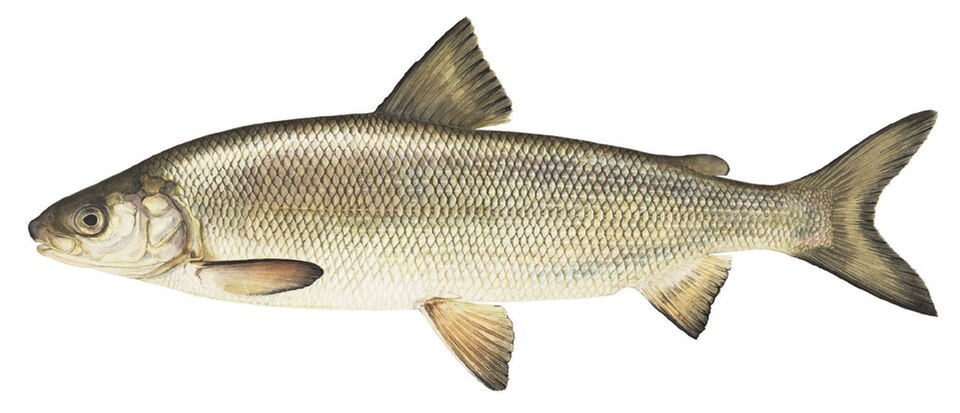
A deepwater cousin of trout and salmon, prized for its mild, delicate flesh. Lake whitefish run deep and cold, so catching one takes more precision than most beginner fish.
Lake whitefish have a silvery, torpedo-shaped body with an olive to blue-gray back and no dark spots or bars anywhere on the sides. The mouth is small and sits underneath a blunt, overhanging snout, more like a sucker's mouth than a trout's. They also have an adipose fin, the small fleshy fin between the dorsal and tail, which marks them as part of the salmon and trout family even though they do not look like either at first glance.
The main mix-up is with cisco (lake herring), which share the same silvery body and adipose fin. Cisco have a more upturned, terminal mouth built for feeding higher in the water, and a slimmer, more compressed body. Lake whitefish are chunkier through the shoulders and have that distinct underslung mouth for feeding off the bottom. Anglers also sometimes confuse small lake whitefish with mountain whitefish, but the two species do not overlap much in range, and mountain whitefish have a slightly longer, more pointed snout.
The app forecasts these conditions for your spot, and learns which ones you catch on.
Season
Where it lives
Cold, deep lakes across the Great Lakes region and the northern parts of the Mountain West and Upper Midwest. Lake whitefish spend most of the year in deep, cold water, often forty to over one hundred feet down, where they cruise near the bottom over mud, sand, or gravel.
In late fall they move into shallower rocky or gravel shoals to spawn, usually in ten to thirty feet of water close to shore. This is the one time of year they come within easy reach of shore-bound anglers. Through ice fishing season they hold near bottom over deep basins and are a common target through the ice on the Great Lakes and northern inland lakes.
What it eats
Mostly small invertebrates: freshwater shrimp, insect larvae, snails, and small clams picked off the bottom. They also eat fish eggs, including their own, during spawning runs. Lake whitefish feed by sight and smell close to bottom and rarely chase anything through open water.
How to catch it
Fish near bottom with small bait. A light jig tipped with a waxworm, maggot, or a small piece of nightcrawler, fished slowly just off the lake floor, is the standard approach through the ice. Set your line so the bait hangs a foot or less above bottom and jig it with short, subtle lifts. Lake whitefish bite light, so watch for a soft tap rather than a hard pull.
In open water, target the fall spawning run with a simple bottom rig: a small hook, light leader, and just enough weight to hold near shoals where fish are staging. Keep gear light and quiet. This is not a fast, aggressive bite, and the fish spook easily in shallow, clear water. Check your state's regulations before keeping fish, since limits and seasons vary and some waters restrict harvest to protect spawning runs.
- When do lake whitefish spawn?
- They spawn in late fall, usually October through December, over gravel or rocky shoals in shallow water once temperatures drop into the 40s.
- What do lake whitefish eat?
- Mostly insect larvae, snails, small crustaceans, and other invertebrates picked off the bottom, along with some small fish and fish eggs when available.
- What is the best time to catch lake whitefish?
- Late fall through winter is prime time, especially right before and during the spawn when they move shallow. Ice fishing over deep basins and drop-offs is one of the most productive methods.
- How big do lake whitefish get?
- Most run one to four pounds, but they can reach over ten pounds in cold, deep, productive lakes. Anything over five pounds is a solid fish.
- Are lake whitefish good to eat?
- Yes, they have firm, mild, white flesh and are considered one of the best-eating freshwater fish around. They are excellent smoked, and their roe is often used for whitefish caviar.
- Do I need any special gear to catch them?
- No. Light tackle with small jigs, spoons, or bait like waxworms and minnows works well, especially fished near bottom around structure or drop-offs.