

Largemouth Bass
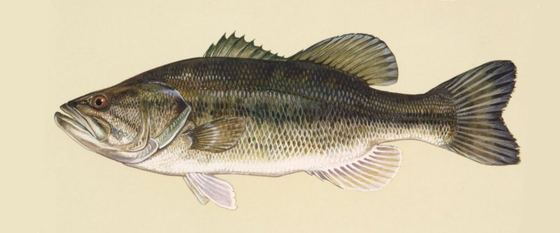
The fish most American anglers are actually after. An ambush predator that lives tight to cover, hits hard, and swims in nearly every warm pond and reservoir in the country.
The biggest tell is the mouth. On a largemouth, the upper jaw (maxilla) extends back past the rear edge of the eye. On smallmouth bass and spotted bass, it stops at or before the back of the eye. If you are staring at the fish trying to decide what you caught, this one feature settles it almost every time.
Largemouth are most often confused with spotted bass (Kentucky bass), since both can show a dark, blotchy stripe down the side and similar green-bronze coloring. Look at the dorsal fin: on a largemouth, the spiny front section and the soft rear section are nearly separate, connected by only a shallow notch, almost looking like two fins. On a spotted bass and smallmouth, that notch is shallow and the fin looks more continuous. Spotted bass also have a rough patch of small teeth on the tongue that largemouth lack, and rows of dark spots below the lateral line that largemouth don't show as clearly. Smallmouth bass are easier to rule out since they run bronze to brown with vertical bars instead of a horizontal stripe, and they lack the deep body and sagging belly profile largemouth get at larger sizes.
The app forecasts these conditions for your spot, and learns which ones you catch on.
Season
Where it lives
Warm water that moves slowly or not at all: lakes, reservoirs, ponds, and river backwaters. Largemouth relate to cover almost obsessively. Weed edges, fallen timber, dock pilings, rock piles, and the lip of a drop-off all hold fish. If you are casting into open water with nothing in it, you are usually fishing where they are not.
They move shallow to spawn in spring once the water reaches the low sixties. They hold deeper through the heat of summer, then feed hard in autumn before winter slows everything down.
What it eats
Whatever fits in the mouth. Shad, bluegill, crayfish, frogs, and big insects, plus the occasional small snake or duckling. Young bass eat insects and larvae.
What that means in practice: your lure choice matters less than putting something near cover and moving it in a way that looks alive.
How to catch it
Three approaches cover most days on the water.
A soft plastic worm on a Texas rig, cast past cover and crawled back slowly, is the most reliable way to catch a bass anywhere. It comes through weeds without fouling, it costs very little, and it works all year.
A topwater lure at dawn or dusk in summer produces the best strikes in freshwater. Work it in short twitches with long pauses. Do not set the hook when you see the splash. Wait until you feel the weight.
A spinnerbait covers water quickly in stained conditions, where a bass will hear the blade before it ever sees the lure.
- When do largemouth bass spawn?
- In spring when water temps hit the mid to upper 60s, earlier in southern regions and later up north. Males move onto shallow flats and clear out round nests near cover, then guard eggs and fry for several weeks.
- What do largemouth bass eat?
- Whatever is easiest to catch. Shad, bluegill, crawfish, frogs, and large insects make up most of their diet, and bigger bass will eat smaller bass without hesitation. Match your lure to whatever baitfish or forage is dominant in that water.
- What is the best time of day to catch largemouth bass?
- Early morning and evening are usually best, especially in summer when the water warms up fast and bass slide into deeper or shaded cover during the heat of the day. On cloudy days they will feed shallow all day long.
- How big do largemouth bass get?
- Most fish caught run one to three pounds, with a solid fish being five pounds or more. The world record is over twenty-two pounds, and fish over ten pounds are considered trophies almost anywhere.
- Are largemouth bass good to eat?
- Yes, the meat is mild and white, though most anglers practice catch and release, especially with bigger fish, since they are prized more as a sport fish than table fare. Smaller bass in the one to two pound range are better eating than large ones.
- What is the best lure for largemouth bass?
- A soft plastic worm rigged weightless or on a light jig head is about as reliable as it gets for beginners. Topwater frogs and poppers, spinnerbaits, and crankbaits all work too, depending on cover and water clarity.