

Lingcod
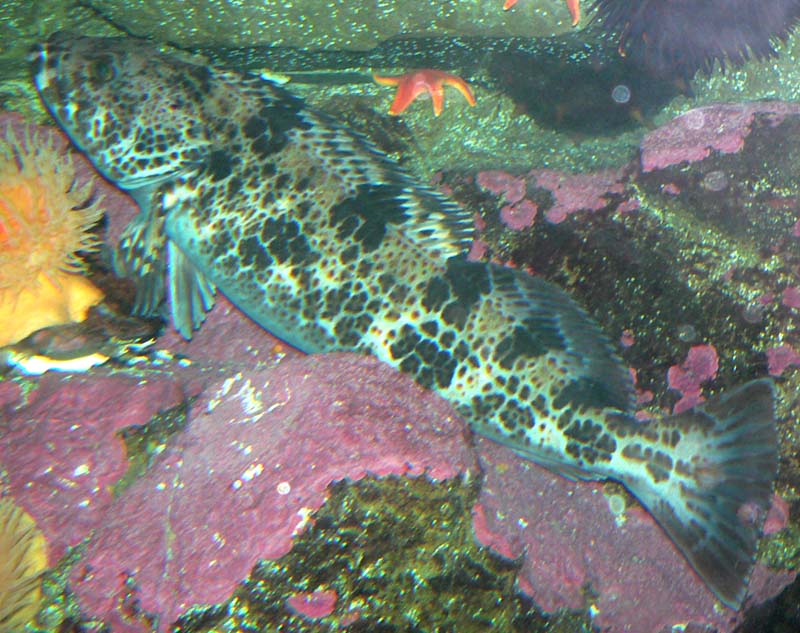
A big-mouthed, mean-looking bottom dweller from the Pacific coast that fights hard and eats well. Lingcod are not a true cod, they are ambush predators built to grab anything smaller that swims by.
Lingcod are not true cod at all, they are the biggest member of the greenling family, and their body gives that away fast. Look for a long, torpedo-shaped body, a huge mouth with sharp canine teeth, and a single continuous dorsal fin with a notch in the middle rather than two separate fins. Color runs all over the place, brown, gray, blue-green, even blue-fleshed on the inside, and they carry dark blotches or mottling that helps them blend into rocky bottom. That variable coloring is normal, not a different species.
The most common mix-up is with rockfish, especially the larger greenish or brown species. Rockfish have spiny, often venomous dorsal fins, bigger eyes relative to head size, and a smaller mouth built for picking prey off structure rather than engulfing it. Lingcod have a noticeably bigger, more toothy mouth and a longer, more streamlined body built for ambush speed. Cabezon is the other lookalike, but cabezon lack scales entirely and have a fleshy flap over each eye, while lingcod are scaled and lack that eye flap. If you catch something with a wide, tooth-filled grin and a body shaped like a torpedo, you have a lingcod.
The app forecasts these conditions for your spot, and learns which ones you catch on.
Season
Where it lives
Rocky reefs, kelp beds, and rugged bottom structure along the Pacific coast, from nearshore rock piles down to several hundred feet of water. Lingcod hold tight to boulders, ledges, and drop-offs, waiting to ambush prey rather than roaming open water.
Smaller fish are more common in shallow nearshore rock and kelp, while larger lingcod tend to sit deeper on offshore reefs and pinnacles. They do not migrate far and will stay on a productive piece of structure for a long time, which is good news once you find one.
What it eats
Lingcod eat other fish, plain and simple. Herring, small rockfish, sculpins, sanddabs, and even smaller lingcod are all fair game. They also take squid and octopus. The mouth is enormous for the body size, and they are not shy about attacking something nearly as big as they are.
How to catch it
Fish the bottom on rocky structure. A heavy jig or a big soft plastic swimbait on a leadhead, dropped straight to the reef and worked with a lift-and-fall retrieve near the bottom, is the standard approach. Bait fishermen do well with a whole herring or a large chunk of fish on a leader above a sliding sinker, fished right on the structure.
Lingcod hit hard and often follow a lure up before striking, so many anglers add a second, smaller jig or bait a few feet above the main lure to trigger a following fish. Because they hold so tight to rock, expect to lose gear. Fish heavier tackle than you think you need, both to horse them off the bottom and to handle their sharp teeth and strong jaws.
Regulations on lingcod are strict in many areas, with size limits, bag limits, and seasonal closures common along the coast. Check your state's current rules before you keep one.
- What does lingcod eat?
- Lingcod are aggressive ambush predators that eat other fish, squid, and octopus. They will hit almost anything that moves near the bottom, including fish nearly half their own size.
- When is the best time to catch lingcod?
- Fall through spring tends to produce the biggest fish, since lingcod move shallower to spawn in winter. That said, they are caught year round wherever seasons stay open, usually by jigging or bait fishing near rocky structure.
- How big do lingcod get?
- Most fish caught run 5 to 15 pounds, but they can grow past 50 pounds and over 4 feet long. Females grow larger than males.
- Are lingcod good to eat?
- Yes, lingcod are considered excellent table fare with firm, white, mild flesh. Do not be alarmed if the meat looks blue-green raw, it turns white when cooked.
- Why do lingcod have blue meat?
- The blue-green flesh color comes from a bile pigment called biliverdin and is completely harmless. It is normal, not a sign of a sick or spoiled fish, and disappears with cooking.
- Do I need to worry about regulations when keeping a lingcod?
- Yes, many areas have minimum size limits, seasonal closures, and rules protecting nesting males that guard egg masses in winter and spring. Check local regulations before you keep one, especially during spawning season.