

Longnose Gar
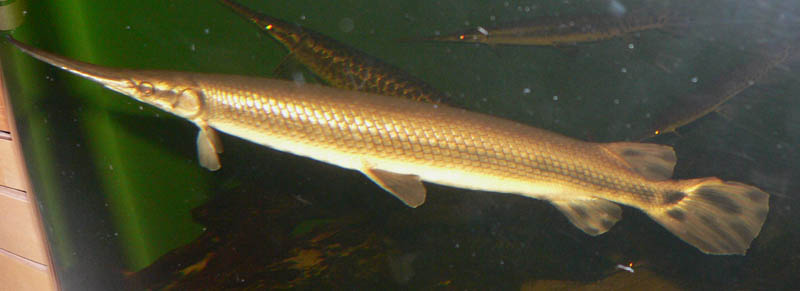
A living fossil with a spear for a snout. Longnose gar look prehistoric because they are, and they give anglers a strange, bony-mouthed fight unlike anything else in freshwater.
Longnose gar are named for the obvious feature: a thin, needle-like snout that is much longer and narrower than any other gar species. The snout is at least ten times longer than it is wide, lined with a single row of sharp teeth. This is the easiest way to separate them from spotted gar and Florida gar, both of which have shorter, broader snouts closer to the width of a broomstick rather than a pencil. Alligator gar, the other common lookalike, have a wide, alligator-like snout with two rows of teeth on the upper jaw and grow far larger overall.
Body color runs olive brown to green on the back, fading to white or pale yellow on the belly, with dark spots scattered on the rear body and fins, especially near the tail. Spotted gar carry heavier, more uniform spotting across the head and body, while longnose gar often show a cleaner head with spots concentrated toward the back half. The body itself is long and cylindrical, covered in hard, diamond-shaped ganoid scales that feel more like armor than fish skin. Juveniles have a dark stripe down the side that fades as they grow, which can cause confusion with young bowfin, but bowfin lack the elongated snout entirely and have a long, low dorsal fin running most of the length of the back, something no gar has.
The app forecasts these conditions for your spot, and learns which ones you catch on.
Season
Where it lives
Slow rivers, big lakes, reservoirs, and backwaters across the Mississippi drainage, the Gulf coastal plain, and much of the Midwest and Great Plains. They also show up in Atlantic and Gulf coastal rivers well upstream of any salt.
Gar like warm, slow-moving water and often sit near the surface in calm bays, sloughs, and river eddies. On hot still days you will see them rolling, gulping air at the surface. That air-gulping is real: gar have a primitive lung-like swim bladder and can survive in water too low in oxygen for most other fish.
What it eats
Almost entirely small fish: shad, shiners, sunfish, and whatever baitfish are thick in the area. They are ambush feeders, holding still and then sweeping that long toothy snout sideways to grab prey. They will also take shrimp or cut bait when a live target is not around.
How to catch it
The classic method uses no hook at all. Tie a length of frayed nylon rope into a small mop-like tangle, cast it out, and twitch it slowly past a gar you can see rolling or cruising. Gar teeth get tangled in the frayed rope and you can horse them in once they are caught up. This is the standard beginner rig because gar mouths are bony and hard to hook conventionally.
If you want a hooked fish, use a small strip of cut bait or a live shiner on a wire leader, since gar teeth shred mono and fluorocarbon fast. Fish it under a bobber near the surface in calm backwaters or slow river bends, especially in summer when gar sun themselves near the top. Give a long pause after the strike before you set, since gar often mouth bait sideways before turning it to swallow. Handle them carefully. Those teeth are sharp and the fight is heavy, thrashing headshakes rather than long runs.
- How big do longnose gar get?
- Most run two to four feet long. Fish over five feet and 20 pounds show up in big rivers and reservoirs, but they are less common than that size range for alligator gar.
- What do longnose gar eat?
- Almost entirely other fish. They ambush shad, sunfish, and other small baitfish with a quick sideways snap of the jaw rather than chasing prey down.
- When is the best time to catch longnose gar?
- Warm months, especially late spring through summer, when they cruise the surface in calm, slow water. Early morning and evening are prime, since gar often bask and feed near the top in low light.
- Are longnose gar good to eat?
- The meat is firm and mild and some people do eat it, but the eggs are toxic to humans and animals and must never be eaten. If you plan to keep one, handle the roe with care and dispose of it separately.
- What is the best bait or lure for longnose gar?
- A rope lure made of frayed nylon works well because the gar's teeth get tangled in the fibers instead of just striking the bait. Cut bait or a whole small fish fished under a bobber also works, since gar strike bait fish first and swallow it after a pause.
- Do longnose gar bite or hurt you if you catch one?
- Handle them carefully. Their teeth are sharp and their thrashing can cause cuts, so keep fingers away from the mouth and use pliers or a cloth to grip the jaw when removing hooks.