

Muskellunge
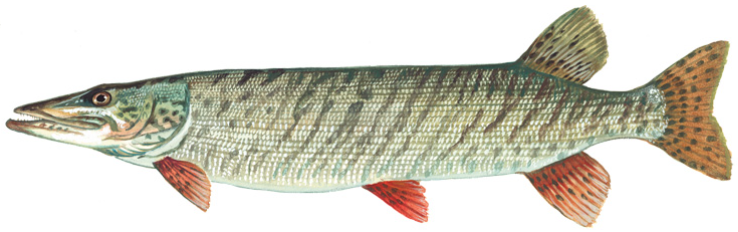
The fish of ten thousand casts, and North Carolina has a few real spots for them. A muskellunge is a long, toothy predator that tests your patience far more than your tackle.
Muskellunge get confused with northern pike constantly, and the two do hybridize into tiger muskie, which muddies things further. The fastest check is body markings. Muskie usually show dark spots or bars on a lighter body, sometimes with barely any pattern at all, while pike show light bean-shaped spots on a darker body. It is the opposite arrangement, and once you know that, the mix-up mostly goes away.
The next check is the tail and cheek. Muskie have pointed tail lobes and a cheek and gill cover that are scaled only on the top half, with the bottom half bare. Pike have rounder tail lobes and a fully scaled cheek but a gill cover scaled only on top, same as muskie, so use that feature alongside the others, not alone. Muskie also have more pores on the underside of the lower jaw, usually six to nine per side compared to four or five on a pike. Tiger muskies split the difference, showing broken, wavy vertical bars over a lighter body, and a body shape closer to true muskie.
Muskie are also frequently confused with large pickerel by beginners simply on the basis of size and shape, but pickerel top out far smaller, rarely pushing past two feet, while muskie regularly exceed three feet. Chain pickerel show a distinct dark chain-link pattern that neither muskie nor pike display.</identification_md"> <parameter name="faqs">[{"question": "When do muskellunge spawn?", "answer": "Muskie spawn in spring, shortly after ice out, when water temperatures reach the mid to upper 40s and low 50s. They scatter eggs over shallow, weedy flats and backwaters and give no parental care afterward."}, {"question": "What do muskellunge eat?", "answer": "Mostly other fish, especially suckers, perch, and whatever forage fish is most abundant in the water they live in. They are opportunistic and will also take ducklings, frogs, and small muskrats if the chance comes up."}, {"question": "When is the best time to catch a muskie?", "answer": "Fall is the classic season, when muskie feed heavily to bulk up before winter and tend to sit on predictable structure. Early morning and evening in summer, and any time around a stable weather pattern, also produce well."}, {"question": "How big do muskellunge get?", "answer": "Most fish caught run 30 to 45 inches, but they can exceed 50 inches and top 50 pounds in the right water. They are one of the largest freshwater gamefish in North America."}, {"question": "Are muskellunge good to eat?", "answer": "They can be eaten, but almost everyone releases them. Muskie are slow growing and hard to catch, so most fisheries depend on catch and release to keep populations of big fish around."}, {"question": "Why are muskies called the fish of ten thousand casts?", "answer": "Because they are low in number compared to other predator fish and notoriously reluctant to strike, often following a lure right to the boat without committing. Persistence matters more with muskie than with almost any other freshwater species."}]
The app forecasts these conditions for your spot, and learns which ones you catch on.
Season
Where it lives
In North Carolina, muskies live in a handful of cool mountain and piedmont rivers and reservoirs, most notably the New River and its tributaries. They want clear, cool, moving water with deep pools, log jams, and rock ledges nearby. In lakes they hold along weed edges and drop-offs close to deep water.
They are ambush predators that claim a stretch of structure and sit in it for long periods. A good muskie spot often holds the same fish for weeks or months at a time.
What it eats
Almost entirely other fish. Suckers, chubs, small bass, and panfish make up most of the diet, along with the occasional frog or small muskrat. Muskies feed in short, aggressive bursts and then go quiet for long stretches, which is a big part of why they are hard to catch.
How to catch it
Big lures for a big, patient fish. Bucktails, large jerkbaits, and swimbaits in the 8 to 12 inch range are standard. Cast tight to log jams, current breaks, and deep rock structure, then work the lure back with an erratic retrieve. Many strikes come as a "figure eight" follow right at the boat or bank, so finish every retrieve by sweeping the lure in a slow figure eight before lifting it out.
Use wire or heavy fluorocarbon leader. Muskie teeth cut straight through mono. Expect long stretches with nothing, then one violent strike. Fall, when water cools and fish feed heavily before winter, is the most consistent time to connect in North Carolina.
- placeholder
- placeholder