

Northern Pike
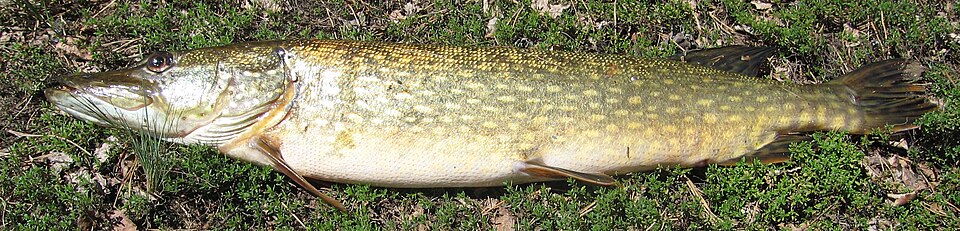
A long, toothy ambush predator that looks like a swimming log until it hits. Northern pike pull hard, bite through weak line, and reward anglers willing to fish cold, weedy water.
Northern pike get mixed up with muskellunge and chain pickerel, and telling them apart matters because size potential and regulations differ a lot. The easiest check is the cheek and gill cover scaling. On a northern pike, the cheek is fully scaled but only the top half of the gill cover has scales, the bottom half is bare. A muskie has the opposite pattern, only the top half of the cheek is scaled and the gill cover is mostly bare. Pickerel have both cheek and gill cover fully scaled.
Color is the second clue. Northern pike have light bean-shaped or oval spots scattered on a darker green-bronze body. Muskies usually show the reverse, dark spots or vertical bars on a lighter body, though some muskies run almost plain and spotless. Chain pickerel are smaller and have a distinct dark chain-link pattern across a lighter green-gold body, and they rarely top a couple feet in length while pike and muskie both grow much larger. Fin count on the tail also helps in tough cases, pike have fewer sensory pores on the underside of the jaw than muskie, but for most anglers the cheek and gill scaling is the fastest field check.
The app forecasts these conditions for your spot, and learns which ones you catch on.
Season
Where it lives
Cold and cool water lakes and rivers across the northern tier of the country: the Great Lakes region, the upper Midwest, the Mountain West, and Alaska. Pike want vegetation. Look for weed beds, weed edges, and slow backwaters with cover close to deeper water.
In spring they move into shallow, weedy bays to spawn right after ice out, often in water barely deep enough to cover their backs. As water warms in summer they slide toward weed lines and deeper pockets, then push shallow again in fall to feed heavily before winter.
What it eats
Pike eat other fish, and they eat them whole. Perch, shad, suckers, smaller pike, plus frogs, mice, and the occasional duckling. They are ambush feeders, holding motionless in weeds until something swims within range, then striking with a burst of speed.
How to catch it
Use wire or heavy fluorocarbon leader. Pike have a mouth full of sharp teeth and will cut straight through plain mono. Large spoons, spinnerbaits, and jerkbaits worked along weed edges and over the tops of submerged grass draw strikes, especially in fall when pike feed aggressively before winter.
Dead bait or a large sucker suspended under a float near weed edges is a slower, very effective method, particularly through the ice. Retrieve fast enough to keep a lure just above the weeds rather than fouled in them, and expect the hit to come as a sudden, heavy stop rather than a tap. Check your state's regulations, since many waters have slot limits or catch-and-release rules on pike to protect trophy fish.
- When do northern pike spawn?
- Right after ice-out in early spring, often in water barely warmer than 40 degrees. They move into shallow, weedy bays and flooded vegetation to spawn, sometimes in water only a foot or two deep.
- What do northern pike eat?
- Mostly other fish. They ambush perch, suckers, shad, and smaller pike, and they will also take frogs, crayfish, and even small ducklings or muskrats if the chance comes up. They are opportunistic and will hit almost anything that moves and looks like food.
- What's the best time to catch northern pike?
- Right after ice-out and again in fall are the two best windows, when pike feed heavily in shallow water. In summer they often move deeper or into weed edges to escape heat, so early morning and evening produce better than midday.
- How big do northern pike get?
- Most fish caught run 2 to 5 pounds, with a solid pike being 8 to 15 pounds. Trophy fish over 20 pounds exist in cold, food-rich waters, but they take years to grow that big and are usually released.
- Are northern pike good to eat?
- Yes, the meat is firm and mild, but pike have a set of small Y-shaped bones in the fillet that take practice to remove. Many anglers learn a specific boneless filleting cut just for pike.
- Do I need to worry about pike's teeth when handling them?
- Yes. Pike have a mouth full of sharp teeth and can thrash hard boatside. Use a jaw spreader or long-nose pliers to unhook them, and consider a glove if you plan to hold one by the jaw.