

Permit
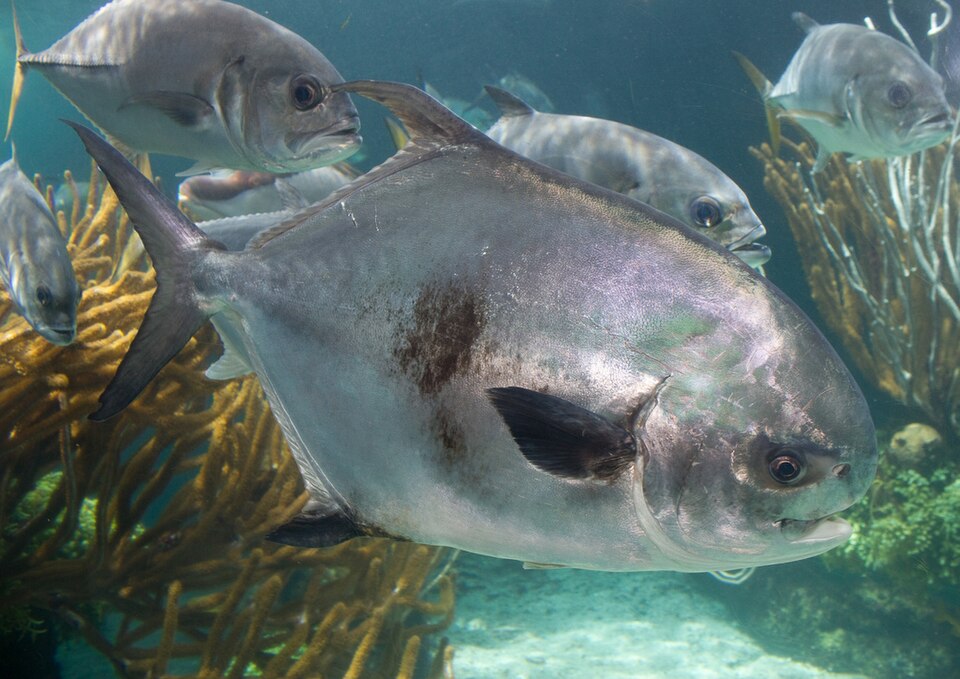
A silver, deep-bodied flats ghost that will break your heart before it breaks your line. Permit are one of the hardest inshore fish to fool, and landing one on purpose is a real achievement.
Permit get confused with pompano constantly, and on the flats they get confused with juvenile black drum too. Permit are deep-bodied and heavily compressed, almost circular in outline, with a steep blunt head profile and a small mouth set low for crushing crabs. Pompano share that same silvery, deep body shape but stay smaller, rarely topping a few pounds, and their body is more elongated and less disc-shaped than a permit's. The dorsal and anal fins on a permit sickle out much longer and more dramatically than on a pompano, especially as the fish matures.
Color is another tell. Permit are mostly silver with a chrome or brassy sheen, and many fish carry a dark blotch on the side near the pectoral fin or a dusky patch on the belly. Pompano tend to show more yellow or orange wash on the fins and belly. On the flats, tailing permit get mistaken for black drum, but drum have barbels under the chin and a duller, bronze-gray color, while permit have no barbels and a bright, flat-sided, mirror-like body. Look at the fork of the tail too. A permit's tail is deeply forked with long pointed lobes, more sickle-shaped than a pompano's shorter, stubbier fork.
The app forecasts these conditions for your spot, and learns which ones you catch on.
Season
Where it lives
Permit live on shallow tropical and subtropical flats, along the Gulf coast and the southern Atlantic coast, wherever warm, clear water meets sand, grass, or coral rubble. They cruise skinny water in singles, pairs, or small schools, often tailing in water barely deep enough to cover their backs.
Beyond the flats, permit hold around nearshore wrecks, reefs, channel edges, and passes, especially in cooler months when they move off the skinny stuff into deeper structure. Look for them on falling tides over sandy potholes near mangroves, where crabs get pushed out of the grass.
What it eats
Crabs are the main event, especially small crabs, and permit will tail furiously over a patch of bottom crawling with them. They also eat shrimp, small baitfish, sand fleas, and other crustaceans they can root out of the sand or pick off structure.
How to catch it
A live crab, cast well ahead of a tailing or cruising fish and left to sink naturally, is still the best bait there is. Small blue crabs or sand fleas on a light fluorocarbon leader work best, and you want the bait to hit bottom without a splash that spooks the fish. Sight-fishing from a poled skiff or by wading is the standard approach, and it takes patience. Permit spook easily and refuse far more than they eat.
Fly anglers use small, sparse crab patterns cast a few feet in front of a moving fish, stripped just enough to look alive. Around wrecks and reefs, jigs tipped with cut bait or live shrimp fished near bottom will pick up permit that are not up on the flats. Expect long runs and a fight that outlasts most inshore species. Many anglers release permit to keep them biting for the next angler, and size and bag limits are tightly regulated in most states, so check your local rules before keeping one.
- What do permit eat?
- Crabs are the main course, especially small crabs on flats and around structure, but permit also eat shrimp, small baitfish, and sand fleas. Their small, tough mouths are built for crushing shellfish, which is why crab patterns and live crabs work so well.
- How big do permit get?
- Most permit caught inshore run 5 to 20 pounds, but they can grow past 40 pounds in deeper water around wrecks and reefs. A 20-pound permit is a genuine trophy on fly or light spinning tackle.
- When is the best time to catch permit?
- Warm months are best, since permit are most active and push onto shallow flats when water temperatures climb. Many anglers target them on calm, sunny days when tailing or cruising fish are easiest to spot in skinny water.
- Are permit good to eat?
- Yes, the flesh is firm and mild, but most permit caught on flats are released because they are prized as a sight-fishing target and are slow growing. Offshore fish taken around wrecks are more commonly kept.
- Why are permit considered hard to catch?
- They spook easily, feed selectively, and often ignore flies or baits that look slightly off. Getting a good presentation without alerting the fish is the real challenge, which is why permit have a reputation as one of the toughest inshore gamefish.
- Do permit spawn on the flats where anglers catch them?
- No, permit spawn offshore near reefs and structure in open water, usually during warmer months. The fish anglers sight-fish on shallow flats are there to feed, not to spawn.