

Pink Salmon
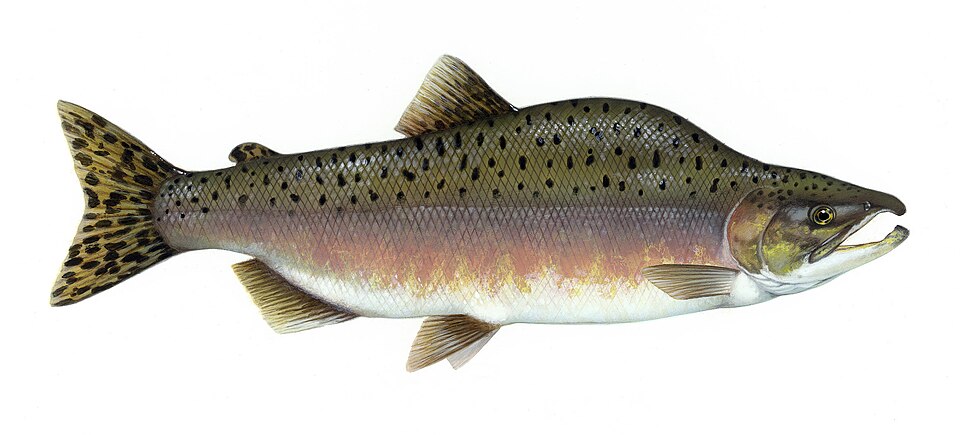
The smallest and most abundant Pacific salmon, running in massive numbers on odd-numbered years. A great target for anglers who want a hard-fighting salmon without a lot of gear or expense.
Pink salmon are the smallest Pacific salmon, and most confusion comes from mixing them up with chum or coho salmon when they are fresh from salt water. In the ocean or right at the mouth of a river, pinks are bright silver with a slim body, small scales, and large oval black spots on the back and on both lobes of the tail. Chum and coho also carry spots, but coho only spots the top of the tail, not both lobes, and chum have no spots at all. That tail pattern, big black ovals covering the whole tail fin, is the fastest way to separate a pink from anything else in the water.
Once pinks move into rivers to spawn, males change dramatically. They grow a huge humped back and a hooked, snaggle-toothed jaw, which is why they are commonly called humpies. This body shape is far more exaggerated than the mild hooking you see on spawning coho or chinook, and no other common salmon develops a hump like it. Spawning females turn olive and blotchy but keep the tail spotting and stay slimmer than the males. Pinks also run smaller than every other Pacific salmon except maybe a small chum, usually three to five pounds, so size alone is a decent clue when everything else is muddy.
The app forecasts these conditions for your spot, and learns which ones you catch on.
Season
Where it lives
Pink salmon live in the North Pacific and spawn in coastal rivers and streams from the Pacific Northwest up through Alaska. They spend most of their two-year life in saltwater, feeding along the coast, then return to their home streams to spawn and die, the same as other Pacific salmon.
Runs are strongest in odd-numbered years across most of their range, though some far northern rivers see decent even-year runs too. You will find them staging near river mouths and tidewater before pushing upstream, often in water so thick with fish you can see their backs breaking the surface.
What it eats
In saltwater, pink salmon feed on zooplankton, small crustaceans, and baitfish like herring and sand lance. Once they enter freshwater to spawn, they stop feeding entirely. Any bites you get on the river come from aggression or reflex, not hunger, which is why bright, flashy lures worked right in front of their face get more strikes than anything meant to look like real food.
How to catch it
In saltwater or river mouths, troll or cast small spoons and spinners in pink and silver. Pink is not a color choice by accident here, these fish respond to it more than almost any other salmon species.
Once pinks are staging in rivers, light spinning tackle with a small pink or chartreuse jig under a float works well. Cast across the current and let the jig swing through pods of fish, twitching it as it drifts. A bare hook wrapped in pink yarn can outfish an expensive lure on a crowded day. Because pinks stop feeding in freshwater, keep your presentation small and quick rather than working an area slowly.
Pink salmon fight hard for their size and are excellent on light tackle. Check your state and river-specific regulations before you go, since limits and open sections change year to year and some systems are closed to protect spawning fish.
- When do pink salmon run?
- Pink salmon spawning runs happen in a fairly predictable two-year cycle, typically in odd or even years depending on the river system, and run timing falls in summer through early fall. Check local reports for your specific river, since the cycle year matters more than the calendar for pinks.
- What do pink salmon eat, and what should I use to catch them?
- In salt water they feed on small baitfish, plankton, and shrimp-like crustaceans, but once they enter rivers to spawn they stop feeding altogether. River fish are caught on reaction strikes, so small pink or chartreuse jigs, spinners, and flies work better than anything meant to imitate a meal.
- How big do pink salmon get?
- They are the smallest Pacific salmon, usually three to five pounds and 20 to 25 inches long. A big one might push seven or eight pounds, but anything larger is unusual.
- Are pink salmon good to eat?
- Yes, especially when caught fresh from salt water before they start spawning. The flesh is lighter and softer than other salmon, which is why most commercial pink salmon ends up canned, but a fresh-caught one grilled or smoked the same day is good eating.
- Is it true pink salmon runs only happen every other year?
- In most river systems, yes. Pink salmon have a fixed two-year life cycle, so a given river usually sees a strong run only in odd or even years, with the off years producing few or no fish.
- Why do male pink salmon get that big hump on their back?
- It develops as they enter fresh water to spawn, along with a hooked jaw, and it is thought to help them compete for mates and defend spawning space. The hump is the most extreme of any Pacific salmon, which is where the nickname humpy comes from.