

Pollock
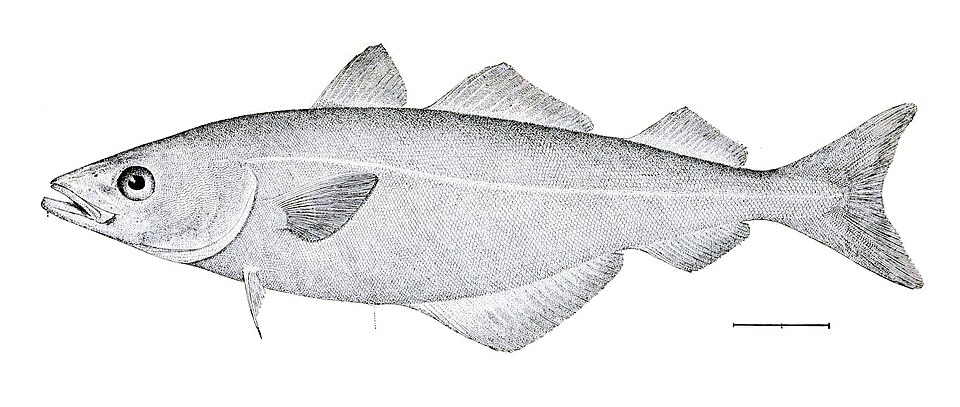
A hard-fighting cousin of cod that schools over rocky bottom and open water alike. Pollock hit lures aggressively and pull well above their weight, making them a favorite target off the Northeast coast.
Pollock get mixed up with Atlantic cod and haddock since all three share the same waters and a similar body shape. The easiest tell is the lower jaw: pollock have a lower jaw that juts out past the upper jaw, while cod and haddock have the opposite, a chin barbel and an upper jaw that overhangs. Pollock also lack that barbel entirely, or show only a tiny stub of one, whereas cod carry an obvious whisker under the chin.
Color is another giveaway. Pollock run olive green to dark bronze on the back with a lighter, silvery gray belly, and the lateral line is pale and sits high on the body before curving down. Haddock have a straight black lateral line and a dark thumbprint patch above the pectoral fin that pollock never show. Cod are more mottled brown or gray with a straighter, less forked tail than pollock, which have a noticeably forked tail similar to a mackerel's, another quick way to separate them from their slower, blunter-tailed cousins.
The app forecasts these conditions for your spot, and learns which ones you catch on.
Season
Where it lives
Pollock live in cold saltwater along the North Atlantic coast, from the Gulf of Maine north into Canadian waters. Anglers find them around rocky ledges, offshore banks, wrecks, and current-swept points, often suspended well off the bottom rather than hugging it like cod.
Smaller pollock, sometimes called harbor pollock, show up closer to shore around piers, breakwaters, and rocky shorelines, especially in fall. Larger fish stay offshore over structure in deeper water, from fifty to several hundred feet down.
What it eats
Pollock feed on small baitfish like herring and sand eels, along with squid and small crustaceans. They are active, fast-swimming predators that chase schools of bait through the water column, which is why they respond so well to jigs and lures worked with speed.
How to catch it
Jigging is the standard method. Drop a diamond jig or a heavy metal jig to the bottom near structure, then work it up through the water column in sweeping lifts, since pollock often hold well above the seafloor. Bucktail jigs tipped with a strip of squid also work.
From shore or a pier, cast a metal spoon or jig and retrieve it steadily, varying the speed until you find what triggers strikes. Pollock fight hard and dive for structure, so use a rod with enough backbone to turn a fish before it wraps you around a rock or wreck. Fall through early winter is prime time as fish move closer to shore, while summer fishing tends to be better offshore over deeper banks.
- How big do pollock get?
- Most pollock caught by anglers run 3 to 10 pounds, but they can grow past 30 pounds in deeper offshore water. Anything over 15 pounds is a genuinely good fish.
- What do pollock eat?
- Pollock feed on small baitfish like herring and sand eels, along with shrimp and other crustaceans. They are aggressive feeders and will chase jigs and baits well up in the water column, not just on the bottom.
- When is the best time to catch pollock?
- Pollock bite well in cooler months, from fall through spring, and they often feed hardest early in the morning or right at dusk. In summer they push into deeper, colder water, so you usually have to fish deeper to find them.
- Are pollock good to eat?
- Yes, pollock have mild, firm white flesh and are a common choice for fish and chips, fish sticks, and other white fish dishes. The flavor is a little stronger than cod but still mild enough for most tastes.
- Do pollock school near the bottom or up in the water column?
- Both, depending on conditions. Younger, smaller pollock often suspend well off the bottom chasing baitfish, while larger fish tend to hold closer to structure like wrecks, ledges, and rock piles near the bottom.
- Are there size or catch limits on pollock?
- Limits vary by location and change from year to year, so check current regulations before you keep any. Pollock populations are generally healthier than cod, but rules still apply in most areas.