

Pumpkinseed
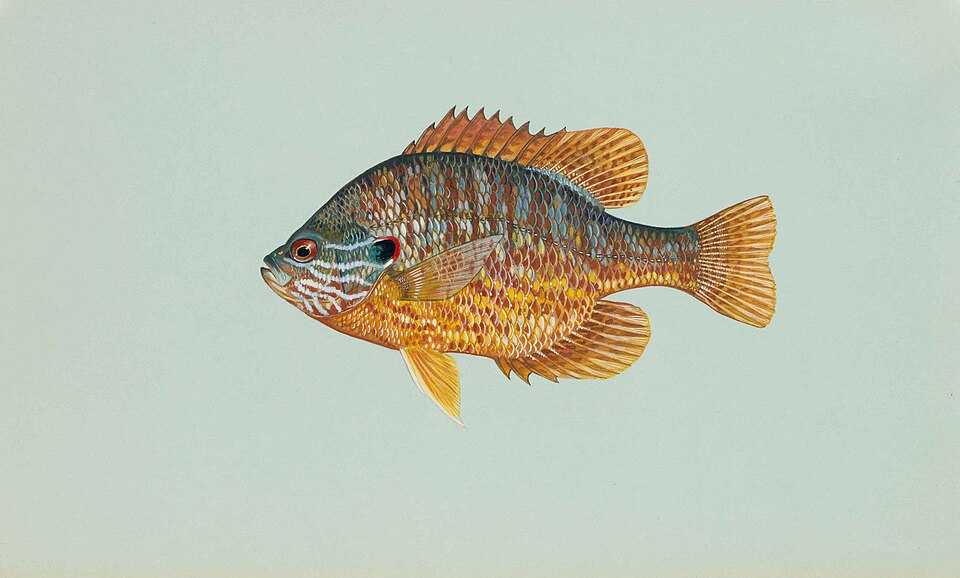
A small, brightly colored sunfish that looks like someone painted a bluegill with a leftover set of watercolors. Easy to catch and a good fish for teaching a kid to fish.
Pumpkinseed are the most colorful of the common sunfish, and that coloring is the fastest way to sort them out. Look at the gill cover: the ear flap is short, stiff, and black, with a bright red or orange crescent right on the tip. No other common sunfish has that red mark. The body is deep and round like a saucer, olive to gold with a wash of orange spots and wavy blue-green lines across the cheek.
Bluegill are the usual mix-up. Bluegill also have a dark ear flap, but it is solid black with no red edge, and bluegill run more silver-blue overall with a dark blotch at the back of the dorsal fin, which pumpkinseed lack or show only faintly. Green sunfish get confused too, but green sunfish have a longer, more torpedo-shaped body, a bigger mouth, and no red on the ear flap. Redbreast sunfish also show orange on the belly, but their ear flap is long and narrow rather than short and rounded, and it stays black without the red tip. When in doubt, that little red crescent on a short black ear flap is the pumpkinseed's signature and nothing else has it.
The app forecasts these conditions for your spot, and learns which ones you catch on.
Season
Where it lives
Cool, clear ponds, lakes, and slow streams with plenty of weeds. Pumpkinseed like vegetation more than most sunfish and are less common in muddy or heavily stained water. In North Carolina and Virginia they turn up most often in mountain and piedmont ponds, spring-fed lakes, and quiet stretches of clear streams.
Look for them around weed beds, docks, and submerged brush in water three to eight feet deep. In spring they move onto shallow gravel or sand flats to spawn, often mixed in with bluegill beds.
What it eats
Insects, snails, small crustaceans, and tiny aquatic worms. Their throat teeth are built for crushing snails, so they spend a lot of time picking through weed beds rather than chasing baitfish. They feed mostly by sight during daylight hours.
How to catch it
A worm or a piece of nightcrawler under a small bobber, fished right along weed edges or dock pilings, will catch pumpkinseed all day. Keep the bait small and close to structure rather than out in open water.
In late spring, look for spawning beds in the shallows near bluegill colonies. A small jig or a bit of worm dropped right into the bed will draw quick bites. Ultralight tackle makes the fight worthwhile since pumpkinseed rarely grow large, but they hit with more attitude than their size suggests.
- How big do pumpkinseed get?
- Most run four to eight inches, and anything over nine inches is a big one. They rarely top a pound, but they are thick-bodied for their length and fight harder than their size suggests.
- When do pumpkinseed spawn?
- Spawning happens in late spring into early summer once water warms into the mid 60s. Males fan out shallow, saucer-shaped beds in sand or gravel along the shoreline and guard them, which makes bedding fish easy to spot and easy to catch.
- What do pumpkinseed eat?
- Small insects, larvae, worms, and snails make up most of their diet. Their crushing throat teeth are built for snails and other shelled prey, which is part of why they do well in weedy, snail-rich ponds.
- What is the best bait for pumpkinseed?
- A small piece of worm under a bobber is hard to beat. Tiny jigs, small poppers, and micro spinners also work well, especially fished around docks, weed edges, and shallow cover.
- Are pumpkinseed good to eat?
- Yes. The meat is mild, white, and flaky like other sunfish, though the fillets are small given the fish's size. Most anglers keep a mess of them along with bluegill for a fish fry.
- Are pumpkinseed easy to catch?
- Yes, they are one of the easiest freshwater fish to catch and a common first fish for beginners. They bite readily, stay shallow much of the year, and hold around visible cover like docks, weeds, and fallen trees.