

Redbreast Sunfish
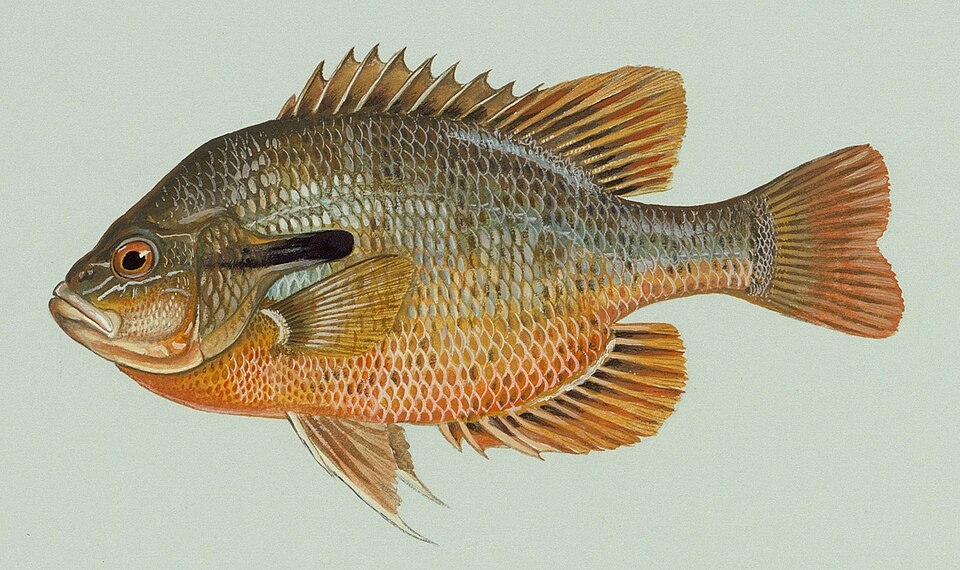
A river specialist most people mistake for a bluegill until it flowing water in the country and mistakes their fest for it. Look for it in the moving water of Piedont and Carolina coastal plain and piedmont rivers, where it out-competes bluegill for the best current-washed cover.
Redbreast sunfish get mixed up with pumpkinseed and bluegill, since all three are round, flat-sided panfish with the same basic sunfish shape. The giveaway on a redbreast is the ear flap: it is long, narrow, and solid black, often with a pale edge, and it lies flat against the body instead of flaring out. Pumpkinseed have a short, stiff ear flap that is black with a bright red or orange spot on the tip, and their sides are covered in wavy blue-green lines and orange speckles that redbreast lack.
Bluegill are the other common mix-up, especially on smaller fish. Bluegill have a short, rounded ear flap that is solid black but stubby, not the long strap-like flap of a redbreast, and bluegill show a dark blotch at the back of the dorsal fin that redbreast do not have. Male redbreast in spawning color also show a bright orange-red breast and belly, which is where the name comes from, while bluegill run more yellow to purple on the underside. Mouth size is another clue: redbreast have a slightly larger mouth than bluegill or pumpkinseed, closer to what you would expect on a small bass.
The app forecasts these conditions for your spot, and learns which ones you catch on.
Season
Where it lives
Redbreast sunfish are a river fish first and a pond fish a distant second. They live in the current seams, undercut banks, and root wads of small to medium rivers and creeks across the Carolinas and Virginia, especially in the coastal plain and piedmont. You will also find them below dams, along rocky bluffs, and in the deeper pools of blackwater rivers like the Lumber, the Black, and the Tar.
They do turn up in a few reservoirs and ponds with good current or spring inflow, but a slow-moving river or creek with sandy or rocky bottom is the classic spot. In spring they move onto shallow gravel and sand flats near the bank to spawn, often in the same colonies bluegill use, but usually a little further upstream where the current still runs.
What it eats
Aquatic insects and their larvae make up most of the diet, along with small crustaceans, worms, and tiny minnows. Redbreast hold in current and pick off food drifting past, which is why they respond so well to a bait or lure presented with a natural drift instead of one sitting still.
How to catch it
A worm or cricket under a small float, drifted along a current seam or past a laydown, is the standard rig and it works. Cast upstream of the cover and let the current carry the bait naturally past it rather than casting straight to the target.
Ultralight spinning gear with small inline spinners or tiny jigs also produces well, especially in spring when fish are shallow and aggressive around spawning beds. Fish these upstream and let them swing through current the same way you would a fly. In the Carolinas and Virginia, a small popper or wet fly on a light fly rod is a favorite approach on rivers like the Broad, the Saluda, or the Roanoke, worked tight to undercut banks and rock edges.
- How big do redbreast sunfish get?
- Most run 4 to 7 inches, with a big one pushing 9 to 10 inches and close to a pound. Anything over half a pound is a genuinely good fish for this species.
- When do redbreast sunfish spawn?
- They spawn in late spring through summer once water warms into the mid 60s to 70s. Males fan out shallow, sandy or gravelly nests near cover and guard them, which makes bed fishing easy during this stretch.
- What do redbreast sunfish eat?
- Insects, larvae, small crustaceans, and tiny minnows make up most of their diet. They feed heavily on whatever is drifting through current in a river, which is why they hold near seams and undercut banks.
- What is the best bait or lure for redbreast sunfish?
- Live worms and crickets under a small bobber are hard to beat. Small spinners, tiny jigs, and dry or wet flies also work well, especially since redbreast are common targets for light fly tackle in rivers.
- Are redbreast sunfish good to eat?
- Yes, they have firm, mild white meat and are considered one of the better tasting panfish. Because they run small, most anglers keep a mess of several to make a meal worthwhile.
- Where do you find redbreast sunfish, lakes or rivers?
- Rivers and streams are their preferred water, more so than most other sunfish, which tend to favor ponds and lakes. Look for them along current seams, rocky runs, undercut banks, and slower pools next to faster water.