

Redfin Pickerel
A small, needle-toothed ambpredator that hushambush in creek backins and swamp margins. Rare on NC anglers seek out on purpose, but it's a fun light-tackle catch when comes with your fish surprise.
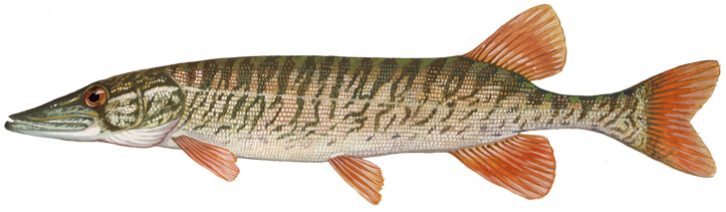
Redfin pickerel are the smallest member of the pike family, usually topping out under 14 inches, and that small size is often the first clue to their identity. They have the same duck-bill snout and single dorsal fin set far back as their bigger cousins, but they lack the distinct chain-like markings of a chain pickerel. Instead, look for a dark, teardrop-shaped bar under the eye and wavy or bar-like markings along the sides that run vertically rather than forming a connected chain pattern. Fins are often washed with orange or red, especially the lower fins, which is where the name comes from.
The most common mix-up is with a young chain pickerel, since juvenile chain pickerel have not fully developed their chain pattern yet. Check the cheek and gill cover: both are fully scaled on a redfin pickerel, while a chain pickerel has a scaled cheek but only a partly scaled gill cover. Body shape helps too. Redfin pickerel are more slender and rounded in cross section, while chain pickerel and northern pike grow noticeably longer and more torpedo-shaped. If the fish is over 15 inches, it is not a redfin pickerel.</identification_md"> <parameter name="faqs">[{"question": "How big do redfin pickerel get?", "answer": "Most run 6 to 12 inches, with a big one pushing 14 inches. Anything larger is almost certainly a different species of pickerel or a young pike."},{"question": "What do redfin pickerel eat?", "answer": "Small fish, insects, crayfish, and tadpoles. They are ambush feeders that dart out from weeds and cover to grab prey rather than chasing it far."},{"question": "When do redfin pickerel spawn?", "answer": "In late winter to early spring, often right after ice out or as water temperatures climb into the 50s. They scatter eggs over vegetation in shallow, quiet water and provide no care for them afterward."},{"question": "Are redfin pickerel good to eat?", "answer": "They are edible but small and bony, so most anglers release them rather than clean them for the table. Their real value is as a scrappy light-tackle target and forage species for bigger predators."},{"question": "What is the best way to catch a redfin pickerel?", "answer": "Light tackle and small lures work best: tiny spinners, small soft plastics, or a bit of worm fished near weed edges, sluggish streams, and swamp margins. They hit hard for their size and are common bycatch when panfishing in the right water."},{"question": "Are redfin pickerel the same as chain pickerel?", "answer": "No, they are a separate species. Redfin pickerel stay much smaller and lack the bold chain-link pattern of an adult chain pickerel, though young chain pickerel can look similar until that pattern fills in."}]
The app forecasts these conditions for your spot, and learns which ones you catch on.
Season
Where it lives
Redfin pickerel live in slow, tannin-stained creeks, swamp margins, coastal plain backwaters, and heavily vegetated ponds. They like still or barely-moving water with plenty of cover: lily pads, submerged brush, overhanging grass, and downed timber.
They are a coastal plain fish more than a mountain or piedmont one. In North Carolina you find them across the eastern half of the state, in the same blackwater creeks and swamps that hold chain pickerel, though redfins tolerate smaller, shallower, more acidic water than their bigger cousin.
What it eats
Small fish, minnows, tadpoles, frogs, and large insects and their larvae. Redfin pickerel are ambush feeders. They sit motionless next to cover and strike anything small that swims within range, using a burst of speed rather than a chase.
How to catch it
Use light tackle. A small inline spinner, a tiny spoon, or a small soft plastic jig worked along weed edges and brush will draw strikes. Cast tight to cover and retrieve steadily. These fish do not hit as hard as a chain pickerel but the strike is still fast and visible in clear, shallow water.
A bit of wire or heavy fluorocarbon leader helps, since their teeth will fray light line. Fly anglers do well with small streamers twitched near pads and grass edges. Because redfins hold in skinny water, polarized sunglasses and a slow, quiet approach along the bank make a real difference.
- How big do redfin pickerel get?
- Most run 6 to 10 inches, with a big one pushing 14 inches. Anything over a foot is a genuine trophy for this species.
- What do redfin pickerel eat?
- Small fish, insects, crayfish, and tadpoles make up most of their diet. They ambush prey from weeds rather than chasing it far.
- When and where is the best time to catch one?
- Spring through early summer is best, in slow, weedy creeks, ditches, and swampy backwaters with tannic, tea-colored water. They feed all day but tend to hit hardest in the cooler hours of morning and evening.
- When do redfin pickerel spawn?
- They spawn in late winter to early spring, often earlier than most other freshwater fish, scattering eggs over flooded vegetation with no nest building or parental care.
- Are redfin pickerel good to eat?
- They're edible but bony, with small, wiry Y-bones like other pickerel. Most anglers release them since there's little meat on a fish this size.
- Do I need a special license or is there a size limit?
- Most states have no specific size or bag limit for redfin pickerel since they're rarely targeted, but check your local freshwater fishing regulations since rules vary.