

Roanoke Bass
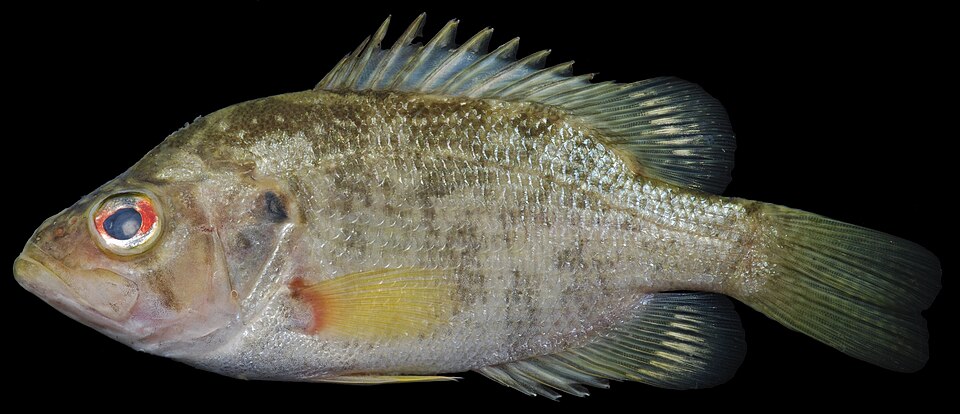
A homebody cousin of the rock bass, found almost nowhere else on earth outside a handful of North Carolina and Virginia river systems. Rare enough that catching one is a small point of pride among river anglers.
Roanoke bass belong to the rock bass genus, and they get mixed up with rock bass constantly wherever the two overlap. The best field mark is the anal fin ray count: Roanoke bass have six spines in the anal fin, rock bass have five. That is hard to check with cold, wet hands, so look at coloration too. Roanoke bass show a mottled pattern of dark olive to brown blotches over a brassy or golden-green body, with rows of dark spots forming faint horizontal streaks along the sides. Rock bass tend to run more uniformly bronze or copper with less contrast in the blotching.
They also get confused with juvenile largemouth or spotted bass by beginners, simply because of the word "bass" in the name. That confusion clears up fast once you look at the mouth and body shape. Roanoke bass have a short, deep, almost perch-like body and a large mouth relative to that body size, but nothing like the elongated shape of a true black bass. The eye is notably large and red to orange, which is a good quick check in the hand. Roanoke bass are also a genuinely rare, range-restricted fish, so if you catch one outside a small handful of watersheds, you very likely have a rock bass instead.</identification_md"> <parameter name="faqs">[{"question": "How big do Roanoke bass get?", "answer": "Most run 6 to 10 inches, with a big one pushing 12 inches and close to a pound. Anything over a pound is an exceptional fish for this species."}, {"question": "What do Roanoke bass eat?", "answer": "Crayfish, aquatic insects, and small fish. A small jig, live crayfish, or a nightcrawler fished near cover will all work."}, {"question": "When is the best time to catch one?", "answer": "Spring through early summer, when water temperatures warm up and the fish move into shallower rocky runs and pools to spawn and feed."}, {"question": "Are Roanoke bass good to eat?", "answer": "Yes, they have firm, mild white meat like other sunfish family members. Because their range is small and populations are limited, many anglers release them to help protect the species."}, {"question": "Why are Roanoke bass so hard to find?", "answer": "They naturally occur in only a handful of river systems, and competition and hybridization with introduced rock bass and other sunfish has shrunk their numbers further. Habitat degradation from siltation and impoundments has also hurt them."}, {"question": "Are there special rules for keeping Roanoke bass?", "answer": "In many areas they are a species of concern with specific harvest restrictions or closed seasons. Check local regulations before keeping any fish you think might be a Roanoke bass rather than a rock bass."}]
The app forecasts these conditions for your spot, and learns which ones you catch on.
Season
Where it lives
Roanoke bass live in cool, clear, moving water. They stick to the Roanoke, Tar, and Neuse river drainages in North Carolina and Virginia, and nowhere else in any real numbers. Look for them in rocky runs, pools below riffles, and around submerged logs and boulders in small to medium rivers.
They need clean water and intact stream habitat, so you will not find them in silty, degraded, or heavily impounded stretches. A healthy population is a decent sign the river itself is in good shape.
What it eats
Crayfish, aquatic insect larvae, and small fish. They feed like their rock bass relatives, holding near cover and ambushing anything that drifts or crawls too close. Crayfish make up a big share of the diet in most streams.
How to catch it
Light spinning tackle and small baits work best. A live crayfish or a small minnow fished on a light jighead, drifted through a rocky run or bounced along the bottom of a pool, is the standard approach. Small crankbaits and jigs that imitate crayfish also produce fish.
Wade or float the river and fish structure directly: current seams, rock ledges, and woody cover. These fish do not school up in predictable spots the way panfish do, so expect to cover water. Handle any you catch carefully and consider releasing them. Populations are limited and localized, and some waters have special regulations to protect them, so check North Carolina and Virginia rules before you keep one.
- How big do Roanoke bass get?
- Most run 6 to 10 inches, with a big one pushing 12 inches and close to a pound. Anything over 10 inches is a genuinely good fish for this species.
- What do Roanoke bass eat?
- Crayfish, hellgrammites, and aquatic insect larvae make up most of their diet, with small minnows and baitfish rounding it out. A live crayfish or worm fished near cover is hard for them to pass up.
- When is the best time to catch Roanoke bass?
- Spring through early summer is best, since that covers their spawning period and the water is still cool enough to keep them active and feeding shallow. They slow down and hold deeper in heavy summer heat.
- Where do you find Roanoke bass in a river?
- Look for slow to moderate current near rock, gravel, or woody cover, especially pools and runs below riffles. They act a lot like rock bass, holding tight to structure and ambushing food rather than chasing it far.
- Are Roanoke bass good to eat?
- Yes, they have firm, mild white meat and are considered good table fish, but because their native range is so limited many anglers practice catch and release to protect local populations.
- Are there special rules for keeping Roanoke bass?
- In parts of their native range they carry specific harvest restrictions or reduced bag limits because of their limited distribution and concerns about hybridization with introduced rock bass. Always check local regulations before keeping any.