

Rock Bass
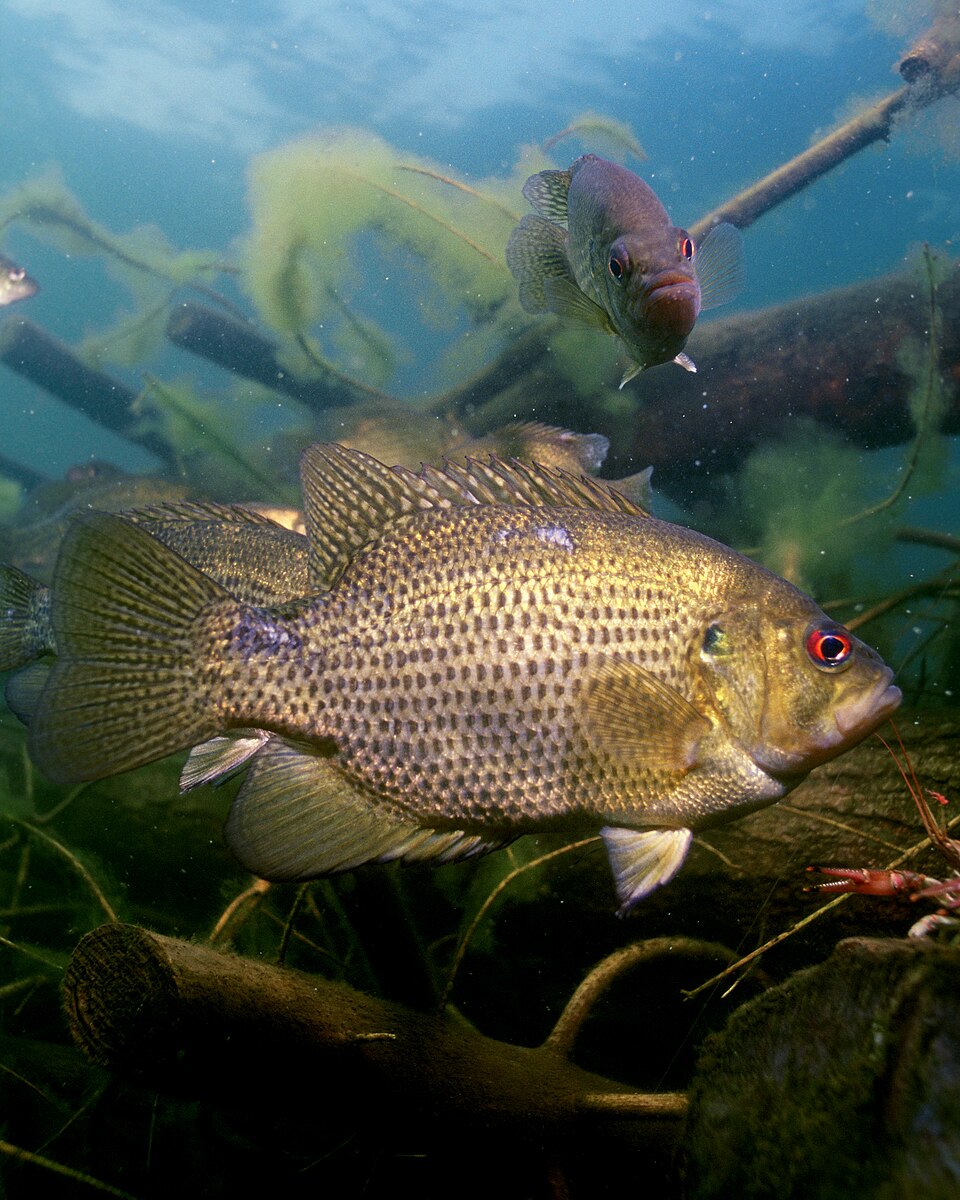
A chunky, red-eyed panfish that hides in rocks and creek pools and bites like it means it. Rock bass are easy to find once you know to look for structure, and great for teaching a new angler to read water.
Rock bass are chunky, big-mouthed sunfish, and that mouth is the fastest way to sort them out from true sunfish like bluegill or pumpkinseed. A rock bass jaw hinges back to below the eye, more like a bass than a bream, and the body is a robust, slightly elongated oval rather than the thin, saucer-shaped body of a bluegill. Color runs bronze to olive with mottled dark blotches scattered along the sides, not the neat vertical bars you see on a bluegill. The dead giveaway is the eye: rock bass have bright red or orange eyes, which neither bluegill nor pumpkinseed share.
The other common mix-up is with warmouth, a close cousin that shares the red eye and the big mouth. Warmouth run heavier through the cheek with faint reddish-brown lines radiating back from the eye, and their bodies are deeper and more compressed, closer to a true sunfish shape. Rock bass are slimmer and more cylindrical, and they carry six spines in the anal fin where warmouth and other sunfish typically have three. Count those spines on the underside of the fish and you have a clean answer every time.
The app forecasts these conditions for your spot, and learns which ones you catch on.
Season
Where it lives
Clear, cool streams, rocky rivers, and the rip-rap edges of lakes and reservoirs. Rock bass want current nearby and something hard to hide behind: boulders, ledges, submerged logs, bridge pilings. In the mountains and piedmont of North Carolina and Virginia, they turn up in the same rocky pools where you'd expect smallmouth.
They don't like mud or thick weed beds. If the bottom is sand or silt with nothing solid on it, move until you find rock or wood.
What it eats
Crayfish are the main course, and rock bass will chase one down eagerly. They also eat minnows, hellgrammites, insect larvae, and other small fish. They feed by ambush from cover more than by cruising open water, which makes them predictable once you find a good rock or eddy.
How to catch it
A live nightcrawler or small minnow fished on a light jighead near the base of a rock or ledge is the simplest way to catch one. Let it sit on bottom or bump it slowly along; rock bass rarely chase far, so bring the bait to them.
A small soft plastic crawfish or tube jig, cast upstream and worked back through a pool, also works well and lets you cover more water. They'll hit small spinners too. Fish slow and low. Rock bass hold tight to structure and won't move far off it, so precise casts near cover beat blind casting into the middle of a pool.
- When do rock bass spawn?
- Rock bass spawn in late spring to early summer once water hits the mid 60s. Males fan out shallow nests near rock or gravel, often close to cover, and will guard the nest aggressively.
- What do rock bass eat?
- Mostly crayfish, insects, and small minnows. They sit tight to cover and ambush anything that wanders past, which makes them easy to catch on simple bait or small lures.
- What is the best time to catch rock bass?
- Anytime from spring through fall works, but dawn and dusk in warm months put more fish in the shallows and rock piles where they are easiest to reach.
- How big do rock bass get?
- Most run six to ten inches and under a pound. A twelve inch rock bass is a genuine trophy, and the world record is barely over three pounds.
- Are rock bass good to eat?
- Yes, the meat is white, mild, and flaky, similar to other panfish. Many anglers rate them better table fare than bluegill because the fillets run a bit thicker.
- Are there any special rules for keeping rock bass?
- Most waters treat rock bass as a panfish with generous or no limits, since they are prolific and can overpopulate small lakes. Check local regulations, but in most places you can keep a mess of them without concern.