

Sauger
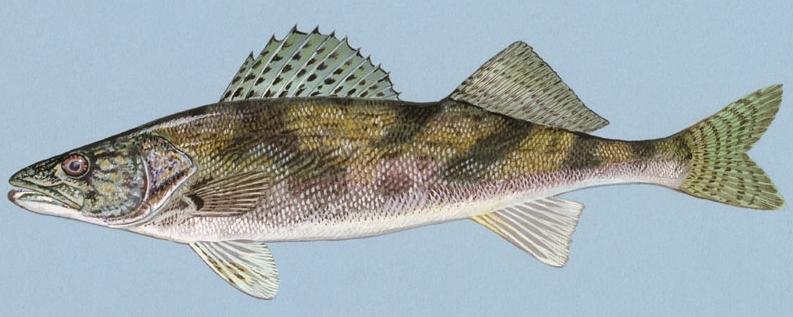
A river-dwelling cousin of the walleye, prized for its sweet white fillets and hard to find outside big, murky rivers. In North Carolina it is a niche target for anglers willing to fish deep and slow in cold water.
Sauger are most often mixed up with walleye, and the two do overlap in the same rivers, so look closely before you decide which one is in your hand. The clearest tell is the first dorsal fin: sauger have distinct black spots scattered across the membrane between the spines, while a walleye's first dorsal fin is plain, dusky, or blotchy without sharp round spots. Sauger also lack the white tip on the lower lobe of the tail fin that walleye almost always show, though sauger do share the milky, glassy eyes that both species use to feed in low light.
Body pattern helps too. Sauger have several dark, saddle-shaped blotches running down their sides that are more distinct and angular than the vague mottling on a walleye. Sauger also run smaller and more slender on average, with a more torpedo-like build, and their cheeks are usually rougher and more scaled than a walleye's. When in doubt, the spotted dorsal fin is the single fastest way to separate the two.
The app forecasts these conditions for your spot, and learns which ones you catch on.
Season
Where it lives
Sauger live in large, turbid rivers and the tailwaters below dams. They hug the bottom in main-channel current, holding in deep holes, wing dams, and current seams where the flow slows enough to rest but still delivers food.
In North Carolina and Virginia, the best populations turn up in the larger river systems and reservoir tailraces, particularly stretches of the New River and other Ohio River basin waters in the far western mountains. They are not a coastal-plain or piedmont fish. Where they exist, they stack up below dams in cold months, which is where nearly all of them get caught.
What it eats
Sauger are bottom-oriented predators that feed mostly on small fish: shad, minnows, and young sunfish, along with crayfish and insect larvae picked off the river bed. Their eyes are built for low light, so they feed heavily at dawn, dusk, and after dark, and stay active in muddy water that would shut down most sight-feeders.
How to catch it
Fish slow and deep. A jig tipped with a minnow, bounced right along the bottom through a current seam or below a dam, is the standard rig. Keep it close to the bottom at all times. Sauger will not chase far or rise up to hit something.
Cold water is prime time. Fish tailrace pools and deep holes in winter and early spring, working the jig with a slow lift-and-drop retrieve. Because they see well in stained water and poorly in bright light, overcast days and low light hours produce far more bites than a sunny midday. Vertical jigging from a boat anchored on a seam is the most consistent method where the fish are known to run.
- When do sauger spawn?
- Sauger spawn in early spring, usually a bit earlier than walleye, once water temperatures reach the low to mid 40s. They move upstream into current below dams and over gravel or rocky bottoms to spawn, often in the same tailwaters year after year.
- What do sauger eat?
- Sauger are almost entirely fish eaters, feeding on shad, shiners, small perch, and other baitfish. They feed most actively along the bottom in current and rely on their light-gathering eyes to hunt in murky or low-light water.
- When is the best time to catch sauger?
- Early spring in tailwaters below dams is prime time, when spawning fish stack up in current. Beyond that, dawn, dusk, and overcast or stained water conditions are best since sauger feed heavily on low light and struggle in bright, clear water.
- How big do sauger get?
- Most sauger run 12 to 16 inches and under two pounds, noticeably smaller than a typical walleye. Trophy sauger can push past 20 inches and several pounds, but they are much rarer than big walleye.
- Are sauger good to eat?
- Yes, sauger have firm white fillets that many anglers rate as good as or better than walleye. They are a popular table fish wherever they are common.
- Can sauger and walleye interbreed?
- Yes, the two species naturally hybridize where their ranges overlap, producing a fish called a saugeye. Saugeye show a mix of features from both parents, which can make identification even trickier in mixed waters.