

Smallmouth Bass
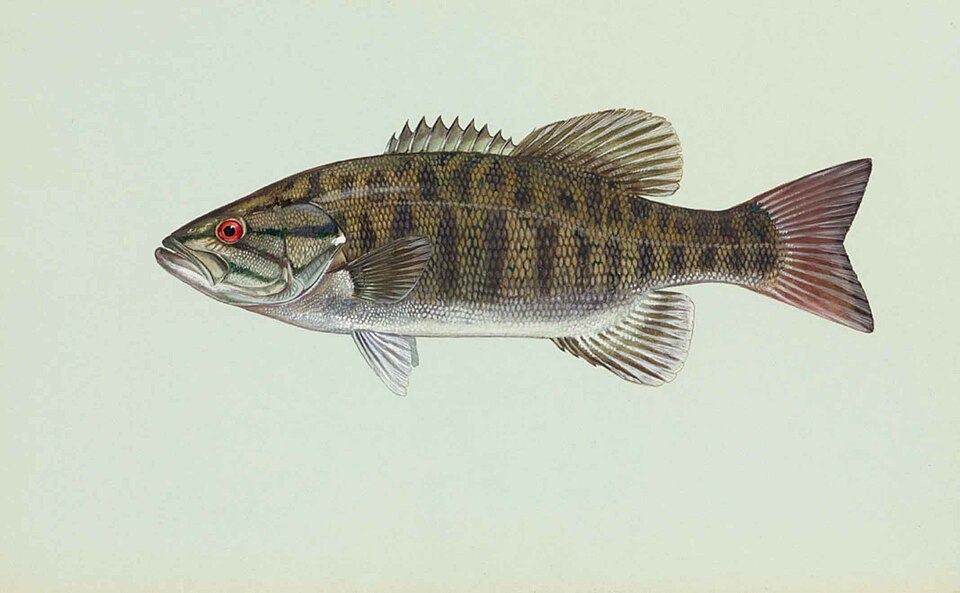
Pound for pound, the hardest fighting bass in fresh water. Smallmouth live in cooler, cleaner water than largemouth and jump repeatedly when hooked, which is why anglers who catch one usually go looking for another.
Smallmouth bass get confused with largemouth bass and, in waters where both exist, with spotted bass. The easiest check on a smallmouth versus a largemouth is the jaw. Close the mouth and look at where the upper jawbone ends relative to the eye. On a smallmouth it stops at or before the middle of the eye. On a largemouth it extends well past the back of the eye. Smallmouth also lack the largemouth's dark horizontal stripe down the side, showing instead bronze to brown sides with vertical, faintly barred markings. Body shape is another tell: smallmouth are more football shaped and less compressed than a largemouth.
Spotted bass are the tighter mix-up, especially where ranges overlap. Spotted bass have a rough patch of teeth on the tongue that smallmouth lack, and their dorsal fin has a shallower notch between the spiny and soft sections, almost connected, where a smallmouth's notch is deeper and more distinct. Spotted bass also tend to have a more defined lateral blotch or broken stripe, while smallmouth show vertical bars instead. If you're unsure and can't check the tongue, the eye color helps too: smallmouth almost always have red or orange eyes, which spotted bass and largemouth do not typically show.
The app forecasts these conditions for your spot, and learns which ones you catch on.
Season
Where it lives
Cool rivers, rocky lakes, and mountain reservoirs. In North Carolina that means the mountain and upper piedmont river systems: the New, the Watauga, the French Broad, and highland lakes like Fontana and James. They want current, structure, and clean water more than they want warmth.
Look for smallmouth around boulders, gravel bars, current seams, and rocky points. In rivers they hold behind rocks and in the slack water at the head of pools. In lakes they stack up on rocky humps and points, especially where a hard bottom meets deeper water.
What it eats
Crayfish are the main event. Smallmouth also eat minnows, hellgrammites, and insects, and in rivers they key hard on whatever crayfish are doing on the bottom. A lure or bait that imitates a crawdad scooting backward will draw strikes almost anywhere smallmouth live.
How to catch it
A soft plastic craw or tube jig worked slowly along rock and gravel bottom is the standard producer, in rivers and lakes alike. Cast upstream or across current and let it tumble naturally through the seam. In lakes, drag it slowly across rocky points and humps.
A small jerkbait or a spinnerbait fished around current breaks and boulders works well in spring and fall. Live bait anglers do very well with a crayfish or hellgrammite drifted under a float through a rocky run. Fish early morning and evening in summer, since smallmouth get lockjawed in the heat of a bright afternoon.
- When do smallmouth bass spawn?
- In spring once water temps reach the low to mid 60s, usually a few weeks later than largemouth in the same lake. Males build nests on gravel or rocky bottoms near shore and guard them aggressively, which makes sight fishing for beds possible in clear water.
- What do smallmouth bass eat?
- Crayfish are the main forage almost everywhere they live, along with baitfish like shad, shiners, and juvenile perch. In rivers they also key heavily on hellgrammites and other aquatic insects, especially smaller fish.
- What is the best time to catch smallmouth bass?
- Early morning and evening in summer, and any time of day during spring and fall when the water is cooler. They also feed well in cold water and stay catchable in winter, unlike largemouth which shut down harder.
- How big do smallmouth bass get?
- Most fish caught run 1 to 3 pounds, with a solid fish being 4 to 5 pounds. Anything over 5 pounds is a genuine trophy in most waters, and the world record is just over 11 pounds.
- Are smallmouth bass good to eat?
- Yes, the meat is firm and mild, similar to other bass. That said, most anglers practice catch and release for smallmouth, especially bigger fish, since they take years to grow to trophy size and populations can be slow to rebound.
- Do smallmouth bass fight harder than largemouth?
- Pound for pound, most anglers say yes. Smallmouth jump more, run harder, and generally fight above their weight compared to a largemouth of the same size.