

Southern Kingfish
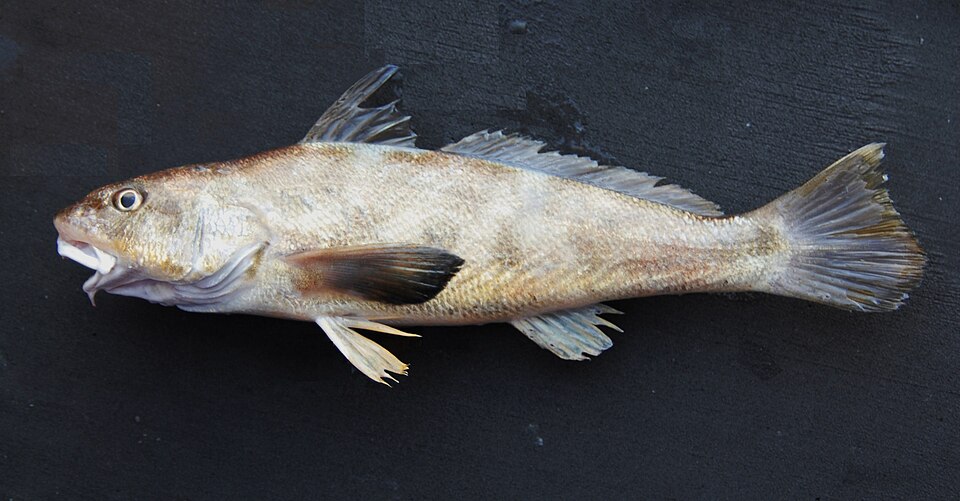
Also called a whiting, this is the surf fish that fills coolers along the Carolina coast. It runs the surf trough right where you're already standing, and it eats bait fished simply on the bottom.
Southern kingfish are one of three "kingfish" or whiting species that get lumped together and mixed up: southern, Gulf, and northern kingfish. All three share the same basic look, a slim silvery body, a single stubby chin barbel, and a mouth set low and underslung for feeding on the bottom. Splitting them apart comes down to small details.
Look at the dorsal fin and the body markings. Southern kingfish have faint, dark diagonal bars or blotches on the sides that are usually hard to see and fade quickly after the fish comes out of the water, while northern kingfish show bolder, more distinct bars. The pelvic fins are a good tell too: on southern kingfish they are pale to dusky, not solidly black like they are on a Gulf kingfish. Southern kingfish also have a longer pectoral fin, reaching back to about the second dorsal fin when laid flat, longer than what you see on the other two species.
People also confuse small southern kingfish with young croaker or spot, since all three are silvery bottom feeders of similar size. Croaker have a shorter, blunter snout with several small barbels along the lower jaw instead of one, and spot have a distinctive dark shoulder spot behind the gill that kingfish lack entirely.</identification_md"> <parameter name="faqs">[{"question": "How big do southern kingfish get?", "answer": "Most run 10 to 14 inches and under a pound, with a big one pushing close to 2 pounds. They do not get large, but they are common and easy to catch in numbers."},{"question": "What do southern kingfish eat?", "answer": "They feed low in the water column on small crabs, shrimp, worms, and other bottom invertebrates. That single chin barbel helps them feel out food buried in sand and mud."},{"question": "When and where is the best time to catch them?", "answer": "Surf and inshore sandy or muddy bottoms are the go-to spots, especially near troughs, sandbars, and inlets. Warmer months, spring through fall, are the most productive, and they bite well any time of day."},{"question": "Are southern kingfish good to eat?", "answer": "Yes, the flesh is white, mild, and flaky. They do not fillet out large, but they are a solid panfish-style catch, especially fresh from the surf."},{"question": "What is the best bait or rig for southern kingfish?", "answer": "A simple bottom rig or Carolina rig with small pieces of shrimp, sand fleas, or cut bait works well. Light tackle makes them fun since they are not big fighters but bite readily."},{"question": "Do southern kingfish spawn in a specific season?", "answer": "Spawning happens offshore in warmer months, generally spring through summer, after which juveniles move into estuaries and surf zones to grow."}]
The app forecasts these conditions for your spot, and learns which ones you catch on.
Season
Where it lives
Southern kingfish live in the surf zone, right in the trough between the beach and the first sandbar. You'll also find them around inlets, piers, and the sandy bottom just off the beach in a few feet of water.
They like moving water with some current over clean sand or a mix of sand and shell. You do not need a boat. Most are caught by waders and pier anglers within easy casting range.
What it eats
Bottom feeders through and through. They root in the sand for sand fleas, small crabs, marine worms, and shrimp. That barbel under the chin is for feeling out food in the sand, not for show.
How to catch it
A simple bottom rig does the job: two dropper loops with small hooks above a pyramid sinker, enough weight to hold in the current. Bait with fresh shrimp, cut shrimp, or sand fleas if you can dig them. Cast into the trough and let it sit. Bites are quick taps, not big pulls, so keep the rod tip low and reel down to feel the weight before setting.
Fish the surf an hour either side of low tide when the trough is easy to read, or work a pier where the water dumps off pilings. No need for heavy tackle. A light to medium surf rod or even a spinning rod off a pier will handle them fine.
- placeholder
- placeholder