

Spanish Mackerel
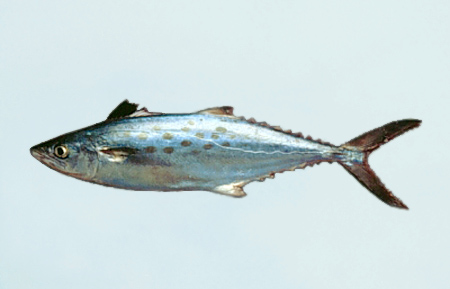
A fast, chrome-sided predator that shows up in big roaming schools along the coast. Spanish mackerel hit hard, run fast, and reward anglers who keep their lures moving.
Spanish mackerel have a slim, torpedo-shaped body with iridescent blue-green backs and silver sides covered in irregular yellow-gold spots. Two dorsal fins sit close together, the front one dark at the tip, and the tail is deeply forked. They have no scales on most of the body except along the lateral line and pectoral fin base, giving them a smooth, slick feel.
The main mix-up is with king mackerel and cero mackerel. King mackerel grow much larger, lack the yellow spots as adults, and have a lateral line that dips sharply below the second dorsal fin instead of running straight back. Cero mackerel are the closest match, but they show a solid yellow-gold stripe running down the side in addition to scattered spots, while Spanish mackerel have spots only, no continuous stripe. Bluefish get confused with mackerel too, but bluefish have a deeper body, a single large canine-toothed jaw, and no spots at all.
The app forecasts these conditions for your spot, and learns which ones you catch on.
Season
Where it lives
Nearshore ocean waters, inlets, and sounds with clean, moving water. Spanish mackerel follow bait schools along beaches, over nearshore reefs and wrecks, and around inlet mouths. They want water with some clarity, so they thin out after heavy rain muddies the surf and sound.
They are migratory. Fish move north along the coast as water warms in spring, stack up off North Carolina through summer, then push back south in fall ahead of cooling water.
What it eats
Small baitfish almost exclusively: glass minnows, menhaden, silversides, and anchovies. They slash through bait schools at speed rather than stalking single prey, which is why flash and speed trigger strikes better than scent or subtlety.
How to catch it
Trolling small spoons like a Clarkspoon behind a planer or trolling weight is the standard approach along the NC and VA coast. Run several lines at different distances behind the boat until you find fish, then repeat that depth and speed.
From piers and boats, casting small metal spoons or jigs and retrieving them fast is the go-to method. Spanish mackerel want speed. A slow retrieve gets ignored. Use a short piece of light wire or heavy fluorocarbon leader since their teeth will cut straight through light line. Watch for diving birds working bait on the surface, that is where the mackerel usually are too.
- How big do Spanish mackerel get?
- Most run one to three pounds and 15 to 25 inches. A fish over 5 pounds is a good one, and the all-tackle record is around 13 pounds.
- What do Spanish mackerel eat?
- Small baitfish like anchovies, glass minnows, and small mullet, along with shrimp. They key in on whatever bait is schooling in open water at the time.
- When is the best time to catch Spanish mackerel?
- Spring through fall when water warms into the mid 60s and above. They follow bait migrations, so they show up inshore and along beaches in big roaming schools during warmer months and move offshore or south in winter.
- What is the best way to catch Spanish mackerel?
- Trolling small spoons or diving plugs at high speed covers water and finds schools fast. Once you find breaking fish, casting small metal jigs or spoons into the school and retrieving fast works just as well.
- Are Spanish mackerel good to eat?
- Yes, but the flesh is oily and softer than king mackerel, so it is best eaten fresh rather than frozen. Many anglers grill or smoke them the same day they are caught.
- Do I need wire leader for Spanish mackerel?
- A short piece of light wire or heavy fluorocarbon helps since their teeth are sharp and can cut straight through light line. Many anglers use 30 to 40 pound fluorocarbon as a compromise since heavy wire can reduce bites.