

Spotted Bass
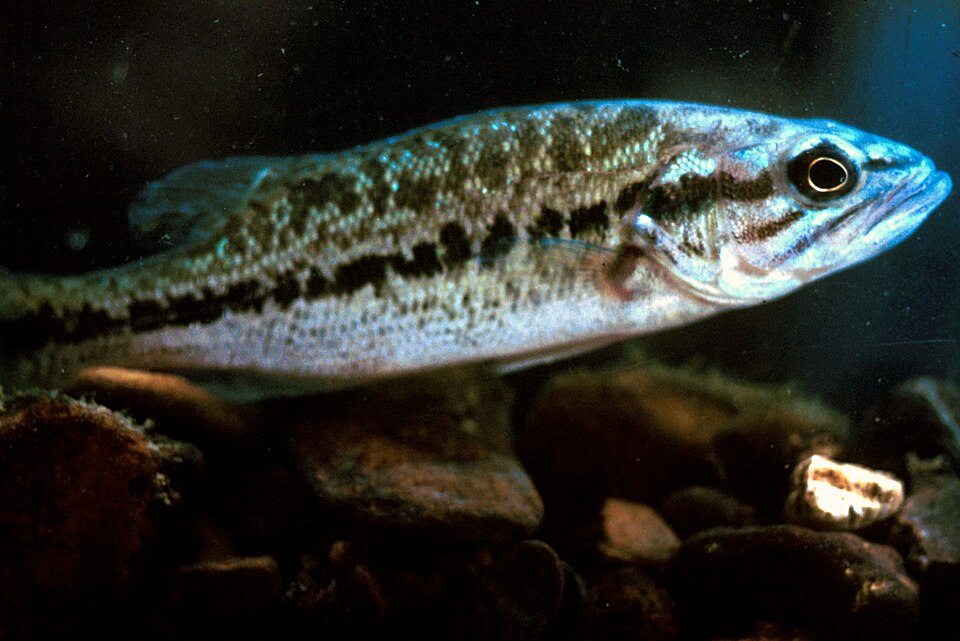
A largemouth look-alike that behaves more like a smallmouth. Spotted bass hold in current and rocky structure that largemouth ignore, and they fight harder pound for pound.
Spotted bass are most often mixed up with largemouth bass and smallmouth bass, and the mix-up is understandable since they sit right in between the two. The easiest check is the mouth: on a spotted bass, the upper jaw lines up under the middle of the eye or just behind it, never past the back edge like on a largemouth. The dark blotchy stripe down the side is made of connected diamond shapes rather than one smooth solid band, and below the lateral line you will see rows of small dark spots that give the fish its name, a pattern largemouth do not have.
Compared to smallmouth, spotted bass usually run darker and greener with that visible side stripe, while smallmouth are typically bronze or brown with vertical bars instead of a horizontal blotch pattern and have no spots on the belly. Spotted bass also have a patch of teeth on the tongue, a small rough tooth patch that both largemouth and smallmouth lack, so if you can get a finger in the mouth, that patch confirms it. Body shape is another clue: spotted bass are more slender and cylindrical than the deep, compressed body of a largemouth.
The app forecasts these conditions for your spot, and learns which ones you catch on.
Season
Where it lives
Spotted bass favor clearer, cooler water than largemouth, and they like current. Look for them around rock bluffs, bridge riprap, gravel points, and the tailraces below dams. In reservoirs they suspend over deep structure like humps and channel edges rather than sitting tight to shallow cover.
In North Carolina they turn up in Piedmont reservoirs like Lake Norman, Lake Wylie, and Badin Lake, plus a number of river systems where they were introduced. They are considered invasive in some western NC waters, where they compete with and hybridize with native smallmouth.
What it eats
Shad, crayfish, and small baitfish make up most of the diet, with crayfish being especially important around rocky bottom. They feed more on current-oriented forage than largemouth do, and they will chase baitfish in open water over deep structure.
How to catch it
Fish deep and rocky rather than shallow and grassy. A shaky head or a small football jig dragged slowly along rock piles, points, and channel breaks is the standard approach, especially in summer when fish stack on deep structure. Around current, a crankbait or a jig worked through riprap and past bridge pilings draws strikes.
In cooler months work main lake points and bluff walls with a jerkbait or a drop shot rigged with a small finesse worm. Spotted bass hit hard and pull well above their size, so use a slightly lighter touch on the hookset than you would with a largemouth.
- How big do spotted bass get?
- Most spotted bass run one to three pounds, with a good fish pushing four or five. Anything over six pounds is an exceptional catch, since they top out smaller than largemouth.
- What do spotted bass eat?
- Shad, minnows, crawfish, and small bluegill make up most of their diet. They will also hit insects and small worms, especially in clearer, rockier water.
- When do spotted bass spawn?
- Spawning happens in spring when water temperatures reach the mid to upper 60s, a bit later than largemouth in the same lake. Males fan out nests on gravel or rock near the bank, often close to deeper water than largemouth prefer.
- Where is the best place to catch spotted bass?
- Look for rock: bluff walls, rip rap, gravel points, and rocky creek channels. They relate to hard structure more than largemouth do and often school up around deep cover like brush piles and ledges.
- Are spotted bass good to eat?
- Yes, the meat is white, mild, and firm, similar to largemouth. Many anglers keep a few for the table since spotted bass populations can get overcrowded and stunted in some lakes.
- Is there a best time of day to catch them?
- Early morning and evening are usually best, especially in summer when spotted bass suspend deep during the heat of the day. In cooler months they feed more actively through the middle of the day.