

Steelhead
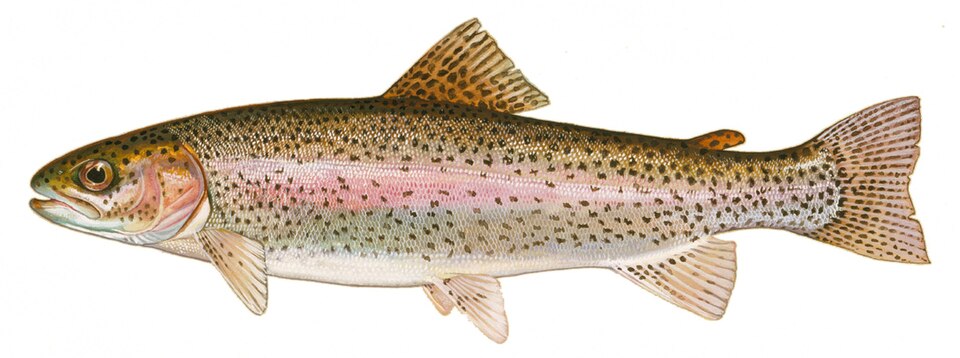
A sea-run rainbow trout that leaves fresh water as a juvenile, grows big in the ocean, and comes back to rivers to spawn. Steelhead pull harder than almost anything else in a river and they take real skill to find and fool.
Steelhead are rainbow trout that ran to big water and came back silver. The two are the same species, and where their ranges cross, anglers mix them up constantly. Freshwater rainbow trout usually keep a broad pink to red stripe down the side and darker, more olive backs. A steelhead fresh from the ocean or a Great Lake loses most of that color and turns chrome, with a bright silver body, a faint or absent pink stripe, and a metallic blue-green back. As steelhead sit in a river to spawn, that color fades back in and they start to look more like a large rainbow, which is where the confusion usually happens.
The other common mix-up is with Atlantic salmon and Pacific salmon species like coho, especially in fall and winter river runs. Steelhead have small, irregular black spots scattered over the back, dorsal fin, and both lobes of the tail, with spots reaching all the way onto the tail edges. Atlantic salmon have fewer spots, often confined to the head and shoulders, and a more slender tail without heavy spotting. Coho and other Pacific salmon have spots only on the upper half of the tail, not both lobes, and their mouths show black gum lines that steelhead lack. Steelhead also have a squared-off tail with a shallower fork than most Pacific salmon, and they keep their teeth and body condition better after spawning, since unlike Pacific salmon, steelhead can survive spawning and return to the water to spawn again.
The app forecasts these conditions for your spot, and learns which ones you catch on.
Season
Where it lives
Steelhead are native to Pacific coast rivers and streams from the northern reaches of California up through the Pacific Northwest and into Alaska. They also exist as landlocked populations in the Great Lakes, where fish run out of the lakes into tributary rivers instead of the ocean, but behave much the same way.
Look for them in moving water: riffles, seams, deep runs, and the tailouts of pools. In coastal rivers they show up on runs tied to rain and river flow, with winter-run fish entering from late fall through early spring and summer-run fish entering in warmer months and holding for a long time before spawning. In the Great Lakes, fish push into tributaries in fall and again in spring, staging near river mouths and moving up as conditions allow.
What it eats
In the ocean or the open lake, steelhead feed heavily on baitfish, squid, and crustaceans, which is where they pack on size and muscle. Once they enter rivers to spawn, they mostly stop feeding. They still strike out of aggression, reflex, or territorial instinct, which is why anglers can still catch them on flies and lures that imitate eggs, small baitfish, or drifting insects even though the fish is not actively hunting a meal.
How to catch it
This is not a beginner's fish and it takes patience to learn. Drift fishing with an egg sac, a cured single egg, or a soft bead threaded above a small hook is a standard approach. Cast upstream and let it bounce along the bottom through a run, staying in the strike zone as long as possible. Add just enough weight to tick bottom without snagging.
Fly anglers swing streamers and egg patterns on a two-handed spey rod, or dead-drift nymphs and egg patterns under an indicator through deep runs and seams. Spin fishermen do well with small spoons and jigs, especially in stained water after rain.
Timing matters more than gear. Fish the leading or trailing edge of a run of fish, right after rain has raised and colored a river, or during a known fall or spring push in Great Lakes tributaries. Steelhead fisheries are heavily regulated, with rules that vary by river and by wild versus hatchery fish. Check your state's regulations before you fish, and be ready to release wild fish unharmed.
- What is the difference between a steelhead and a rainbow trout?
- They are the same species. A rainbow trout that stays in freshwater its whole life is called a rainbow trout. One that migrates out to the ocean or a large lake and comes back is called a steelhead. Steelhead grow bigger and turn silver from the time spent in big water.
- When is the best time to catch steelhead?
- That depends on the run, but most rivers see steelhead moving in from fall through spring, with winter and early spring being prime time in a lot of watersheds. Summer-run fish exist too in some rivers and show up in the warmer months instead.
- What do steelhead eat?
- In big water they feed on baitfish, shrimp, and other forage. Once they enter rivers to spawn they mostly stop feeding, but they still strike out of reflex or aggression, which is why egg patterns, jigs, spinners, and beads all work.
- How big do steelhead get?
- Most river-run steelhead run 5 to 12 pounds, with fish over 15 pounds considered big. Some populations, especially in certain Pacific coast rivers, produce fish over 20 pounds.
- Are steelhead good to eat?
- Yes, the meat is similar to salmon, firm and orange to pink. That said, many rivers have strict regulations, catch and release seasons, or wild fish release rules to protect steelhead runs, so check local regulations before keeping one.
- Do steelhead die after spawning like salmon?
- No. Unlike most Pacific salmon, steelhead can survive spawning and return to the ocean or lake, then come back to spawn again in a later year. Not all of them make it, but the species is built to repeat spawn rather than die after one run.