

Striped Bass
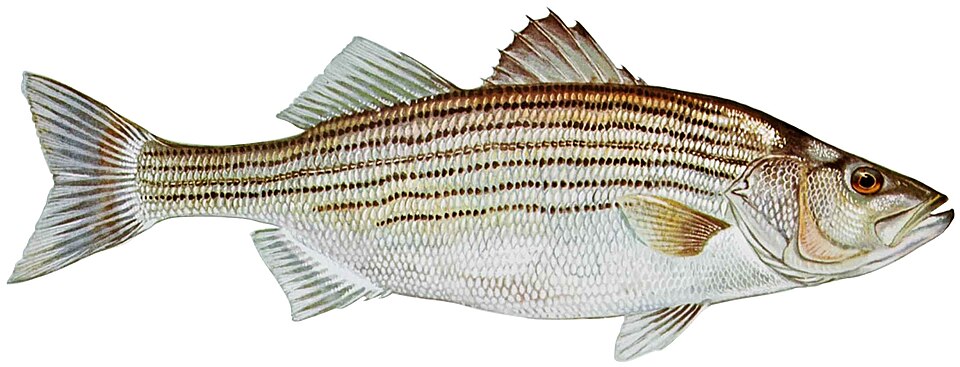
Striped bass, or rockfish as most Carolinians call them, are the big-game fish of the mid-Atlantic. They run in coastal rivers, sounds, and reservoirs, grow large, fight hard, and demand more skill and patience than most freshwater fish.
Striped bass have a silver body with six to eight dark horizontal stripes running from gill to tail, a body shape more torpedo than deep-bodied, and two spiny dorsal fins that are clearly separated, almost touching but not joined. The stripes run in unbroken lines, which is the key detail when you are trying to sort them out from lookalikes.
The most common mix-up is with white bass and hybrid striped bass (the wiper, a striped bass and white bass cross). White bass are shorter and deeper-bodied, and their stripes are faint and often broken or wavy rather than straight. Hybrid stripers split the difference: their stripes are usually broken or interrupted along the body instead of running solid like a true striper's. White perch, another lookalike in some coastal waters, have no stripes at all and a smaller, more compressed body. If you count solid stripes running the full length of the body and the fish has that long, lean shape, you are looking at a true striped bass.
The app forecasts these conditions for your spot, and learns which ones you catch on.
Season
Where it lives
Striped bass live in two very different worlds in this region. Along the coast they move between the ocean, sounds, and rivers, following bait and water temperature. The Roanoke River below Weldon, the Neuse, and the Cape Fear all hold spring runs of migratory fish pushing upstream to spawn. In winter and early spring, look for them staging in deep holes and current seams near river mouths and bridges.
Inland, striped bass live year-round in big reservoirs like Lake Norman, Lake Gaston, and Santee Cooper in South Carolina, where they were stocked and now sustain themselves or get supplemented by hatcheries. In lakes they suspend over deep water most of the year and push baitfish to the surface in open water during cooler months, especially early morning.
What it eats
Striped bass are aggressive open-water predators. They eat shad, herring, menhaden, eels, and any schooling baitfish they can corner against the surface or a hard structure. In rivers they will also take crustaceans and smaller fish stirred up by current. They feed heavily when baitfish schools are thick, often in short, violent surface blitzes that give away their location.
How to catch it
In rivers during the spring spawning run, cast or drift bucktail jigs, swimshads, or cut bait like herring along current seams and deep holes. Match the retrieve to the water temperature: slow and deep in cold water, faster near the surface as it warms.
On reservoirs, find them by watching for diving birds and surface activity early and late in the day, then throw topwater plugs or soft swimbaits into the commotion. When fish are deep, which is most of the day, troll umbrella rigs or live bait rigs like a down line with a live shad or herring near the thermocline. A planer board or downrigger helps get baits to the right depth without spooking fish in clear reservoir water.
Striped bass fight hard and often deep, so use stouter tackle than you would for bass or bream: at least 20-pound line, a heavy action rod, and a reel with a strong drag. Because runs and bites are seasonal and location-specific, this is not a fish you catch by luck. Scout reports, water temperature, and local regulations before you go, since size and creel limits are strictly enforced on migratory stocks.
- How big do striped bass get?
- Freshwater stripers commonly run 5 to 20 pounds, while ocean-run fish can push well past 40 pounds. The largest stripers on record have topped 70 pounds, caught in coastal or tidal waters.
- What do striped bass eat?
- They are aggressive baitfish hunters, feeding heavily on shad, herring, menhaden, and other schooling fish. In freshwater reservoirs they key in on shad, while coastal fish chase bunker, mackerel, and eels.
- When is the best time to catch striped bass?
- Early morning and late evening are best, especially in warmer months when stripers avoid the heat of the day. In spring and fall, cooler water temperatures push them shallower and more active throughout the day.
- When do striped bass spawn?
- They spawn in spring, typically April through June, when water temperatures reach the mid to upper 50s and low 60s. Spawning happens in freshwater or brackish rivers, even for fish that live most of their life in the ocean.
- Are striped bass good to eat?
- Yes, striped bass have firm, white, mild-flavored meat and are considered excellent table fare. Many states have consumption advisories in certain waters due to contaminants, so check local guidance before keeping fish for the table.
- Are there size or catch limits on striped bass?
- Most states and coastal fisheries regulate striped bass with minimum size limits and daily bag limits, and some stocks are managed under strict conservation rules due to population declines. Always check current regulations for the specific water you are fishing before keeping any fish.