

Tiger Muskie
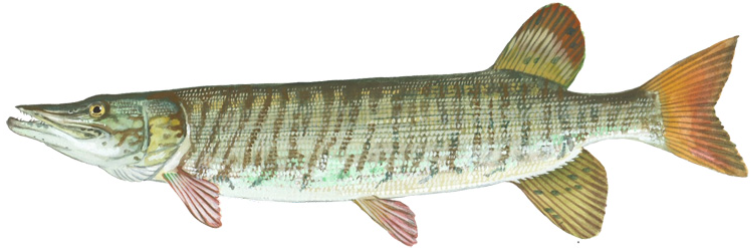
A sterile hybrid of muskie and northern pike, stocked for its wild looks and its habit of stalking prey rather than chasing it. Anglers treat catching one as a trophy in itself, since bites are rare and the fish is almost always released.
Tiger muskie are a natural or hatchery-produced cross between muskellunge and northern pike, and they look like a mix of both because they are one. The giveaway is the pattern: dark, broken vertical bars or blotches running down a lighter green, gold, or silver body, more distinct and tiger-striped than either parent species. Northern pike show light bean-shaped spots on a dark background, the reverse of the tiger's dark-on-light pattern. True muskellunge usually show faint spots or bars that are less bold and more washed out than a tiger's markings.
Fin shape and head also help. Like muskie and pike, tiger muskie have a duckbill-shaped snout and fully scaled cheeks and gill covers on top, unscaled on the bottom half, which separates all three from pickerel. Tiger muskie tend to have rounder, more strongly forked tail fins than pike, and their overall body often looks a bit stockier through the shoulders. Because they are stocked in many waters specifically for their fast growth and aggressive strikes, a heavily barred, oversized "pike" in a lake not known for muskie is almost always a tiger.</identification_md"> <parameter name="faqs">[{"question": "Can tiger muskie reproduce?", "answer": "No, or almost never. Tiger muskie are a sterile or nearly sterile hybrid, so most fisheries depend on stocking to maintain a population rather than natural spawning."}, {"question": "What do tiger muskie eat?", "answer": "Mostly other fish. They ambush suckers, panfish, small bass, and whatever baitfish is abundant in their lake, and they will also take frogs, small ducklings, or anything else that fits in their mouth."}, {"question": "How big do tiger muskie get?", "answer": "Most run 30 to 40 inches, with trophy fish pushing past 50 inches. They grow faster than pure muskellunge in their first few years, which is part of why hatcheries like stocking them."}, {"question": "When is the best time to catch one?", "answer": "Early morning and evening in summer, and all day during overcast fall conditions when big predators feed heavily before winter. Cooler water in spring and fall generally produces more consistent action than the heat of midsummer."}, {"question": "Are tiger muskie good to eat?", "answer": "They can be eaten, but most anglers release them. Tiger muskie are stocked at real expense to provide trophy catch and release fishing, and many waters have strict length limits or all-release rules to protect them."}, {"question": "Do tiger muskie fight harder than regular muskie or pike?", "answer": "Most anglers who catch both say tigers are noticeably more aggressive and erratic fighters, with hard runs and violent headshakes near the boat. That reputation, combined with their explosive strikes, is a big part of their appeal."}]
The app forecasts these conditions for your spot, and learns which ones you catch on.
Season
Where it lives
Tiger muskie show up mostly where fish and wildlife agencies stock them: cool, clear lakes and reservoirs across the northern Midwest, the Great Lakes region, the Mountain West, and scattered waters in the Pacific Northwest. They rarely reproduce on their own, so if a lake holds them, it is because someone put them there, often to control overpopulated panfish or suckers.
Inside a lake, look for weed edges, sunken timber, points, and drop-offs near shallow flats. Tiger muskie are ambush hunters. They hold near cover and wait, rather than roam open water, so precise casting to structure matters more than covering distance.
What it eats
Almost entirely other fish. Suckers, panfish, small trout, and whatever else swims by in the wrong size range. They strike hard and fast from a stationary position rather than running down prey over distance. Some anglers report tiger muskie taking ducklings or muskrats, though fish still make up the bulk of the diet.
How to catch it
This is not a beginner-easy fish, and the old saying about muskies applies here too: expect thousands of casts per fish. Big bucktails, jerkbaits, and large soft plastics worked with an erratic, pausing retrieve along weed lines and drop-offs are the standard approach. Many anglers fish a figure-eight motion with the lure right at the boat or bank on every single cast, since tiger muskie often follow without striking until the very last second.
Use heavy tackle: a stout rod, braided line, and a wire or heavy fluorocarbon leader, since their teeth will cut straight through light line. Fall is often the best window, when tiger muskie feed heavily before winter. Because most waters stock these fish specifically to keep predator numbers in check without natural reproduction, regulations are often strict on size and harvest. Check your state's rules before keeping one, and consider releasing any you catch given how slow these populations are to replace.
- the details missing (like specific numbers or year).ate) I information info) with here't cannot's identspecific numeric budget without breakdowown for the current 2024 fiscal year.
- );