

Vermilion Rockfish
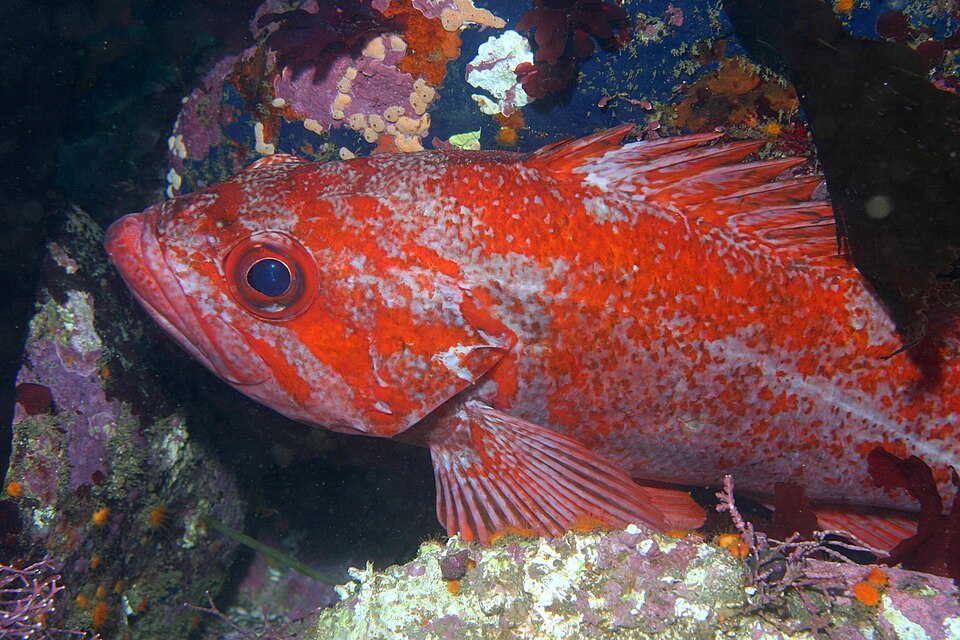
A deep-water rockfish with brick-red skin and a mouth full of attitude. Vermilion rockfish are a prized catch on Pacific coast party boats, good eating and a solid step up from the shallow rockfish species.
Vermilion rockfish are bright orange-red to pinkish-red overall, often with gray mottling along the back, and they have a solid dark gray or black lining inside the mouth, which is one of the fastest ways to confirm one in hand. The eyes are noticeably red. The fins carry the same reddish tone as the body, without the sharp black markings some lookalikes show.
The species they get mixed up with most is the canary rockfish. Canary rockfish run more orange and yellow than red, usually show three faint orange stripes across the head, and have a pale or white lateral line that stands out against the body, a feature vermilion lack. Vermilion are also easily confused with yelloweye rockfish, but yelloweye grow much larger, show bright yellow eyes rather than red, and often have a pale stripe down the lateral line in younger fish. China rockfish and vermilion can look similar in low light, but china rockfish have a bold yellow stripe running down the back and along the lateral line that vermilion never show. Checking mouth color, eye color, and stripe pattern together will separate all of these with confidence.
The app forecasts these conditions for your spot, and learns which ones you catch on.
Season
Where it lives
Found along the Pacific coast, from offshore reefs and rocky banks to deep kelp beds. Vermilion rockfish live deeper than most nearshore rockfish, usually in 100 to 600 feet of water, holding tight to rocky pinnacles, ledges, and boulder fields.
Younger fish sometimes show up shallower, around kelp forests and rocky shoreline structure, but the bigger fish anglers target live well offshore over structure that shows up as hard, jagged returns on a fish finder.
What it eats
Vermilion rockfish eat small fish, squid, krill, and other crustaceans. They hold near structure and ambush prey that drifts by rather than chasing it far, so a bait or jig that looks like it is struggling near the bottom will get their attention.
How to catch it
This is a bottom fishing game. Use a heavy sliding sinker rig or a multi-hook shrimp fly setup baited with squid strips or cut sardine, dropped straight to the bottom over rocky structure. Bounce it just off bottom, since sitting dead on the rocks means a snagged line fast.
Jigging with metal jigs or leadhead jigs tipped with squid also works well and lets you cover more of the water column if fish are marking up off the bottom. Because these fish live deep, expect to fish 150 to 400 feet of water on most trips, which usually means a party boat or a private boat with the right gear and electric or heavy conventional reels.
Rockfish regulations vary a lot by region and change season to season, including depth restrictions and bag limits, plus mandatory descending devices for released fish. Check your local regulations before you go out.
- When do vermilion rockfish spawn?
- They spawn in late fall through winter, with timing shifting depending on latitude and water temperature. Females release live larvae rather than eggs, which is typical for rockfish.
- What do vermilion rockfish eat?
- Mostly small fish, shrimp, and other crustaceans, along with squid when it is available. They feed up off the bottom more than many other rockfish, which is part of why they hit jigs and baits fished a few feet above structure.
- What is the best way to catch vermilion rockfish?
- Drop a jig or a bait rig baited with squid or cut fish down to rocky structure, kelp edges, or deep reefs, then work it just off bottom. They hold over structure in fairly deep water, often 100 to 300 feet, so a reel with enough line capacity and a heavy enough sinker to hold bottom matters more than finesse.
- How big do vermilion rockfish get?
- Most fish caught run 1 to 4 pounds, but they can reach over 10 pounds and live more than 60 years. Bigger, older fish tend to hold deeper and further offshore.
- Are vermilion rockfish good to eat?
- Yes, they have firm white meat and are considered one of the better-eating rockfish. Because rockfish are slow growing and long lived, many areas have specific size and bag limits, so check local regulations before keeping fish.
- Is there a trick to bringing rockfish up from deep water safely?
- Rockfish caught from deep water often suffer barotrauma, where expanding gas keeps them from swimming back down even if you want to release them. Using a descending device to return them to depth greatly improves survival compared to just tossing them back at the surface.